Phuket in a day
9 h route5 stopsBest: Sunday, so you finish on the Thalang walking streetUpdated July 2026
With only one day, the beach is the cheapest thing to skip: there are thirty kilometres of sand down the west coast and they resemble each other quite a lot. What doesn’t exist anywhere else in Thailand is Phuket Town, the old quarter the tin miners built with Chinese money and Portuguese frontages, still standing street by street.
Geography sorts the day out for you: morning in the old town, over on the east side, midday climbing to the big Buddha, visible from half the island, afternoon heading south to the cape where the island runs out. Budget for a taxi or a car all day. There is no line joining those three things together, and that’s Phuket’s first lesson.
The route, stop by stop
5 STOPS- 01
Thalang Road and the tin houses
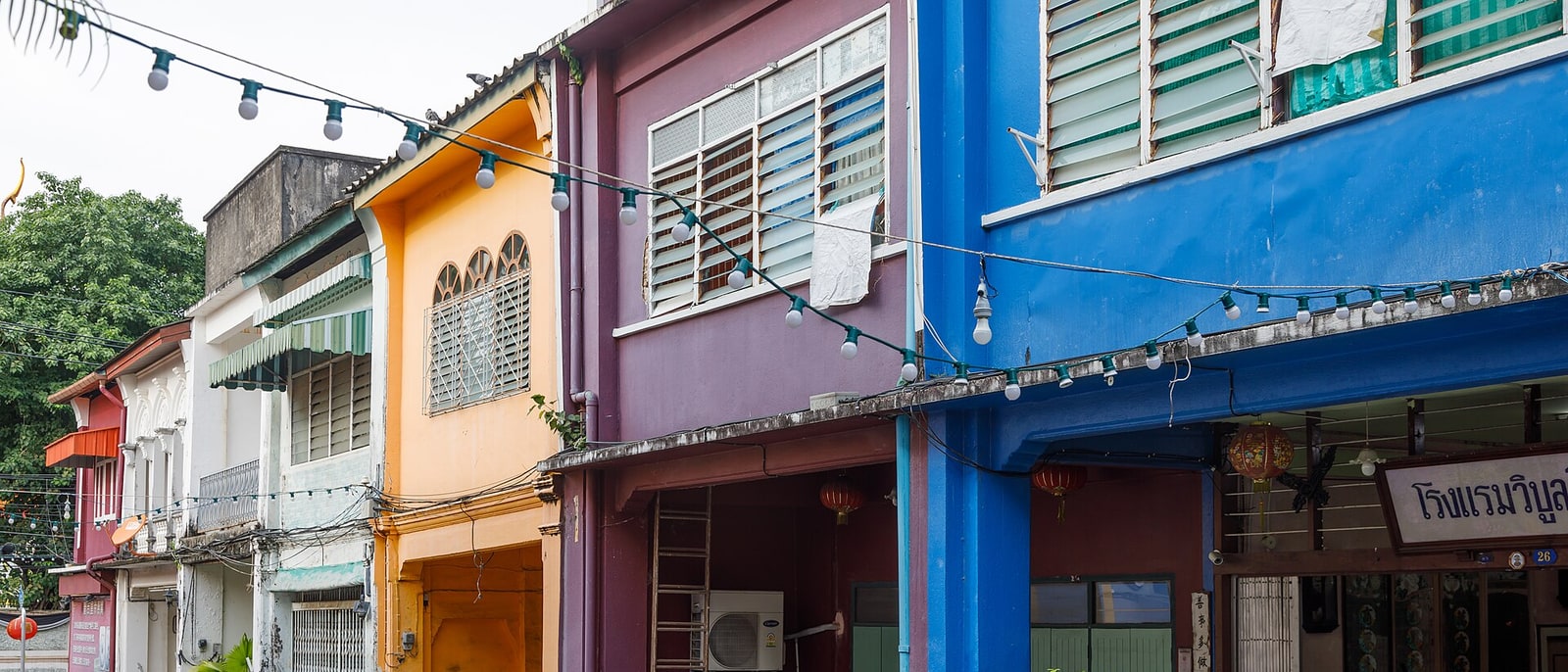
Phuket didn’t get rich on tourists, it got rich on tin. Through the nineteenth century thousands of Hokkien miners came over from southern China, and the ones who did well built themselves two-storey houses with a covered front, tall windows and European tiles: the style they call Sino-Portuguese here, copied wholesale from Penang and Malacca. Thalang is the best-preserved stretch and you walk all of it in twenty minutes.
Turn up Soi Romanee, the lane heading north. It was where the miners’ brothels and gambling houses were, and today it’s the row of coloured fronts in every photograph. The first half of that story rarely gets told.
And step into any of the arcades: the continuous covered pavement isn’t decoration, it’s a colonial rule meant for walking under both rain and sun, and it still delivers.
- 02
Wat Chalong and the firecrackers
The largest temple on the island honours two monks, Luang Pho Chaem and Luang Pho Chuang, who treated the wounded during a nineteenth-century miners’ revolt. The island still owes them, and you can see it in what goes on inside: people come here to ask, and above all to pay up.
In the grounds there’s a brick kiln where people set off firecrackers once the thing they asked for has happened. If you hear bangs while you’re wandering, it isn’t a festival: it’s someone settling a promise.
The three-storey chedi holds a bone fragment of the Buddha brought from Sri Lanka, and the top balcony gives you the whole south of the island, which is the best way to understand where you’re going next.
- 03
The big Buddha on Nakkerd
Forty-five metres of white Buddha on top of Nakkerd hill, visible from half the island and from the plane window on the way in. It’s clad in Burmese marble and paid for by donation, slab by slab: that’s why it has been under construction since 2004 and why it still isn’t quite finished. You can buy a tile, write on it, and see it go up on the wall.
The climb is six kilometres of tight hairpins up from Chalong and it’s the road where most rental bikes end up on the tarmac. If you haven’t been riding for years, this isn’t where you learn.
There’s wind at the top, which at midday on this island is a luxury, and a three-hundred-and-sixty-degree view: Chalong bay on one side, Kata on the other, and in between the mountain spine that explains why nothing here is near anything else.
- 04
Rawai, where the fish comes ashore
Worth knowing before you lay out a towel: at Rawai the water is shallow, it’s full of moored boats and the sand runs out against a wall. It’s a working harbour. This is where the chao leh, the so-called sea gypsies, have had their village since long before Phuket was Phuket.
Along the front there’s a line of stalls grilling whatever just came off the boats, and a small fish market where you pick the creature and they cook it opposite for a bit extra. It’s the most honest food on the island and it’s ten minutes from the cape.
The longtail boats tied up there are the ones that run to the islands across the water: the engine is literally a car engine mounted on a pole, which is why they sound the way they do.
- 05
Promthep, where the island ends
This is where Phuket stops. The cape is the south-western tip and the place the whole island comes to watch the sun go down, so leave time: the car park fills an hour beforehand, the upper viewpoint half an hour. Take the path down to the little lighthouse, which almost nobody does, and you get the same sun with half the crowd.
From the edge you get more than the sunset: the islets sit straight ahead (Ko Kaeo, and on clear days the outline of Phi Phi behind) and the whole of Nai Harn bay is off to the right. There’s a shrine where people leave wooden elephants when they ask for something, and there are hundreds of them.
And when the sun goes, it goes: tropical dusk lasts twenty minutes and then it’s properly dark.
Frequently asked
What do you do in Phuket if you only have one day?
Phuket Town’s old quarter in the morning, the big Buddha at midday, Promthep Cape at sunset. The beach is the cheapest thing to skip: there are thirty kilometres of sand and they resemble each other, while the tin houses exist nowhere else in Thailand.
Do you need a car or a taxi to get around Phuket?
In practice, yes. There’s no network linking the beaches to each other: songthaews run out from Phuket Town to each beach and back, so going from Patong to Kata by public transport means looping through town. For a single day, agree a taxi by the hour, or drive.
How long does it take to cross the island?
From the airport in the north to Promthep Cape in the south is about fifty kilometres and roughly an hour and a half: longer than the map suggests. The island has a mountain spine down the middle and the roads either go round it or wind over it.