The beaches of Phuket, one by one
6 stopsBest: November to April the sea is flat. May to October, look at the flagUpdated July 2026
Every beach is on the west coast, facing the Andaman Sea: Patong in the middle, Karon and Kata below it, Nai Harn and Ya Nui in the south, Bang Tao and Mai Khao up north. The east coast has no swimming beaches (it has mangrove, harbours and boats) and that asymmetry explains in one go why the hotels are all on the same side.
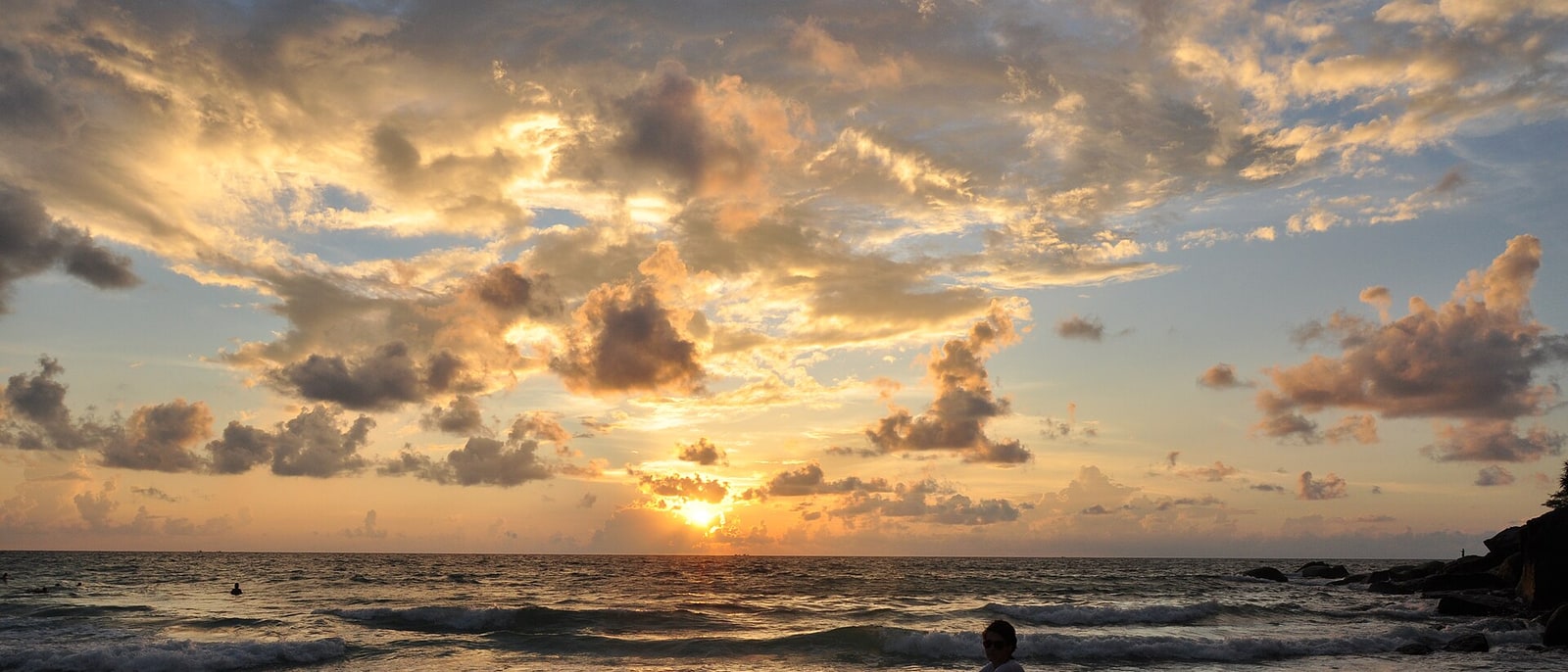
Before picking one: the red flag. From May to October the south-west monsoon sets up rip currents along this exact coast and people drown every year, almost always foreigners, almost always past a red flag, almost always on a beach that looked calm from the sand. Lifeguards don’t plant those flags for fun. It’s the only thing on this page with no nuance to it.
The route, stop by stop
6 STOPS- 01
Patong
Say Phuket and people picture this beach: three kilometres of sand in a closed bay, the town pressed up behind it and everything you might need fifty metres from the water. It’s crowded, there are jet skis and there’s noise, and even so the curve of the bay is one of the best on the island if you look at it from the northern end. It does one thing extremely well: if you’re travelling with people who want different things, everyone finds theirs here without getting in a car. It’s the only place in Phuket you can say that about. And the northern end, up towards Kalim, is a good deal quieter than the middle, where everything concentrates.
- 02
Karon and Kata
Karon stretches three kilometres with the widest sand on the island, so wide that at midday you cross it in hops because it burns. Behind it there’s a row of hotels and not much else, which is why it’s quiet at night. The sand also squeaks underfoot, it’s quartz, and no other beach on this coast does that.
Kata sits south, shorter, more tucked in, and it has the one thing Karon doesn’t: surf. In low season this is where the whole island learns, with the important caveat that the waves making the school are the waves bringing the current. Kata works very well with children in high season and patchily in monsoon.
- 03
Kata Noi
Kata Noi sits a kilometre from Kata, over a headland, and that headland alone is enough to give it a third of the people. It’s a short bay wedged between two points, with a slow shelving bottom and almost nothing built on it: three hotels and little else. It’s the answer to the standard complaint that Phuket is overrun. It isn’t: it’s unevenly spread. Any beach that costs one extra bend empties itself. The trade-off is that there’s nowhere to eat here beyond the hotels, so you come for the day and go back to Kata at dusk.
- 04
Nai Harn and Ya Nui
Nai Harn escaped development for an unromantic reason: much of the land behind it belongs to a monastery and couldn’t be sold. That’s why the beach still has a lagoon, pines and a strip of sand with nothing on it, on an island where that no longer exists.
Ya Nui is two kilometres on, a small cove of rock and sand on the way to Promthep Cape. It fills up fast because it doesn’t hold many people, but it has the best close-to-shore snorkelling in the south of the island.
Both are ten minutes from Promthep: you do the beach and drive up to the cape for the sun without moving the car twice.
- 05
Bang Tao and Mai Khao
The north goes its own way. Bang Tao is six kilometres of sand with the big resorts behind it, and Mai Khao, eleven kilometres, is Phuket’s longest beach and its emptiest: you can walk for half an hour without passing anyone. It sits inside Sirinat national park, which is why it’s still like that. Leatherback turtles come ashore at Mai Khao between November and February, which is why the beach is protected. It’s also the beach that runs up to the end of the runway: the planes come in low and there was a period when people lay against the fence for the photo, until the authorities banned it for the obvious reason. You watch from the sand and leave it there.
- 06
The rip current, and what to do if it takes you
A rip current sends water back out through a narrow channel, and you can spot it from the sand if you know what to look for: a strip where the waves don’t break, water of a different colour, or foam and sand streaming outwards. It’s exactly the patch that looks calmest to swim in, which is why it takes who it takes.
If it pulls you out, what kills isn’t the current but swimming against it until you’re spent: they’re faster than any swimmer. You get out by swimming parallel to the shore until you clear the channel, which is usually only metres wide, then coming back in at an angle. If you can’t, float and wave.
And before any of that: with a red flag up you don’t go in, even if other people are in the water.
Frequently asked
What’s the best beach in Phuket?
Depends who you’re with: Patong to have everything at hand, Karon and Kata for families, Kata Noi and Nai Harn for space, Mai Khao to walk half an hour without seeing anyone. The rule that works everywhere: the beach that costs one extra bend is half empty.
What does the red flag mean on Phuket’s beaches?
That you don’t go in. From May to October the monsoon sets up rip currents along the west coast and every year people drown who swam past a red flag on a beach that looked calm. The calm you see from the sand is precisely the sign of the rip channel.
Can you swim in Phuket in the rainy season?
Many days yes, some days no, and it’s the flag on the beach that decides, not the forecast. The sea from May to October changes day to day. Beaches with lifeguards mark it every morning, and the ones without a lifeguard are the ones to avoid in those months.