OZU /UNITED KINGDOM /LONDON /GUIDE
London’s neighbourhoods
6 h route4 stopsBest: The east, on a Sunday, for the marketsUpdated July 2026
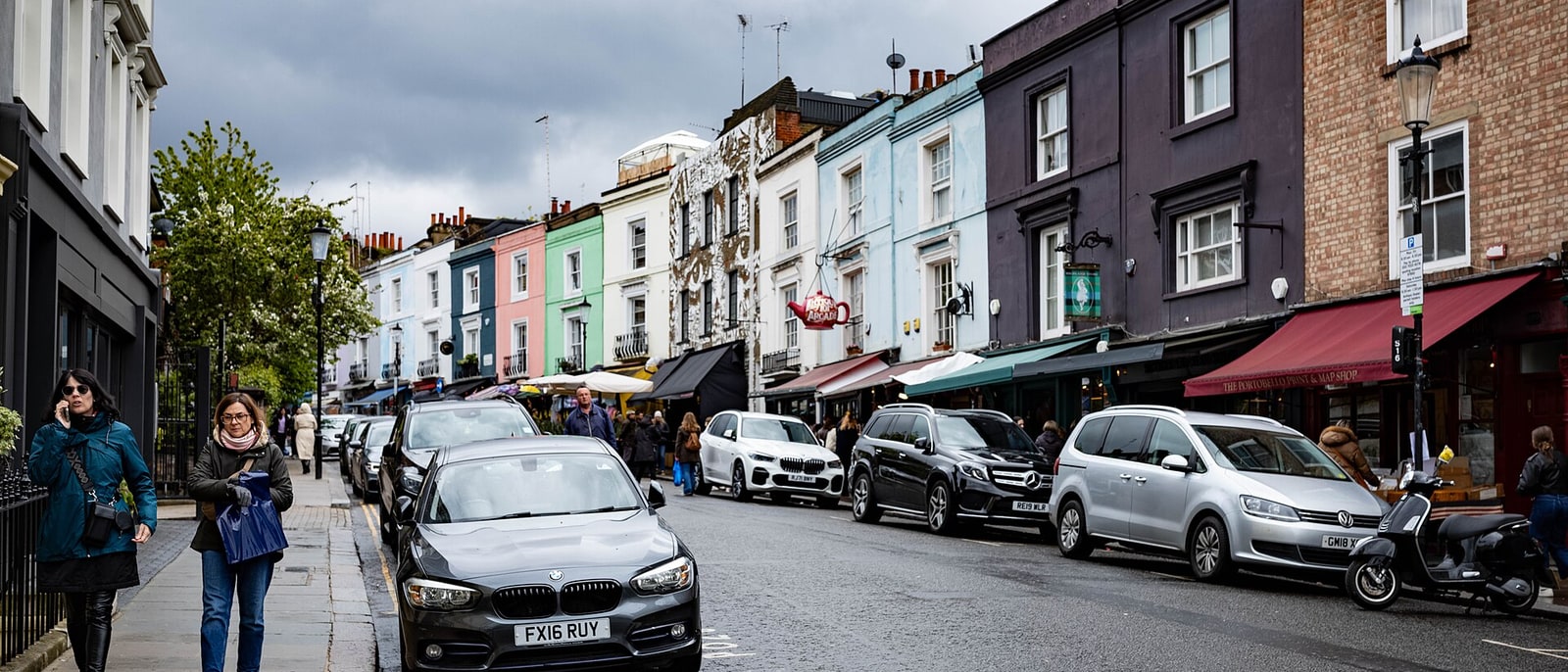
Neighbourhoods here aren’t zones of a city: they’re villages that grew until they touched and never quite fused, each with its own character and sometimes its own accent. That’s why you cover London in pieces rather than in one go.
And there’s a building in the east that explains it all better than any museum. It’s the first stop.
The route, stop by stop
4 STOPS- 01
Brick Lane and Spitalfields
At 59 Brick Lane stands a discreet building that tells the entire history of European immigration. It was built in 1743 as a chapel for the Huguenots, French Protestants fleeing Catholic persecution, who brought the silk industry here. When they assimilated and moved on, it became a Methodist chapel.
In 1898 it became the Great Synagogue, when the neighbourhood filled with Jews escaping the pogroms of Eastern Europe. And in 1976, when the Bangladeshi community from Sylhet arrived, it became a mosque, which is what it is today.
Three waves of refugees, three religions, the same roof. There’s no object in any London museum that says this better. Around it: Brick Lane market, the curry houses and Spitalfields, covered.
- 02
Soho and Covent Garden
Soho has supplied the nightlife, the theatres and the West End for centuries: it was a district of immigrants, of music, of sex and of bars, and it keeps some of that despite the rents.
And it hides one of the most important sites in the history of science: on Broadwick Street there’s a replica of a water pump. In 1854, during a cholera epidemic, the doctor John Snow mapped where the dead lived and realised they all used that pump. He persuaded the authorities to remove its handle, the outbreak stopped, and it was established that cholera travelled in water and not in the air.
Modern epidemiology was born there. There’s a pub next to it named after him, and the irony is that Snow was teetotal.
- 03
Greenwich
It earns the trip for what it means: in 1884 an international conference in Washington decided the prime meridian would pass through the observatory on this hill, and since then every longitude on the planet and every time zone has been measured from here. There’s a line marked in the ground and everyone photographs themselves with a foot on each side.
It was for practical reasons, not empire: most of the world’s nautical charts already used Greenwich because the British ruled the sea. There’s also the Cutty Sark, an 1869 tea clipper in dry dock, the Painted Hall of the old naval college, they call it the British Sistine Chapel, and the park, with the best view of Canary Wharf.
Go by boat from the centre: the journey is part of the plan.
- 04
Camden and the north
Camden takes the title of the city’s most famous market and its most crowded too: clothes, street food and a punk aesthetic that today is mostly souvenir. It’s packed and it’s loud, and it’s still enjoyable with adjusted expectations.
The trick almost nobody uses: arrive by canal. The Regent’s Canal runs through Camden and you can walk the towpath from Little Venice, passing behind London Zoo, you see animals from the path, with houseboats alongside. It’s an hour on foot, flat and quiet, and you arrive at Camden through the back door. It’s one of the best walks in the city and it appears on no list.
Frequently asked
Which London neighbourhood should you visit?
The east, around Brick Lane and Spitalfields, especially on a Sunday for the markets. That’s where 59 Brick Lane is, a Huguenot chapel in 1743, a synagogue in 1898 and a mosque since 1976: three waves of refugees under one roof.
Why does the prime meridian run through Greenwich?
Because an international conference in Washington decided so in 1884, for practical reasons: most of the world’s nautical charts already used Greenwich as their reference, given British dominance at sea. Since then every longitude and time zone has been measured from that hill.
Is Camden Market worth it?
With adjusted expectations: it’s the most famous and the most crowded, and the punk aesthetic is now mostly souvenir. What is very much worth it is walking there along the Regent’s Canal towpath from Little Venice, an hour flat and quiet behind the zoo.