What to see in São Paulo
8 h route4 stopsBest: The museums on a weekday. The street on a SundayUpdated July 2026
The paintings at Brazil’s most important art museum don’t hang on the wall: they float. They’re mounted on transparent glass panels driven into concrete blocks, loose in an open hall, and you can walk around them and see the back. The caption with the name and date is behind, not in front, so you’re obliged to look at the painting before knowing what it is and who painted it.
That decision, taken by Lina Bo Bardi in 1968, is the best way into São Paulo, because this city has no monuments and does have ideas. You won’t see a Gothic cathedral or an old town here: you’ll see a museum that reinvented how a painting is looked at, a wave-shaped building with a thousand apartments inside, a concert hall in a railway station and an alphabet invented in the periphery that climbs façades. What to see here are decisions, not stones.
The route, stop by stop
4 STOPS- 01
The glass easels
The MASP holds the best European art collection in the southern hemisphere (Raphael, Goya, Van Gogh, Renoir, Picasso) and displays it in a way that exists in no other museum in the world: without walls. The paintings are held on colourless glass panels on concrete feet, spread through an open hall like a forest, and the visitor moves among them choosing their own route.
The idea is Lina Bo Bardi’s, the Italian-Brazilian architect who made the building, and it was political: remove the hierarchy, remove the order imposed by the curator, remove the solemnity of the walled hall and let the visitor decide what to look at and in what order. And put the caption behind so you look first and read after, instead of reading and then looking.
In 1996 the museum decided that was inconvenient, dismantled them and put up conventional walls. For nearly twenty years the MASP was an ordinary museum. In 2015 they were brought back. That coming and going tells an entire argument about what a museum is for.
- 02
The wave building
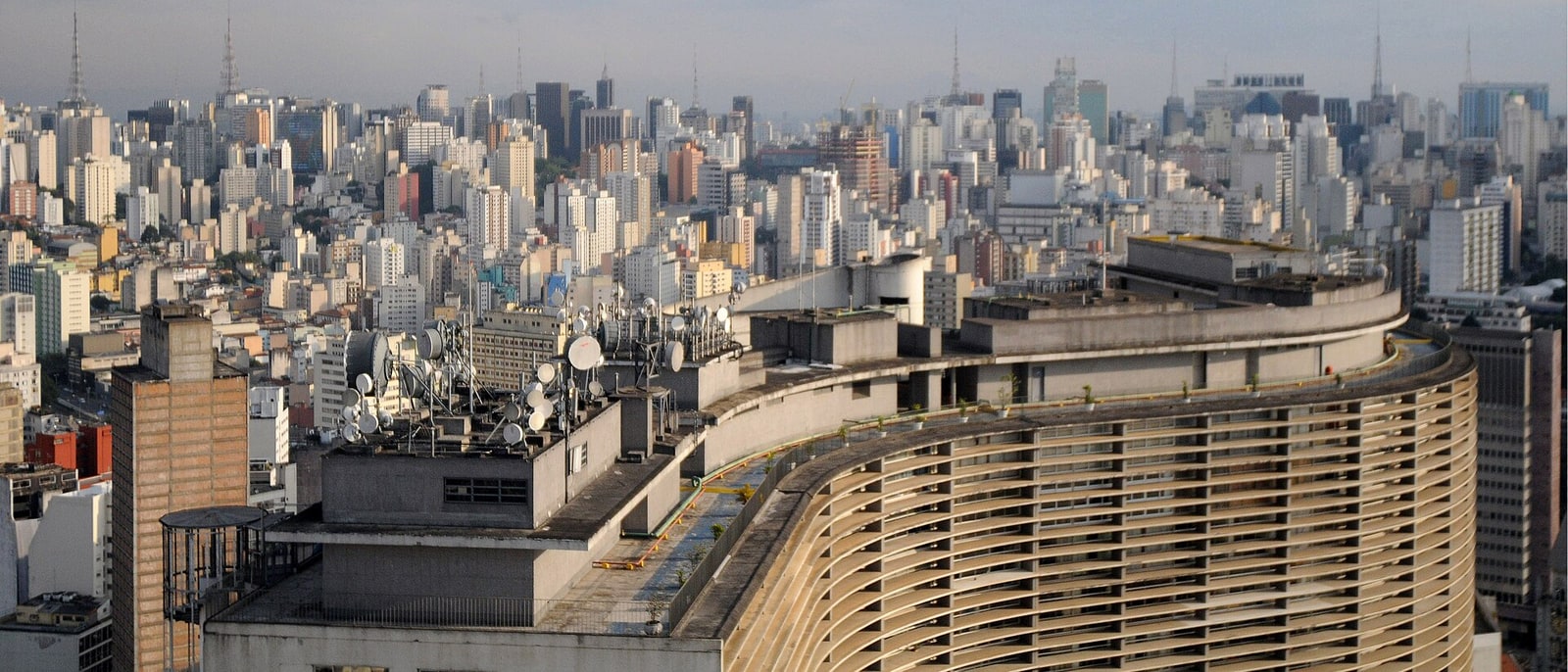
The Copan, a Niemeyer housing block shaped like an S, raises a three-hundred-metre concrete wave thirty-eight storeys high, with the façade covered in horizontal brise-soleils that give it that characteristic striping. It was finished in the sixties and it’s the largest residential concrete building in Brazil.
The numbers tell what it is: over eleven hundred apartments, from twenty-metre studios to large flats, and some two or three thousand people living inside. It has so many residents it has its own postcode, and on the ground floor there are shops, a bar, a hairdresser and a church. It’s a vertical village, and unlike almost every experiment of that kind in the twentieth century, this one worked: it’s still inhabited, it still mixes social classes in the same entrance and it’s still a desirable place to live.
You go up to the roof on a guided tour and from there you see the extent of this city, which is what genuinely impresses: concrete to the horizon in every direction.
- 03
The concert hall in the station
In the old centre, inside a 1930 railway station that’s still working, there’s one of the best concert halls in the world. They took the station’s great hall, restored it and built a symphonic auditorium inside. The trains still come and go alongside.
And it has an engineering trick that justifies the trip: the ceiling is made of dozens of independent panels that rise and fall on motors, so the hall’s volume can be changed according to what’s being played. For a large symphony orchestra the ceiling goes up and the hall breathes. For chamber music it comes down and closes. It’s genuine variable acoustics, not a cosmetic adjustment.
You can go to a concert for very little compared with Europe, and there are guided tours on Saturdays. That the best hall in Latin America should be inside a commuter station in the hardest quarter of the centre is very much this city.
- 04
What was left when the billboards came down
Walk the centre looking at the façades from the thirties, forties and fifties: the Martinelli, Latin America’s first skyscraper in 1929, the Banespa, a small-scale Empire State you can go up for free, the modernist buildings around República square. There’s a density of twentieth-century architecture no other Latin American city has.
And here’s the connection with the advertising: for decades, much of this was covered. The façades were wrapped in giant banners, the ground floors covered in signs and the party walls rented out as advertising space.
In 2007, when the Clean City law forced it all down within months, the city appeared underneath, and there was a well-documented moment of collective astonishment: people discovering buildings they’d walked past for twenty years.
The ruins and the shacks the billboards had hidden also appeared, and that was the uncomfortable part. Looking at the centre knowing this is seeing a city that had its bandage removed.
Frequently asked
What must you see in São Paulo?
The MASP and its glass easels, where the paintings float with no wall and the caption is behind so you look before you read, Niemeyer’s Copan building, a concrete wave with eleven hundred apartments and its own postcode, the Sala São Paulo, a concert hall inside a railway station with a movable ceiling, and the old centre, with the greatest density of twentieth-century architecture in Latin America.
What is pixação?
A visual language born in São Paulo that exists nowhere else: black vertical letters, angular and tight, climbing whole façades. The alphabet comes from the typography of eighties heavy metal covers, deformed until it’s illegible to outsiders. The value comes from the risk: twenty-storey façades are climbed without ropes and at night, and people have died. It isn’t the same as colour graffiti, which here is tolerated.