São Paulo in a day
9 h route4 stopsBest: April-May or September. And bring layers: the weather turns by itselfUpdated July 2026
In 2007, São Paulo banned outdoor advertising. It didn’t regulate it: it banned it entirely. Some fifteen thousand billboards came down, shop signs were forced to a minimum size, the ads on buses vanished, the banners on buildings, the flyers. The law was called Clean City, it was applied within months and it’s still in force. It’s the most radical urban experiment any large city in the world has run, and almost nobody outside Brazil knows about it.
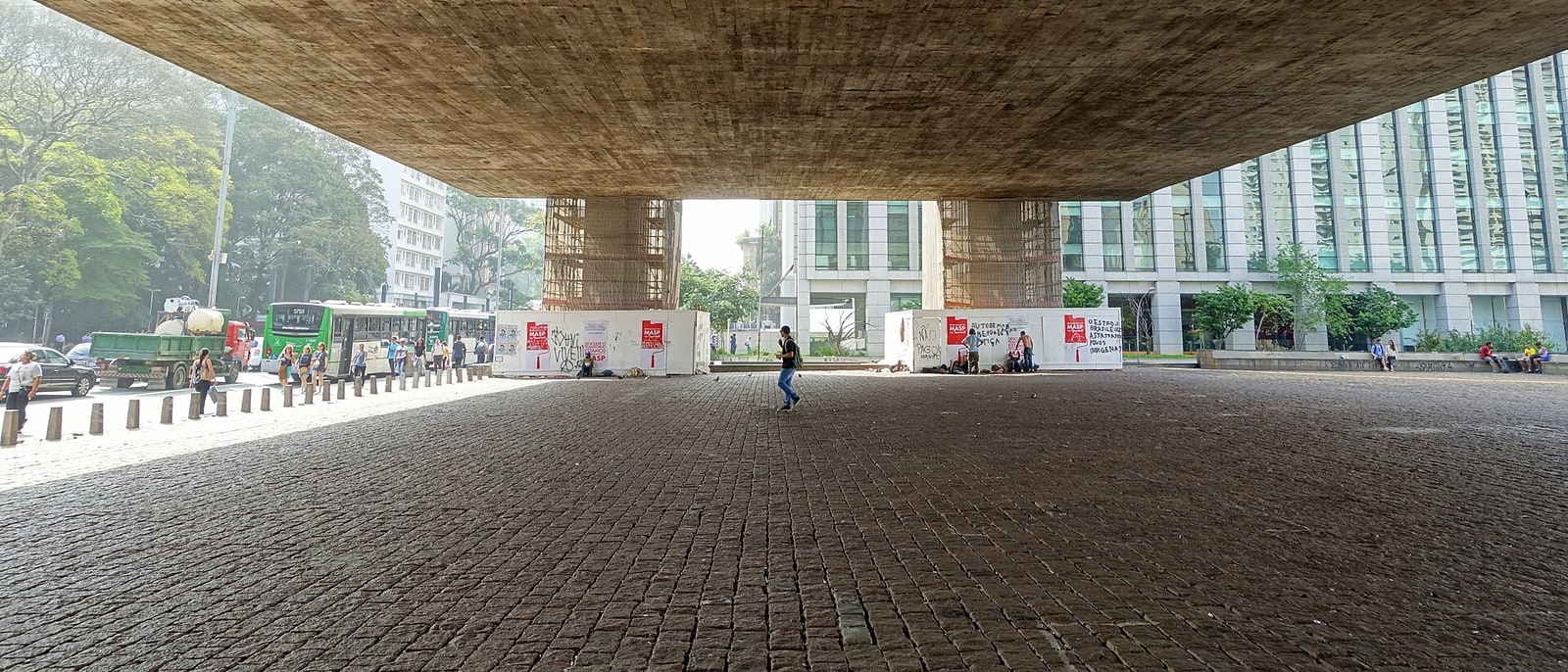
The interesting part was what appeared underneath. When the banners fell, architecture that had been covered for decades emerged, and so did the favelas and the ruined houses the billboards had hidden. Plenty of paulistas said they were seeing their city for the first time. A day here is about exactly that: looking at an enormous, ugly, brutal, fascinating city that had its make-up removed by decree.
The route, stop by stop
4 STOPS- 01
The MASP
A block of glass suspended in the air between four red columns, leaving an empty seventy-metre public plaza underneath. Lina Bo Bardi designed it in the sixties and it’s the most famous building in Brazil after Niemeyer’s. But what you need to see is inside.
The paintings don’t hang on walls: they’re mounted on transparent glass panels held by a concrete block, floating in an open hall. You can walk around each painting and see the back of the canvas, with the stretcher, the labels and the object’s history. There’s no imposed order, no route and no sign in front: the caption is behind, so first you look and then you read.
Lina Bo Bardi did it that way in 1968 to strip the museum of solemnity and put the visitor in charge. In 1996 they were dismantled and normal walls went up. In 2015 they were put back. It’s the best museographic idea of the twentieth century and it’s here.
- 02
Avenida Paulista
Nearly three kilometres of avenue along the top of a ridge, with office towers, museums, banks and a river of people. It’s São Paulo’s emblematic street and you should walk it end to end, which takes an hour.
This is where the mansions of the coffee barons stood, the ones who built this city with money from the bean in the late nineteenth century. Almost all were demolished to raise towers, and that gesture, knocking down your own heritage to put up offices, is very paulista and explains the look of the city. One or two survive, wedged between skyscrapers, so you can compare.
And if you can, come on a Sunday: since 2015 the avenue closes to traffic for the whole day, and what appears is another thing entirely. Cyclists, skaters, musicians, families, stalls and thousands of people walking on six empty lanes. It’s the best day of the week in this city, by a distance.
- 03
The Mercadão
The Municipal Market opened in 1933 with enormous German stained glass showing Brazilian agriculture, and inside it smells of fruit you’ve never seen in your life. The stalls hand you samples: cupuaçu, jabuticaba, graviola, pitaya. Say yes to everything and then buy something, which is the tacit deal.
And upstairs, on the mezzanine, is why half the city comes: the mortadella sandwich. It’s a deliberate outrage: between two slices of bread they pile a mountain of thinly sliced mortadella weighing half a kilo, with melted cheese if you want. It’s absurd, it’s iconic and you won’t finish it alone: order one between two and don’t be ashamed. Beside it is the salt cod pastel, which is the same thing fried.
And then walk out into the old centre, which is right there, and look at the thirties buildings that were covered by billboards for decades until 2007.
- 04
Pixação
Look up at any building in the centre and you’ll see black letters, tall, angular and tight, climbing whole façades to impossible heights. It isn’t international graffiti: it’s pixação, and it’s a visual language born in this city that exists nowhere else in the world.
The alphabet comes, according to the pixadores themselves, from the typography of eighties heavy metal album covers, deformed until it’s illegible to anyone outside. And the point isn’t the paint: it’s where it’s put.
The value comes from the risk, so they compete to climb the impossible places, without ropes, up twenty-storey façades and at night. People have died doing it.
It’s illegal, it’s a class matter, it comes from the periphery and it attacks the rich city, and it has reached contemporary art biennales, which generates an argument still live here. You don’t have to like it. But knowing what it is, you stop seeing a dirty façade and you see a message.
Frequently asked
What to see in São Paulo in a day?
The MASP, with its paintings floating on glass panels with no wall behind, the best museographic idea of the twentieth century, Avenida Paulista on foot, and on a Sunday, when the whole thing closes to traffic, the Municipal Market and its mortadella sandwich, ordered between two, and looking up to see the pixação, that vertical alphabet born here that exists nowhere else.
Did São Paulo really ban advertising?
Yes, in 2007, and it’s still in force. The law was called Clean City and it didn’t regulate outdoor advertising: it banned it entirely. Some fifteen thousand billboards came down, shop signs were forced smaller and the banners on buildings and the ads on buses vanished. The interesting part was what appeared underneath: architecture covered for decades, and also the favelas and ruins the billboards had hidden.