Day trips from São Paulo
9 h route4 stopsBest: April to September, the dry season. In summer it rains every afternoonUpdated July 2026
The English built an entire English village here, and not one stray house: wooden streets, plank houses with chimneys, a cricket pitch and a clock tower copying Big Ben, in the middle of the Atlantic rainforest and in the fog, an hour from São Paulo. The British railway company that built the coffee line raised it in the late nineteenth century, to house its engineers and its workers. It’s called Paranapiacaba and it’s still there, inhabited and standing.
That place explains where this city’s money came from: the coffee that came down by train from the interior to the port of Santos, crossing a range with nearly eight hundred metres of drop on a system of cables and inclined planes that was an engineering feat. Around São Paulo there’s more of the same: the Atlantic rainforest, the port that moved all of it and the beaches the city goes down to at weekends. All one or two hours away, if the traffic allows.
The route, stop by stop
4 STOPS- 01
Paranapiacaba
A complete Victorian village hung off the edge of the range, with painted wooden houses, lamps, an Anglican church and the clock tower. The English raised it to operate the railway that brought the coffee down from the plateau to the port, and they did it their way: with houses by rank, the chief engineer’s up on the hill and the workers’ below, separated by a fence. That hierarchy still reads on the map.
The reason it exists is the range: between São Paulo and the sea there are eight hundred metres of drop in very little distance, too much for a locomotive. The solution was to split the descent into sections and raise and lower the wagons with steel cables driven by fixed steam engines, one inclined plane after another. The machinery can be visited.
And the name says it all: Paranapiacaba means, in Tupi, something like the place from which the sea is seen. The irony is that it’s almost always buried in fog and you see nothing. Take a jacket: it rains and it’s cool here when São Paulo is hot.
- 02
The Atlantic rainforest
The Mata Atlântica, a tropical forest, covered the entire Brazilian coast, thousands of kilometres north to south, and holds on to around twelve per cent of itself today. It isn’t the Amazon: it’s another biome, older in its current form, and it has a surprising fact. Per hectare it’s even more diverse than the Amazon, with a very high proportion of species that exist nowhere else on the planet.
Coffee, sugarcane, cattle and cities ate it: it was felled to plant what made this state rich, the city you’re in included. What remains is mostly on the range running to the sea, precisely because it was too steep to farm.
It starts an hour from São Paulo and there are parks where you walk among giant ferns, bromeliads and enormous trees, with real monkeys and toucans. Seeing that forest after crossing fifty kilometres of concrete to reach it is understanding at last what was paid for this city.
- 03
Santos and the port
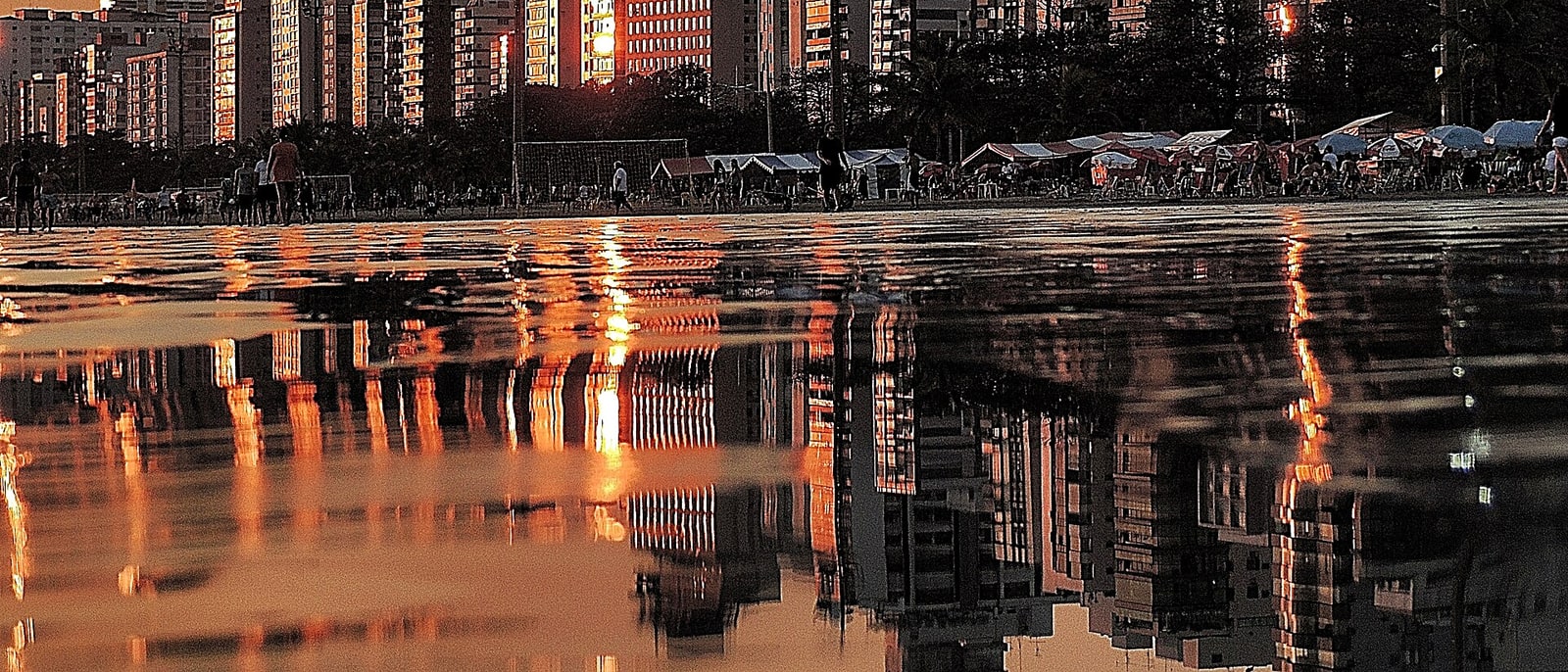
Down the range you drop into Santos, the largest port in Latin America and the place all the coffee that built São Paulo left through. It has a very long promenade with gardens, an urban beach and an old town with the former Coffee Exchange, today a museum and worth the visit: it’s the room where the price of the bean was set for half the world, with its stained glass and marble floor intact.
And this port is where half this region’s history begins: the millions of Italians who filled São Paulo came in through here, and the Kasato Maru docked here in 1908 with the first Japanese families. Every wave of people that made this city set foot on that wharf. It’s also the city where Pelé played his whole career, and there’s a museum at the stadium.
Practical: you go down a winding motorway through the range, on a summer weekend there are monumental jams because half of São Paulo goes down to the beach, and Santos beach is fine but it isn’t the Caribbean. If you want beautiful water, keep going north.
- 04
The northern beaches
Two or three hours up the coast to the northeast are the good beaches: the north littoral, with pale sand, green water and the Atlantic rainforest dropping straight into the sea. Juquehy, Maresias, Camburi and, beyond, Ubatuba, with dozens of coves. And opposite, Ilhabela, a mountainous island reached by ferry, with waterfalls inside the forest and beaches only reachable by boat.
It’s where São Paulo goes at the weekend, and there’s the problem: in summer and on public holidays, the coast road jams in a legendary way, and what is two hours becomes five or six. If you’re going to do it, leave very early on Saturday and come back late Sunday or on Monday, or do it midweek.
The other thing to know is the calendar: December to March is summer and it rains a lot, almost every afternoon, with heavy storms. April to September has less water, fewer people and it’s still fairly hot on the coast. That’s the window.
Frequently asked
What day trips can you do from São Paulo?
Paranapiacaba, an hour away: an entire English Victorian village, with a clock tower copied from Big Ben, built by the British railway company in the middle of the Atlantic rainforest. Santos, Latin America’s largest port, where the coffee left and the Japanese arrived in 1908. The Atlantic rainforest, of which only 12% remains and which per hectare is more diverse than the Amazon. And the northern beaches, two or three hours away.
Is there a beach near São Paulo?
Yes, but not in the city: São Paulo is eight hundred metres up and an hour from the coast. Santos is the nearest urban beach and it’s merely fine. The good ones are two or three hours northeast (Juquehy, Maresias, Ubatuba) and the island of Ilhabela. Mind the traffic: in summer and on holidays the coast road jams and two hours become five or six.