Where to stay in Paris
5 stopsUpdated July 2026
Paris’s twenty arrondissements spiral outward from the centre, clockwise, like a snail: that’s why they call it l’escargot. Number one is at the Louvre and twenty is on the north-eastern edge. That detail, which looks like trivia, is the most useful tool we’ll give you: the number tells you how far from the centre you are. One to seven, you’re inside. Fifteen upwards, you’re on the edge.
And there’s a second rule that orders the rest: the Seine splits the city into rive droite, to the north, and rive gauche, to the south. The right is money, business and the big museums. The left is the university, the cafés and the bookshops. With those two coordinates, number and bank, you know exactly where a hotel is without looking at a map.
The route, stop by stop
5 STOPS- 01
The Marais (3rd and 4th)
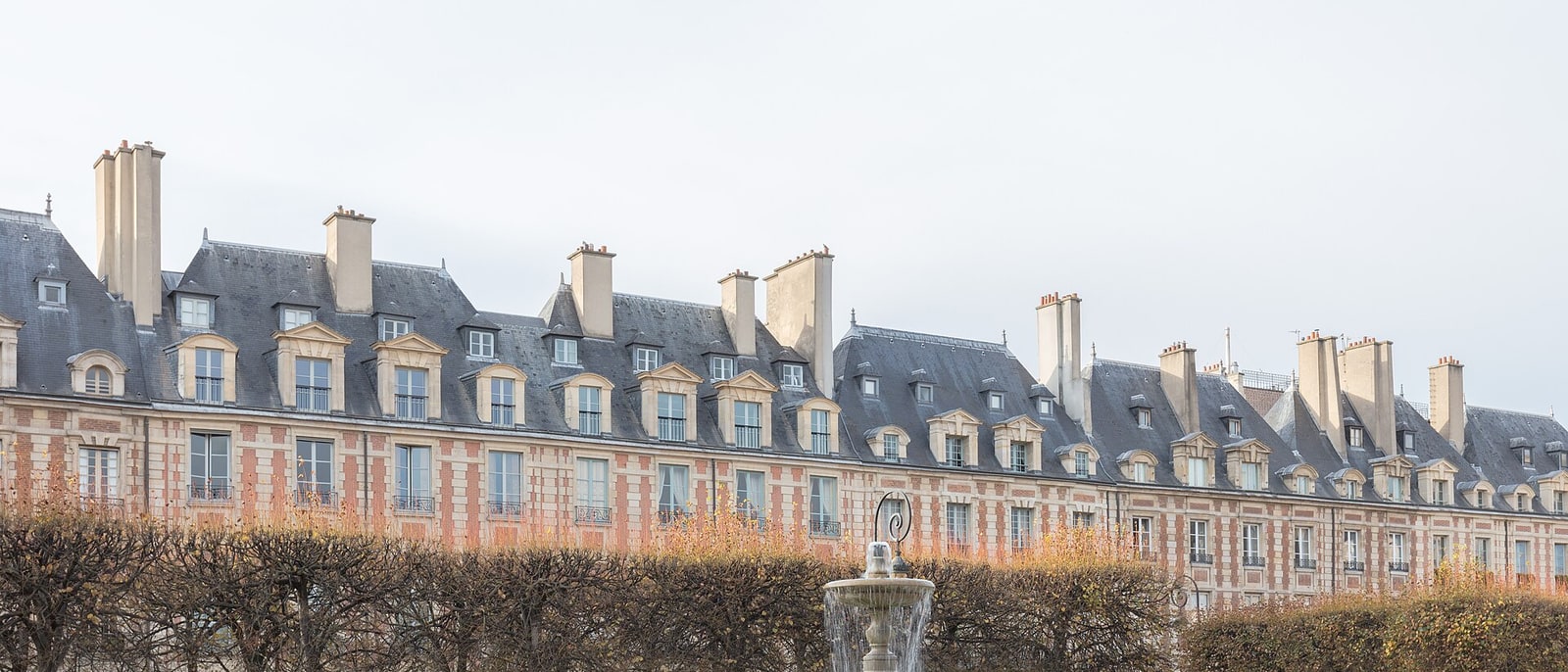
This piece of Paris escaped Haussmann, the only large one that did, so it’s the only one with narrow crooked streets and sixteenth- and seventeenth-century houses. It’s dead centre, everything is walkable, it has the Place des Vosges, and you eat superbly at any hour, which is rare in this city.
It has been marshland, aristocratic, Jewish and run-down, in that order, and that last phase is what saved it: when Haussmann was levelling, this wasn’t worth the trouble. Today it’s among the most expensive and on Sundays it’s packed, because it’s one of the few areas in Paris where the shops open that day.
If it’s your first trip and the budget allows, sleep here and don’t think about it further.
- 02
Saint-Germain and the Latin Quarter (5th and 6th)
The classic rive gauche: the Sorbonne, the existentialists’ cafés, the bookshops and the Panthéon. It’s called the Latin Quarter for a literal reason: the university was founded in the twelfth century and until 1793 classes were taught in Latin, so these streets rang with Latin all day. The name outlived the language by two hundred years.
Saint-Germain, next door, is more expensive and more elegant, with the cafés where Sartre and De Beauvoir wrote, which today charge what they charge precisely because of that.
It’s a very good area to sleep: it’s central, you walk to the Louvre and Notre-Dame, and at night there’s still student life in the small streets. What to avoid is rue de la Huchette and around it, which is a trap of restaurants with men in the doorway inviting you in.
- 03
Montmartre (18th)
Montmartre lay outside Paris: a village with vineyards and windmills on top of a hill, outside the city and therefore outside its taxes, which is why it filled with cheap taverns and penniless artists. It was annexed in 1860 and the village still shows in the staircases and the streets that go nowhere. A real vineyard survives on the northern slope, and it’s harvested every October with a festival.
What to know about sleeping here: it’s beautiful and it’s far. The hill is on the northern edge, so almost everything else is a long half-hour away, and getting home means stairs or a funicular. And the Place du Tertre, with the portrait painters, is one of the most touristed spots in Europe, two streets away, though, it’s still a neighbourhood.
A good choice for a second visit to Paris, a middling one for the first.
- 04
Canal Saint-Martin and the 11th
To the east, Napoleon had the Canal Saint-Martin dug to bring drinking water into the city, and today it’s where Paris sits on sunny days, on the stone edge with legs dangling. Around it, the 11th is a real neighbourhood: people who live there, small bars, markets, and restaurants where you eat better and for half what the centre charges.
There isn’t a single monument and that’s exactly the offer. It’s the best value in Paris for sleeping, it’s three métro stops from the centre and at night there’s life without it being a theme park.
It’s where you stay if you’ve already seen the tower or if the city interests you more than the postcard. And on Saturdays there’s one of the largest street markets in Paris, on boulevard Richard-Lenoir.
- 05
Around the tower (7th and 15th)
The 7th gathers the Eiffel Tower, the Invalides and the ministries: grand buildings, wide streets, embassies and absolute quiet. A lot of people book here because they want to see the tower from the window, and that’s achievable and it’s lovely on day one.
The cost is that it’s an area with no life of its own: it’s institutional rather than residential, and at nine in the evening there’s nowhere to eat except expensive places built for tourists. And the distances deceive: it looks central on a map, but the Marais or the Latin Quarter are half an hour away.
If you’re with children and want calm, it works well. If you’re here four days and want to live in the city, anything else on this list gives you more.
Frequently asked
How do Paris arrondissements work?
They spiral outward from the centre clockwise, like a snail: 1 is at the Louvre and 20 on the north-eastern edge. The number tells you how far from the centre you are: 1 to 7 you’re inside, 15 upwards you’re on the edge. The Seine splits the city into rive droite (north) and rive gauche (south).
Where is it best to stay in Paris?
The Marais if the budget allows: it’s the only genuinely old quarter and it’s central. Saint-Germain and the Latin Quarter, also central and alive. The 11th and Canal Saint-Martin are the best value and where Paris lives. Montmartre is beautiful and far. The 7th is quiet and dead at night.
Why is it called the Latin Quarter?
For a literal reason: the Sorbonne was founded in the twelfth century and until 1793 classes were taught in Latin, so those streets rang with Latin all day. The name outlived the language by over two hundred years.