What to see in Paris
5 stopsUpdated July 2026
The Mona Lisa was just another painting until it was stolen. In August 1911 an Italian workman carried it out under his coat, and the Louvre took twenty-eight hours to notice it was gone. It was missing for two years, the story went round the world, people queued to see the empty space on the wall where it had hung, and Picasso was questioned as a suspect. When it came back, in 1913, it was already the most famous painting on the planet. Leonardo didn’t paint the fame: the theft made it.
That story is useful because it teaches you how to look at Paris: almost everything here taken as eternal has a concrete and often prosaic reason behind it. The Eiffel Tower was saved for being an aerial. Versailles was a political cage. The Musée d’Orsay is a station that narrowly escaped demolition. And the whole city has this face because one prefect knocked down sixty per cent of it in seventeen years.
The route, stop by stop
5 STOPS- 01
The Louvre
It started as a medieval fortress, carried on as a royal palace, and opened as a museum in 1793, when the Revolution decided the king’s collection now belonged to the people. You can still see the foundations of the twelfth-century castle in the basement, and that empty room is one of the best things in the museum and there’s nobody in it.
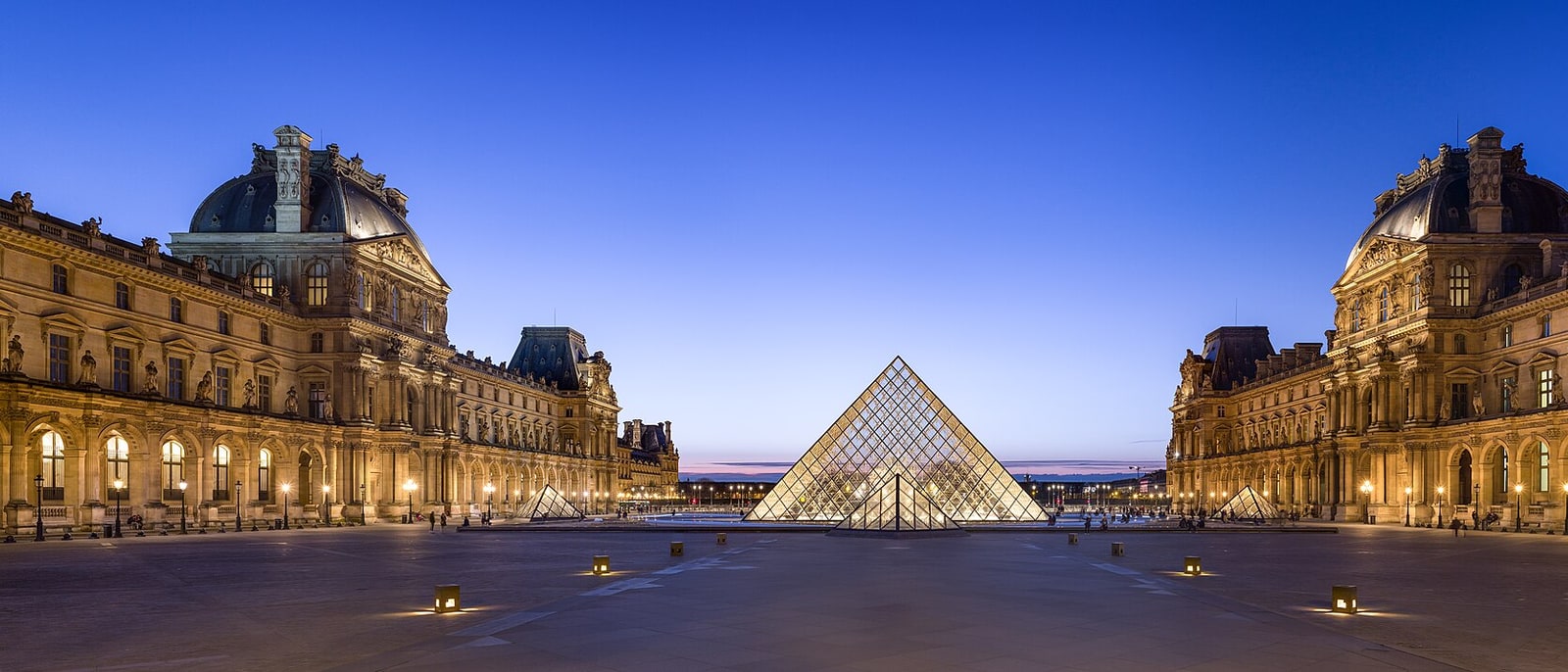
I. M. Pei’s pyramid, from 1989, was hated with the same intensity the Eiffel Tower was hated a century earlier: it was called an Egyptian monstrosity in the heart of France. Today it’s a symbol of Paris.
And in passing, a correction: it circulated for years that it had six hundred and sixty-six panes, with everything that implied. It has six hundred and seventy-three. Someone counted badly, or found it convenient to.
- 02
The Sainte-Chapelle
Here Gothic reaches its logical conclusion: if the flying buttresses carry the weight outside, the wall stops being necessary. Here it was taken to the limit and practically vanished: what’s left is impossibly thin stone ribs and, between them, six hundred square metres of stained glass. One thousand one hundred and thirteen scenes telling the whole Bible, read bottom to top and left to right.
It was built in seven years, around 1248, which for the period is an extraordinary speed, and for a single purpose: to house the crown of thorns Louis IX bought from the emperor of Constantinople, who was broke and needed cash. He paid three times more for the relic than it cost to build the chapel holding it.
Go in the morning, when the sun comes from the east, and sit down: there’s nothing more impressive in this city.
- 03
The Eiffel Tower
Two years, two months and five days of work for the 1889 Exposition, with eighteen thousand iron pieces and two and a half million rivets, and a permit that clearly said it came down after twenty years. There was a manifesto of artists and writers against it (Maupassant, Dumas fils and Garnier, of the Opéra, signed it) calling it useless and monstrous.
Radio saved it. Eiffel, who was clever, set about proving his tower was good for scientific experiments and above all that it was an excellent aerial. In 1909, when it was due to come down, the army wanted it for wireless telegraphy. It stayed for being useful, not for being beautiful.
Look at the names engraved under the first floor: there are seventy-two French scientists and engineers, and not one woman, which has been pointed out fairly often, starting with Sophie Germain.
- 04
Haussmann’s buildings
The image you have of Paris (the wide boulevards, the identical pale stone buildings, the continuous balconies, the grey zinc roofs) isn’t old: it’s from between 1853 and 1870. In seventeen years, Baron Haussmann demolished around sixty per cent of the medieval city and remade it by decree, pushing tens of thousands of poor people out to the edges.
And the uniformity isn’t style, it’s regulation: the building’s height was tied to the street’s width, the façade had to be local limestone, and the continuous balconies were compulsory on the second and fifth floors. That’s why every building lines up.
The official motivation was hygiene and traffic. The other, which is argued over but was there, is that a straight wide boulevard is impossible to barricade and very easy to sweep with artillery. Paris is beautiful by decree and wide out of caution.
- 05
The catacombs
Beneath Paris there are some three hundred kilometres of galleries, which are the quarries the stone the city above was built from came out of: Paris literally dug itself. And along one stretch of those galleries the bones of around six million people are stacked.
The reason is specific and fairly unpleasant. The Holy Innocents cemetery had been burying people in the middle of the city for ten centuries and was overwhelmed: the ground had risen two metres above street level. In 1780 a wall adjoining a cellar gave way under the pressure and the bodies came into the neighbour’s house.
That ended the argument: it was closed, and for decades the bones were moved at night, in carts, into the old quarry void. Someone stacked them into walls and patterns, which is what you visit. You book ahead and capacity is small.
Frequently asked
Why is the Mona Lisa so famous?
The theft. It was just another painting until an Italian workman carried it out under his coat in 1911. It was missing for two years, people queued to see the empty space on the wall, and Picasso was questioned as a suspect. When it came back in 1913 it was already the most famous painting in the world.
Why do all Paris buildings look the same?
Regulation, not style: between 1853 and 1870 Haussmann knocked down sixty per cent of the city and remade it by decree, with height tied to street width, limestone façades compulsory and continuous balconies on the second and fifth floors. The wide boulevards are also impossible to barricade.
Why are there bones in the Paris catacombs?
Because the Holy Innocents cemetery in the centre had been filling for ten centuries and in 1780 a wall gave way under the pressure and the bodies came into the neighbour’s cellar. It was closed and the bones of around six million people were moved at night into the old quarries the city’s stone came out of.