Eating in Paris
5 stopsUpdated July 2026
A 1993 decree defines in law what may be called a baguette de tradition: only flour, water, salt and yeast, no additives and never having been in a freezer at any point. Anything else can be called a plain baguette, but not a tradition. That’s why the bakery has two prices and two different loaves, and why anyone asking for “a baguette” gets the worse of the two.
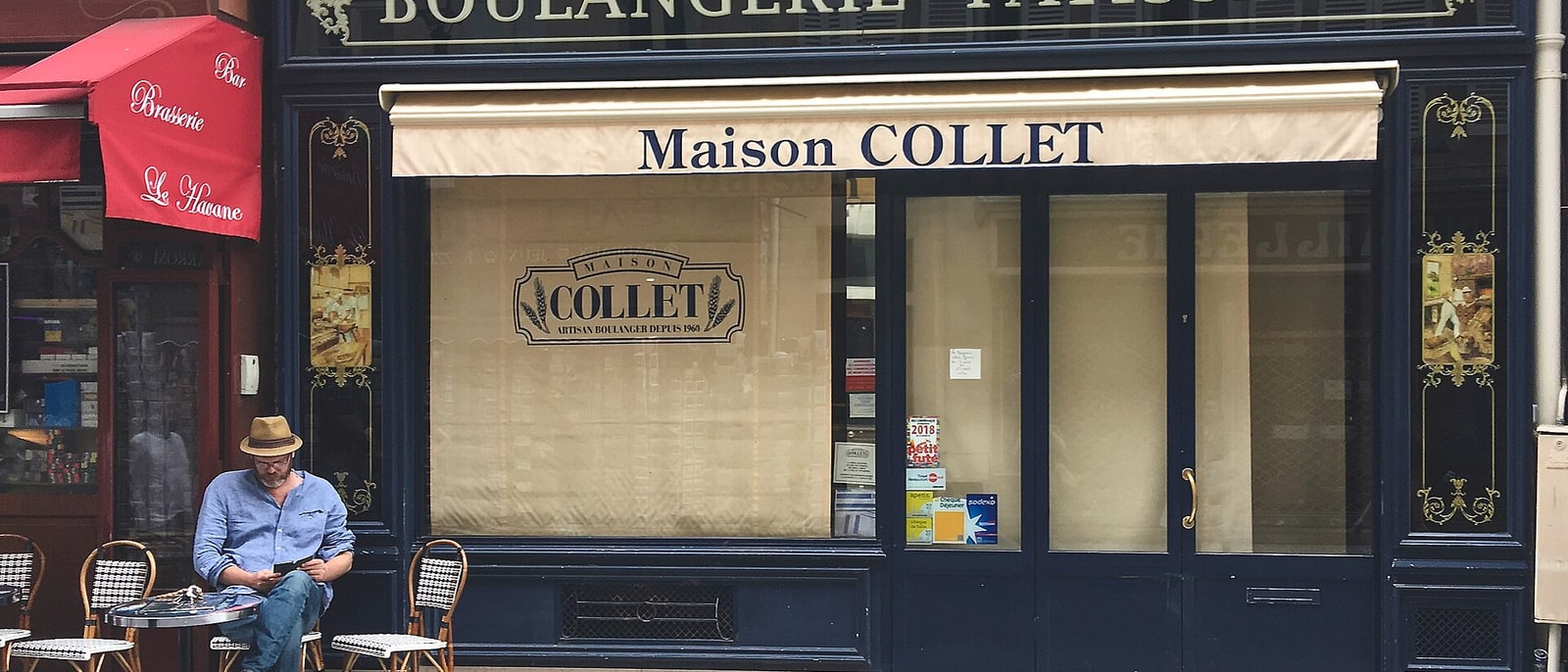
That decree explains how food works in France: things here are defined by law, and knowing the definition is knowing how to order. Same with coffee, which has three legal prices depending where you sit, or with cheese, which comes before dessert and not after. It isn’t snobbery: they’re written rules, and whoever knows them eats better and pays less.
The route, stop by stop
5 STOPS- 01
The baguette, and the two of them
In any French bakery there are two baguettes and they aren’t the same thing. The ordinaire may contain additives, improvers and frozen dough, and it comes out pale and soft. The tradition is regulated by the 1993 decree: flour, water, salt, yeast, nothing else, and never chilled. You can spot it: it’s darker, the slashes are irregular and the ends are pointed, and inside the holes are different sizes.
Ask for “une tradition, s’il vous plaît” and not “une baguette”. It costs a few cents more and it’s a different product. And one more thing to know: in France only a place that mixes and bakes on the premises may call itself a boulangerie. If you buy bread somewhere signed “dépôt de pain”, that bread came from elsewhere.
Unesco listed the baguette as intangible heritage in 2022, and there’s an annual competition in Paris whose winner supplies the Élysée with bread for twelve months.
- 02
Coffee, and its three prices
In a French café there are three prices for the same thing and all three are legal: au comptoir, standing at the bar, en salle, sitting inside, and en terrasse, outside. The difference can be double, and by law it must be posted on a visible sign. It isn’t a tourist scam: the Parisian next to you pays the same.
What you’re paying for on the terrace is the chair and the hours: in France, once you sit, the table is yours as long as you want and nobody will rush you or bring the bill unasked. That’s a cultural rule too, and it explains why a terrace coffee in Saint-Germain costs what it costs.
A plain “café” is an espresso. If you want a long one, ask for an “allongé”, and if you want it with milk in the morning, a “crème”. Ordering a milky coffee after lunch isn’t forbidden, but you will get a look.
- 03
The bistro, the brasserie and the café
The three names mean different things and knowing it stops you walking into the wrong one. The café is for drinking and for being, you can eat something, but that isn’t what it’s for. The bistro is small, has a short menu written by hand or on a blackboard, market cooking and strict service hours: arrive at three and the kitchen is shut.
The brasserie is another thing and its name says so: brasserie means brewery. Alsatians who came to Paris after the 1870 war, when Alsace went to Germany, set them up and brought beer, choucroute and oysters. They’re large, loud, they have long menus and they serve at any hour, even four in the afternoon, which is exactly when you need it.
If you’ve come out of a museum late and you’re hungry, your place is a brasserie: it’s the only one that will be open.
- 04
The order of the table
Cheese comes before dessert, not after, and that throws half of Europe. The logic is about wine: cheese is eaten with the red already on the table, and once you move to something sweet, the wine is finished. So the order is starter, main, salad, cheese, dessert. Yes, the salad comes after the main and not before: it’s there to clean the palate.
And a few practical things: bread doesn’t go on a plate, it goes straight onto the cloth to your left, and it isn’t spread with butter except with radishes or cheese. You don’t cut salad with a knife, you fold it with the fork.
And you don’t ask for the bill with a gesture in the air: you say “l’addition, s’il vous plaît” when someone passes. None of this will get you thrown out anywhere, but knowing it changes how you’re treated, which is what the next section is about.
- 05
The croissant, which is Austrian
The croissant arrived from abroad: it comes from the Austrian kipferl, and it was brought to Paris in 1839 by a Viennese artillery officer called August Zang, who opened a bakery on rue de Richelieu. The French copied it, applied puff pastry to it and improved it so much they kept it. In France, pastries are still called viennoiserie, “things from Vienna”, and that’s an acknowledgement of authorship that has been in plain sight for two hundred years.
And a trick almost nobody knows that you can see from the door: the shape tells you the ingredient.
By a widespread convention in French bakeries, the straight croissant is made with butter, croissant au beurre, and the curved one, the classic crescent, with margarine. If both are on the counter, pick the straight one. If there are only curved ones, ask.
Frequently asked
What is a baguette de tradition?
The one the 1993 French decree regulates: only flour, water, salt and yeast, no additives and never frozen. The other, the ordinaire, may contain improvers and frozen dough. Ask for “une tradition” and not “une baguette”: it costs a few cents more and it’s a different product.
Why is coffee more expensive on the terrace in Paris?
Because there are three legal prices and they must be on a sign: au comptoir (standing at the bar), en salle (sitting inside) and en terrasse (outside). It can be double. It isn’t a scam: the Parisian pays the same. What you pay for is the chair and the time, because once you sit the table is yours as long as you like.
Does cheese come before or after dessert in France?
Before. The order is starter, main, salad, cheese, dessert. The logic is that cheese is eaten with the red wine already on the table, and once you move to something sweet the wine is done. And yes: the salad comes after the main, to clean the palate.