Paris in a day
10 h route5 stopsBest: May to June or September. In August Paris leaves ParisUpdated July 2026
Paris covers a hundred and five square kilometres, which makes it smaller than Madrid and considerably smaller than Berlin, and inside that area sits absolutely everything you’ve seen in photographs. You can walk across it end to end in two and a half hours, and there are three hundred-odd métro stations, so you’re never more than four hundred metres from one. Distance isn’t the problem here.
The problem is queues and booking. The Louvre, the Sainte-Chapelle and the tower need timed tickets and they sell out. Turning up at the door loses you the morning. So a day in Paris is planned from your sofa at home: you pick two big things, you book them, and you fill the rest of the day walking, which is exactly what this city is for.
The route, stop by stop
5 STOPS- 01
The Sainte-Chapelle first thing
Fifteen windows fifteen metres high with one thousand one hundred and thirteen scenes, and the walls have almost vanished: only the ribs holding the glass remain. It was built in seven years, around 1248, and it’s the most impressive thing in Paris per square metre. It hides inside the courts complex, which is why plenty of people walk past it.
The fact that explains it: Louis IX had it built to house the crown of thorns, which he’d bought off the emperor of Constantinople. The crown cost him a hundred and thirty-five thousand livres and the chapel forty thousand. So the reliquary cost three times less than the relic. Once you know that, the building changes: it isn’t a church, it’s a box.
Go at nine, when it opens and the sun comes from the east. At midday the light is flat and it isn’t the same thing.
- 02
Notre-Dame
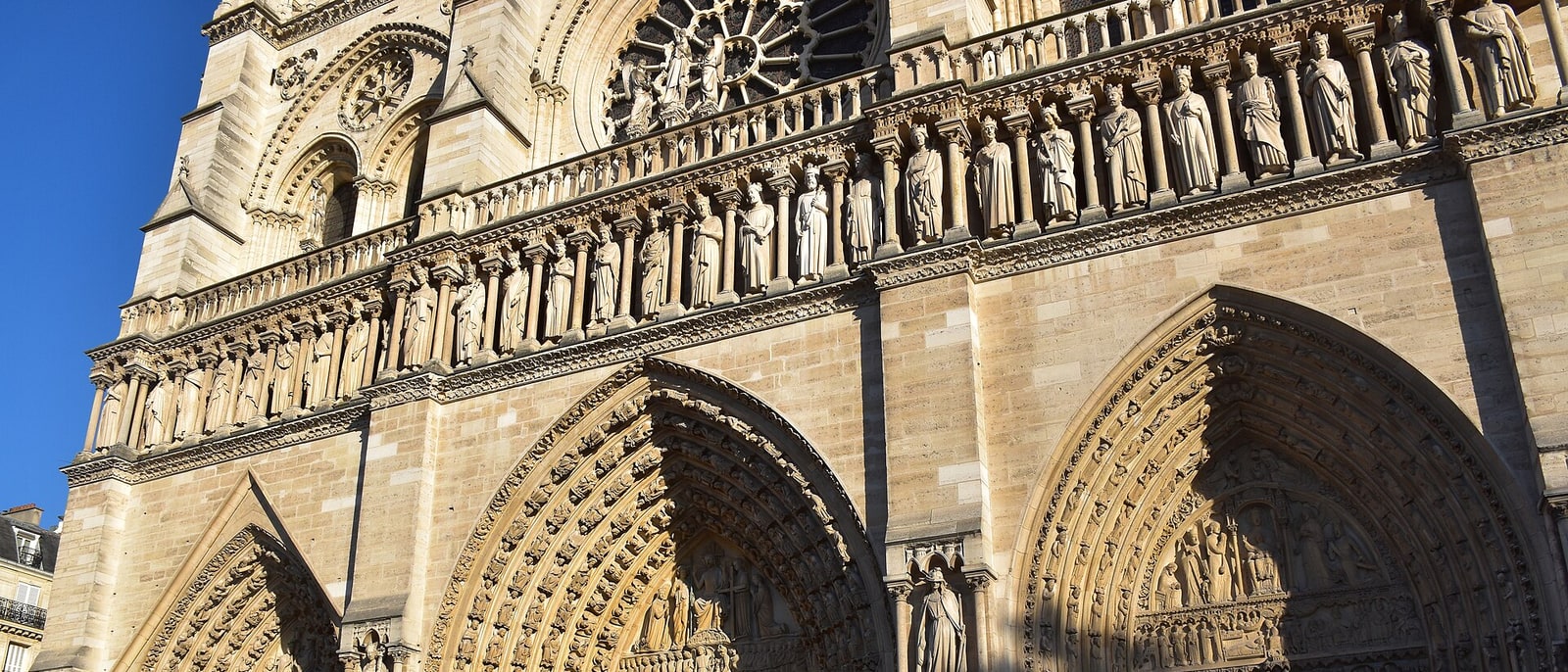
It reopened in December 2024, five years after the fire, and entry is still free as it has always been. What surprises you walking in is the colour: the stone was cleaned during the restoration and the interior is far lighter than it was, almost golden. People who knew it before say it looks like a different church, and in a way it is.
What burned was the forest: the roof structure was a lattice of thirteenth-century oak beams, around thirteen hundred of them, each from a different tree, and it was called exactly that, la forêt.
It has been remade in French oak with the same medieval techniques, cut by hand with axes, because that was the only way the timber would behave the same.
It’s on the Île de la Cité, five minutes from the Sainte-Chapelle, and both fit into one morning.
- 03
The Louvre, with a strategy
Thirty-five thousand works on show across seventy-two thousand square metres. Seeing it all isn’t hard, it’s impossible: if you spent thirty seconds in front of each piece without sleeping or eating, it would take you over twelve days. So the only way to enjoy it is to accept that and choose two wings, no more.
The classic trap is running for the Mona Lisa. It’s a painting seventy-seven by fifty-three centimetres, behind glass, at the end of an enormous room with two hundred people in front of it holding phones up: you see it for ten seconds, badly and from a distance. Look at it if you want, but don’t build the day around it.
In the same room, on the opposite wall and with nobody in front of it, is Veronese’s Wedding at Cana, seventy square metres: it’s the largest painting in the museum and almost nobody turns round to look.
- 04
The tower, and the man who ate underneath it
It went up for the 1889 Exposition, in two years, two months and five days, and the permit was temporary: after twenty years it had to come down. Half the city hated it, there was a manifesto signed by writers and architects calling it a “factory skeleton”, and it was genuinely condemned. It was saved by something with nothing to do with art: it was an excellent radio aerial, and in 1909 the army wanted it. That’s why it’s still there.
A couple of things you see better knowing them: iron expands, so in summer the tower is about fifteen centimetres taller than in winter and leans slightly away from the shaded side.
And it’s entirely repainted by hand every seven years, with sixty tonnes of paint.
The story about Maupassant eating in its restaurant every day because it was the only place in Paris from which he couldn’t see it is probably apocryphal and far too good to check.
- 05
Dinner in the Marais
The Marais escaped Haussmann, the only large piece of Paris that managed it, and that’s why it keeps narrow crooked streets and pre-nineteenth-century houses. It was marshland, marais means marsh, then the aristocracy’s quarter, then the Jewish quarter, and then, for a long time, a run-down place nobody wanted. That saved it: it wasn’t worth knocking down.
The Place des Vosges, from 1612, is the oldest planned square in Paris and still has its original thirty-six houses with the same arcades.
You eat well around it, and there’s one very specific thing to do: rue des Rosiers has been the heart of the Jewish quarter for centuries and that’s where the falafel is, eaten standing with a queue on the pavement. It’s the best cheap dinner in Paris and has been for decades.
Frequently asked
What to see in Paris in a day?
The Sainte-Chapelle first thing and Notre-Dame, which are on the same island and go together, the Louvre choosing two wings, no more, the Eiffel Tower, and dinner in the Marais. Book the timed tickets before you leave home: turning up at the Louvre door loses you the morning.
Is Notre-Dame free to enter?
Yes, entry to the cathedral is free, as it has always been. It reopened in December 2024, five years after the fire, and the interior is far lighter than before because the stone was cleaned during the restoration.
Is the Mona Lisa worth seeing?
In passing, yes. Building the day around it, no. It’s 77 × 53 cm, behind glass at the end of an enormous room, and you see it for ten seconds with two hundred phones in front. On the opposite wall, with nobody there, is Veronese’s Wedding at Cana: seventy square metres and the largest painting in the museum.