OZU /INDONESIA /JAKARTA /GUIDE
Jakarta’s neighbourhoods
6 h route4 stopsBest: Group by zone: crossing the city twice a day is losing itUpdated July 2026
Jakarta reads as a north-south axis, and that axis is also a timeline. The north is the old part: the port the Dutch arrived through, colonial Batavia, the Chinatown. The south is the new: skyscrapers, malls, the middle class and the bars.
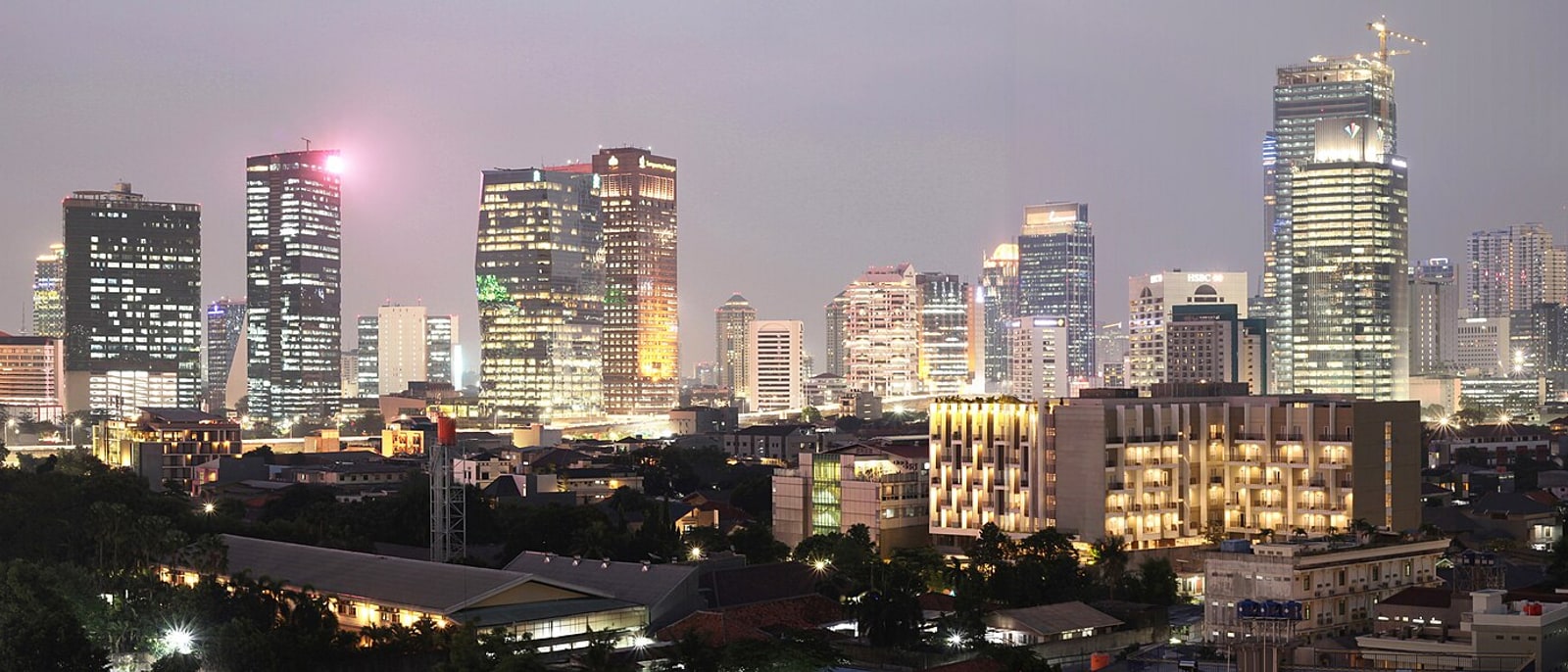
And in between, the political centre with the Monas and the mosque. The rule here isn’t which district is best, it’s not crossing the whole axis twice in one day, because the traffic charges you for every attempt.
The route, stop by stop
4 STOPS- 01
Kota Tua and the north
The north holds the origin: the Dutch arrived here in the 17th century and built Batavia, the capital of their commercial empire in Asia for three hundred years. Fatahillah Square survives with the old city hall, the half-restored colonial buildings and the port of Sunda Kelapa with its wooden schooners.
And it’s also the part having the worst time: north Jakarta is what’s sinking, by up to 25 centimetres a year in places, with whole neighbourhoods below sea level behind a dyke.
That double condition, colonial splendour and the water winning, is what makes this the most interesting area in the city and the most uncomfortable.
- 02
Glodok
Narrow alleys, wet markets, incense-filled temples and the best food in the north. It’s one of the oldest Chinatowns in Southeast Asia and there’s nothing staged about it: there are no tourists and people are getting on with their lives.
It helps to know its history to understand what you’re seeing. Jakarta’s Chinese community has suffered very hard episodes: the 1740 massacre under the Dutch, and the 1998 riots during Suharto’s fall, when Glodok was looted and burned. For decades it was illegal to teach Chinese or celebrate the new year in public.
That the district is alive today, with its temples open and its market heaving, is a story of resilience and not a brochure fact.
- 03
Menteng and the centre
The residential district the Dutch laid out in the early 20th century as a garden city, with tree-lined streets and art deco villas, later occupied by the Indonesian political elite. It’s one of the few green, quiet places in the centre.
A fact that surprises: Barack Obama lived here as a child, between the ages of six and ten, and attended a local state school. His mother had married an Indonesian. There’s a statue of him as a boy in a nearby park.
Around it are the Monas, the Istiqlal mosque and the cathedral, so the political and residential centres are walked together.
- 04
The south: Kemang, Senopati, Blok M
In the south Jakarta’s middle class lives and goes out, and where the city contradicts its reputation: speciality coffee, good restaurants, bars and rooftops. Blok M has the most local feel, Senopati the most fashionable, and Kemang, the expat district, sits in between.
And here’s the best thing that has happened to this city in decades: the MRT. Jakarta had no metro until 2019 (a megacity of ten million with no metro, in the 21st century) and now the southern line works, it’s clean, it’s punctual and it doesn’t know what a jam is. The extension is under construction.
Pick a hotel near a station and your trip changes completely.
Frequently asked
Where should you stay in Jakarta?
Near an MRT station, and that’s the whole rule: in this city you don’t pick a hotel by the photos but by whether it spares you the traffic. The south (Senopati, Blok M, Kemang) has the bars and restaurants. The centre, by the Monas, puts you walking distance from the mosque with a train to the north.
Does Jakarta have a metro?
Yes, since 2019: a megacity of ten million had no metro until then. The southern line works well, it’s clean and punctual, and it doesn’t know what a jam is. An extension is under construction. There’s also a commuter railway, which is what takes you north to Kota Tua.
Did Obama live in Jakarta?
Yes, in the Menteng district, between the ages of six and ten, when his mother married an Indonesian. He went to a local state school and there’s a statue of him as a boy in a nearby park. Menteng was laid out by the Dutch as a garden city in the early 20th century.