Day trips from Milan
5 stopsBest: May to September for the lakes. The rest, all yearUpdated July 2026
A glacial lake with the Alps behind it, forty minutes away by train. A whole walled medieval city at fifty. Italy’s first capital at an hour. Milan sits in the middle of the north with a rail network that works, and that combination turns any spare day into a real trip.
It’s also what locals do: Milan works Monday to Friday and leaves at the weekend, and makes no secret of it. Copying them is the best advice on this page. And there’s a practical advantage Rome doesn’t have: almost all of this is regional trains, no booking and no high speed, so you decide in the morning by looking out of the window.
The route, stop by stop
5 STOPS- 01
Lake Como
A glacier dug it and it’s over four hundred metres deep, which puts its bottom below sea level: it’s one of the deepest lakes in Europe. It’s shaped like an upside-down Y, with three arms, and the villages cling to the shores because there’s no flat ground anywhere.
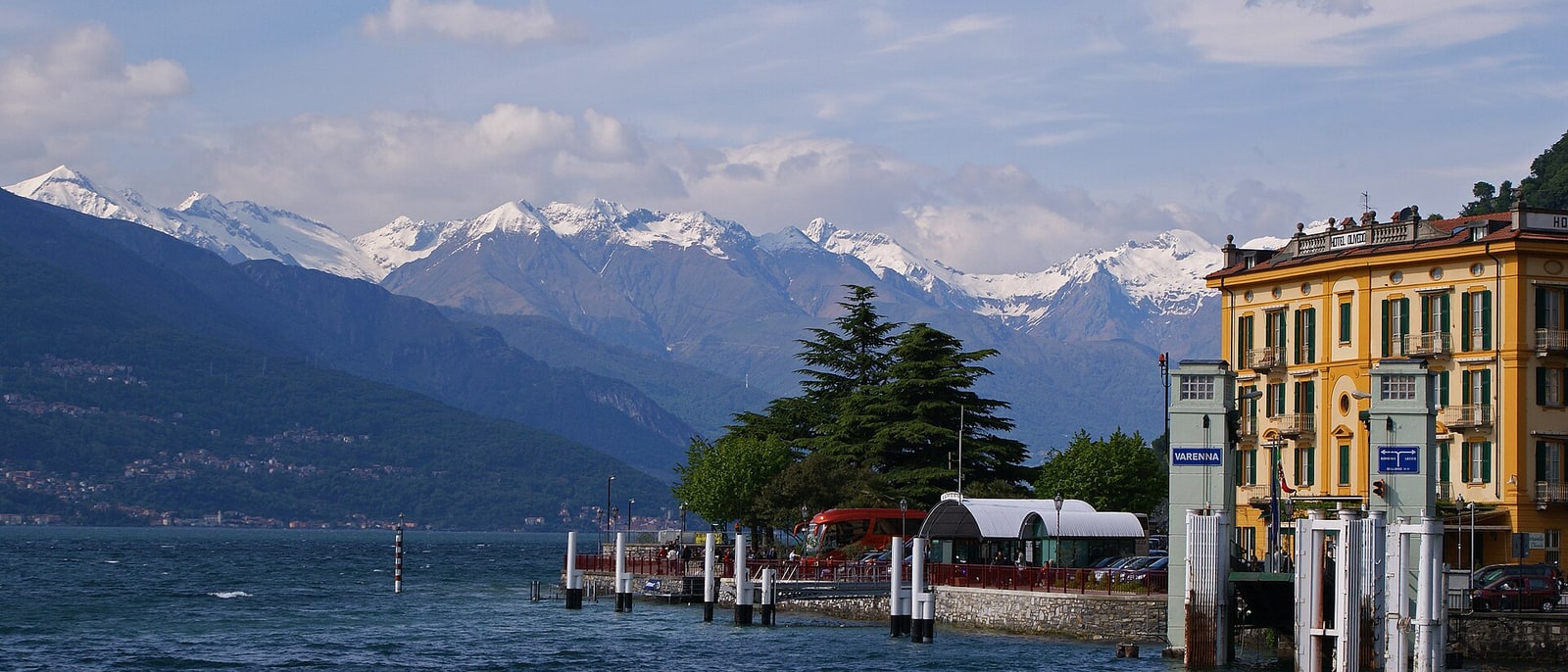
The strategy the Milanese use, which almost no tourist knows: don’t go to Como town, at the tip, which is the least beautiful part. Take the train to Varenna, whose station is two hundred metres from the pier, and cross by ferry to Bellagio in a quarter of an hour. That ferry, with the lake’s three arms opening out and the Alps behind, is the whole trip. The rest is a bonus.
And take something warm: it’s ten degrees cooler here than in Milan.
- 02
Bergamo Alta
Bergamo splits into two cities: the lower one, modern, with the station, and the upper one, medieval and complete, perched on a hill inside a sixteenth-century wall that goes all the way round without a single gap. You go up by funicular in three minutes and no cars get in.
The Venetians built the wall, Bergamo was the western edge of the Republic of Venice for three hundred and fifty years, and it’s a world heritage site. You can walk along the top of it, all the way round the city, with the Po plain on one side and the Alps on the other.
Almost no tourist from Milan comes here, and it’s fifty minutes by train: it’s probably the best ratio of what you see to what you walk in the whole of northern Italy.
- 03
Turin
Turin took on the role of first capital of the kingdom of Italy in 1861, and it still shows: it’s a city of enormous squares, straight streets and eighteen kilometres of arcades, so the court could walk without getting wet. It’s an hour by high-speed train and it’s nothing like Milan, though they’re next door.
Two concrete things. One: the Museo Egizio, the second most important Egyptian collection in the world after Cairo, here because of the collecting mania of the kings of Sardinia.
Two: chocolate. Turin invented gianduia, the mix of cocoa and hazelnut, because during the Napoleonic blockade cocoa ran short and they eked it out with local hazelnuts. A certain spreadable cream you know descends directly from that.
- 04
The Certosa di Pavia
Half an hour by train, in the middle of the rice fields, there’s a fourteenth-century charterhouse with a marble façade so loaded it looks like a piece of furniture: it’s one of the masterpieces of the Lombard Renaissance and it stands in a field, with no city around it and no queues.
It was built by the same family that started the Duomo, the Visconti, as a family mausoleum and as penance, and it took them two hundred years. Inside are cloisters with cells that were independent little houses with their own gardens, because Carthusians lived in silence and alone.
There are still monks. One of them guides the visit and it’s free, for a donation. It’s half a day and it’s one of the calmest things you can do leaving Milan.
- 05
Verona
An hour and a quarter by train drops you in a city with a first-century Roman amphitheatre that still works: in summer they stage opera inside it, with twenty thousand people sitting on the original stone, and people bring candles that all light at once when it starts. It’s probably the best spectacle in Italy.
The Juliet balcony needs saying: the house is real and medieval, but the balcony was added in the thirties, and Juliet didn’t exist. It’s an admitted tourist set-up, and people queue anyway.
Ignore it and take the rest: Verona has an intact medieval centre in pink stone, the river wrapped around it, and not a tenth of Venice’s crowds, and Venice is another hour’s train away.
Frequently asked
What’s the best day trip from Milan?
Lake Como in forty minutes, going to Varenna and crossing by ferry to Bellagio, or Bergamo Alta in fifty, a whole medieval city inside an intact Venetian wall. Turin is an hour and Verona an hour and a quarter. Almost all of it is regional trains, no booking.
Is Juliet’s house in Verona worth it?
No, and it’s worth knowing: the house is medieval and real, but the balcony was added in the thirties and Juliet never existed. It’s an admitted tourist set-up. Verona is worth it for everything else: a first-century Roman amphitheatre where they still stage opera, and an intact medieval centre.
Which Lake Como village should you go to?
Not Como town, which is at the tip and the least beautiful part. The Milanese trick is to take the train to Varenna, whose station is two hundred metres from the pier, and cross by ferry to Bellagio in a quarter of an hour. That ferry is the trip.