What to see in Milan
5 stopsUpdated July 2026
The cathedral took six hundred years. It was begun in 1386 and the last bronze door was fitted in 1965, which means Gothic, the Renaissance, Napoleon, who ordered the façade finished because he wanted to be crowned inside, and the twentieth century all passed through the site. In Milan there’s an expression, “fabbrica del Duomo”, meaning a job that never ends. They got it from here.
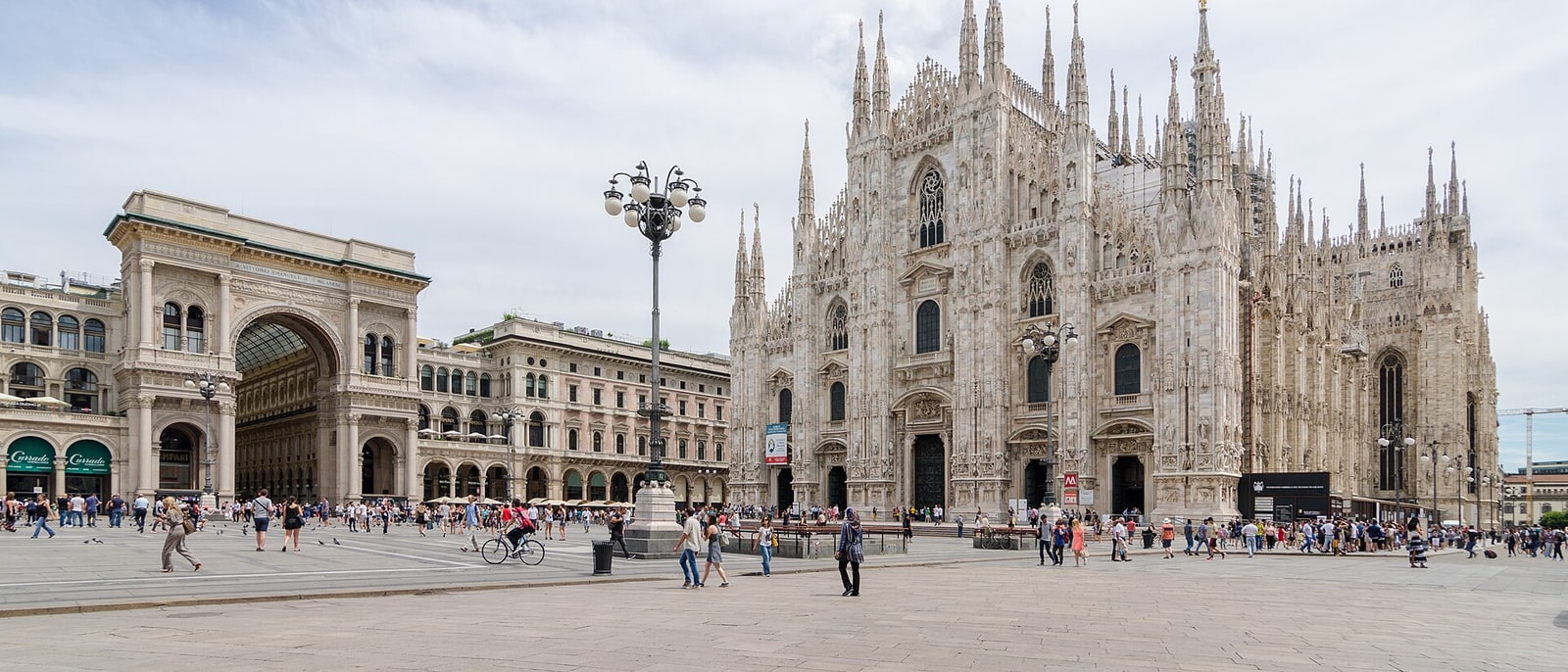
And that’s the key to the city: Milan isn’t Rome or Florence, it has no frozen historic centre, and what it has it has made and remade as it suited. It’s the Italian city that works, the one bombed harder than any other in the north, the one that rebuilt at speed, and the one that invented the aperitivo so it wouldn’t have to cook dinner. You see it in a day and it fools you: there’s more than there looks.
The route, stop by stop
5 STOPS- 01
The Duomo
The Duomo carries more statues than any other cathedral in the world: around three thousand four hundred, plus a hundred and thirty-five spires and two thousand two hundred gargoyles. And all of them are different. That excess is exactly the effect it was after: it was paid for by the city’s donations over six centuries and every donor wanted their own.
The marble is pink and comes from Candoglia, on Lake Maggiore, from a quarry Gian Galeazzo Visconti handed the cathedral in 1387, tax-free. The Veneranda Fabbrica del Duomo, the body that runs the works, still owns that quarry and still takes stone out of it today to repair what wears. It’s the same organisation, with the same marble, for over six hundred and thirty years.
Go up on the roof: it’s the best part and almost nobody does it.
- 02
The Last Supper
Leonardo painted it between 1495 and 1498 on the dining-hall wall of a convent, so the friars could eat looking at it. And he deliberately made the technical mistake that doomed it: he rejected fresco, which lasts centuries but forces you to paint fast on wet plaster, and used tempera on dry plaster, so he could correct. It began falling off within twenty years.
What keeps it here is a brutal piece of luck. In August 1943 Allied bombing destroyed the refectory: the roof and three of the four walls came down. The fourth, the Last Supper’s, had been protected with sandbags and scaffolding, and it held.
There are photographs of the painting in the open air, among rubble, with sky above it. It’s visited in groups of thirty-five every fifteen minutes and needs booking months ahead.
- 03
The Rondanini Pietà
In the Sforza Castle, in a big bare room, stands Michelangelo’s last sculpture. He began it, left it, took it up again nearly ten years later and instead of finishing it recarved over it, cutting into stone he had already cut and completely changing what he wanted to say. He was still at it six days before he died, at eighty-eight.
It’s unfinished and that’s what makes it enormous: you can see the arm from the earlier version hanging loose, a leftover of what it was, and the two figures merge into a single mass that resembles nothing in the Renaissance. It looks modern without meaning to.
It stands alone, no rope and no queue, ten minutes from the Duomo. It’s the most impressive thing in Milan and it’s on nobody’s top ten.
- 04
The Galleria Vittorio Emanuele II
From 1877, with an iron and glass vault, it links the Duomo to La Scala and it’s the oldest covered shopping arcade in the world still in operation. Milanese call it “il salotto”, the city’s sitting room, because it’s where people stayed when it was cold or raining, which in Milan is often.
The architect, Giuseppe Mengoni, fell off the scaffolding and died the day before it opened, in 1877.
Inside, in the central octagon, is the mosaic of Turin’s bull with a hole several centimetres deep worn by the heels of people spinning on it for luck. They repair it every few years and it comes back. It’s a silly fact and it’s one of the few traditions you can verify with your eyes.
- 05
The Cimitero Monumentale
Milan has an open-air sculpture museum, it’s free, it’s a walk from the centre, and almost nobody goes: the monumental cemetery. When the city got rich on industry, the families competed for the most spectacular mausoleum, and hired the best sculptors of each era for a century and a half.
The result is hectares of marble with Greek temples, pyramids, obelisks and a scale reproduction of the Last Supper in bronze. There’s art nouveau, there’s rationalism, there’s socialist realism. And there’s a plain monument in the middle, to the Milanese who died in the concentration camps, which is the best thing in the grounds.
You walk it in an hour, it costs nothing, and it’s one of the strangest and best things in the city.
Frequently asked
How long did Milan’s Duomo take to build?
Almost six hundred years: begun in 1386 and the last bronze door fitted in 1965. Gothic, the Renaissance and Napoleon, who ordered the façade finished because he wanted to be crowned inside, all passed through the site. In Milan, “fabbrica del Duomo” means a job that never ends, and it comes from here.
What is the Rondanini Pietà?
Michelangelo’s last sculpture, in the Sforza Castle: he recarved it over an earlier version and worked on it until six days before he died, at eighty-eight. It’s unfinished, an arm from the old version still hangs loose, and it looks modern without meaning to. No queue.
Where does the Duomo’s marble come from?
From the Candoglia quarry on Lake Maggiore, which Gian Galeazzo Visconti handed the cathedral in 1387, tax-free. The body that runs the works still owns it and still takes stone from it today for repairs: six hundred and thirty-odd years with the same quarry.