What to see in Venice
14 h route4 stopsBest: April to June and September to OctoberUpdated July 2026
Almost everything that looks decorative in Venice is in fact a technical solution to an odd problem: building a city on mud, with no drinking water, no firm ground and no horses. Looked at that way, the city becomes far more interesting.
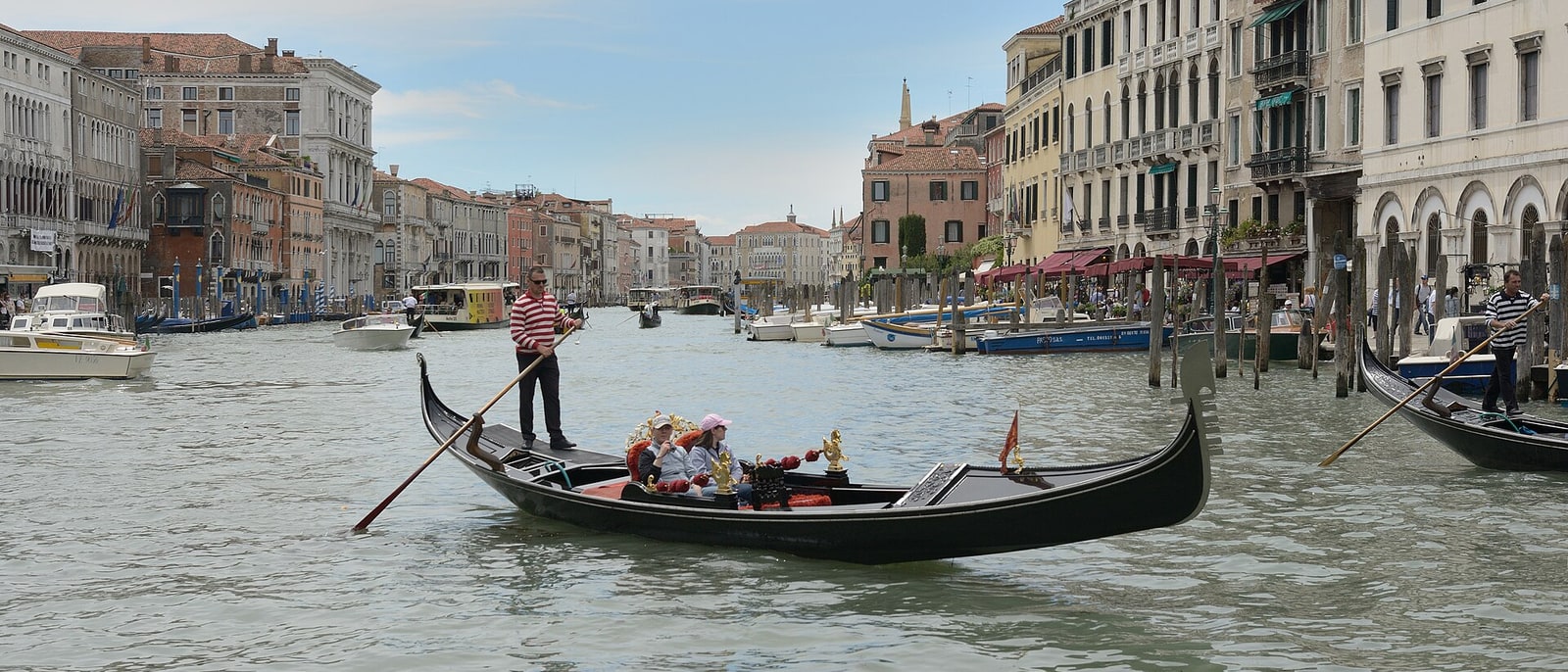
The gondola is the best example, and it isn’t what people think.
The route, stop by stop
4 STOPS- 01
The gondola, deliberately crooked
A gondola is about eleven metres long and built from eight different woods, each chosen for a property: oak, cherry, elm, lime. And the important part: it isn’t symmetrical. The left side is some twenty-four centimetres longer than the right, and the hull is deliberately tilted.
The reason is that the gondolier rows standing, always on the right side and with a single oar. A symmetrical boat would turn constantly. With the asymmetry, the oar’s force exactly cancels the drift and the boat runs straight. It’s naval engineering solved by eye over centuries.
Their all being black comes from a seventeenth-century sumptuary law: families competed by decorating them with gold and silk, and the Republic banned it. The toothed iron at the prow, the ferro, has six teeth forward for the six sestieri and one back for the Giudecca.
- 02
Acqua alta and the MOSE
Acqua alta doesn’t flood Venice: the tide rises above street level when moon, sirocco wind and low pressure line up. It happens mostly between October and January, lasts a few hours and goes down by itself.
When it’s forecast a siren sounds, with tones indicating how many centimetres are expected, and the council sets up raised walkways along the main routes.
Since 2020 the MOSE has been operational, a system of mobile gates installed on the bed of the three mouths where the lagoon meets the Adriatic. When a high tide is forecast they fill with air, rise and seal the lagoon off from the sea. It has already prevented major floods, though its maintenance and cost remain matters of argument.
- 03
The Scuola Grande di San Rocco
The Venetian scuole were lay confraternities of mutual aid, and San Rocco’s commissioned Tintoretto in 1564 to decorate its entire building. He worked on it for more than twenty years and left over fifty canvases still exactly where he placed them, never having passed through a museum.
The upper hall, with its whole ceiling painted, has you looking up until your neck aches. Hand mirrors are provided so you can see it without breaking yourself.
It has been called the Sistine Chapel of Venice and, unlike the other one, there’s almost never a queue. It’s probably the most impressive thing in the city after St Mark’s.
- 04
The Biennale and the Arsenale
The Arsenale outsized every industrial complex in Europe before the Industrial Revolution: at its peak it employed thousands and ran on an assembly line, the hull moved along a canal and at each station a part was added, capable of finishing a galley in a day. Venice showed it to foreign embassies as a demonstration of power.
Today much of the site hosts the Biennale, which alternates art and architecture in successive years and also occupies the national pavilions in the Giardini.
Outside Biennale season the Arsenale is only partly visitable, but it’s worth walking around it: the land gate, from 1460, with stone lions brought from Greece, one of them carved with runic inscriptions by Scandinavian mercenaries in the eleventh century.
Frequently asked
Why are gondolas black and crooked?
Black because of a seventeenth-century sumptuary law banning decoration, since families were competing with gold and silk. And asymmetric by engineering: the left side is some twenty-four centimetres longer to offset the gondolier rowing standing on the right with a single oar, so the boat runs straight.
What is acqua alta and when does it happen?
The tide rising above street level, mostly between October and January, under certain combinations of moon, wind and pressure. It lasts a few hours and recedes by itself. A siren warns and walkways are set up. Since 2020 the MOSE has been working, mobile gates that seal the lagoon from the sea when it’s forecast.