OZU /MEXICO /MEXICO CITY /GUIDE
Mexico City in a day
9 h route4 stopsBest: March to May and October to NovemberUpdated July 2026
Mexico City is read in layers, and they’re all stacked in the same place: below is Tenochtitlan, the Aztec capital founded in 1325 on an island in Lake Texcoco, above it, the colonial city the Spanish built from the stones of the previous one, and on top of everything, today’s megacity. In the historic centre you see all three at once without leaving one square.
A day covers that square and its surroundings, unhurried. The rest (Chapultepec, Coyoacán, Xochimilco) is far away and asks for a day of its own.
The route, stop by stop
4 STOPS- 01
The Zócalo and the Cathedral
The Plaza de la Constitución, which everyone calls the Zócalo, is one of the largest main squares in the world and sits exactly on the ceremonial centre of Tenochtitlan. The Spanish didn’t choose the spot by chance: building on top was how you made clear who was in charge.
The Metropolitan Cathedral went up over nearly two and a half centuries using stone taken from the Aztec temples, and it’s visibly tilted: like the whole city, it sinks, and the ground gives way unevenly. Inside there’s a hanging plumb line that proves it.
Enormous subsoil works have been needed to stabilise it and you still feel the slope walking around inside.
- 02
The Templo Mayor
In February 1978, electricity company workers digging a trench behind the cathedral hit a monolith over three metres across: the goddess Coyolxauhqui, dismembered, carved on a stone disc.
It lay right at the foot of the Templo Mayor, the Aztecs’ double temple, which until then was known to be around there but not exactly where.
They decided to demolish the buildings above and excavate. Today you cross the site on walkways, seeing the seven superimposed building phases, each ruler enlarged the temple by wrapping the previous one, and the museum beside it holds what was found, the Coyolxauhqui included, and an enormous quantity of offerings.
- 03
The Palacio Nacional and Rivera’s murals
The Palacio Nacional occupies the east side of the Zócalo, on what was Moctezuma’s palace. What you come for is on the main staircase: the mural Diego Rivera painted between 1929 and 1935, the history of Mexico from the pre-Hispanic world to twentieth-century class struggle, all in one gigantic composition.
It isn’t decoration: Rivera put in identifiable portraits, explicit propaganda and his own political reading of every episode.
The courtyard corridors continue with panels on indigenous life before the conquest. Check access conditions beforehand, as it’s a seat of government and they change.
- 04
Bellas Artes and the Alameda
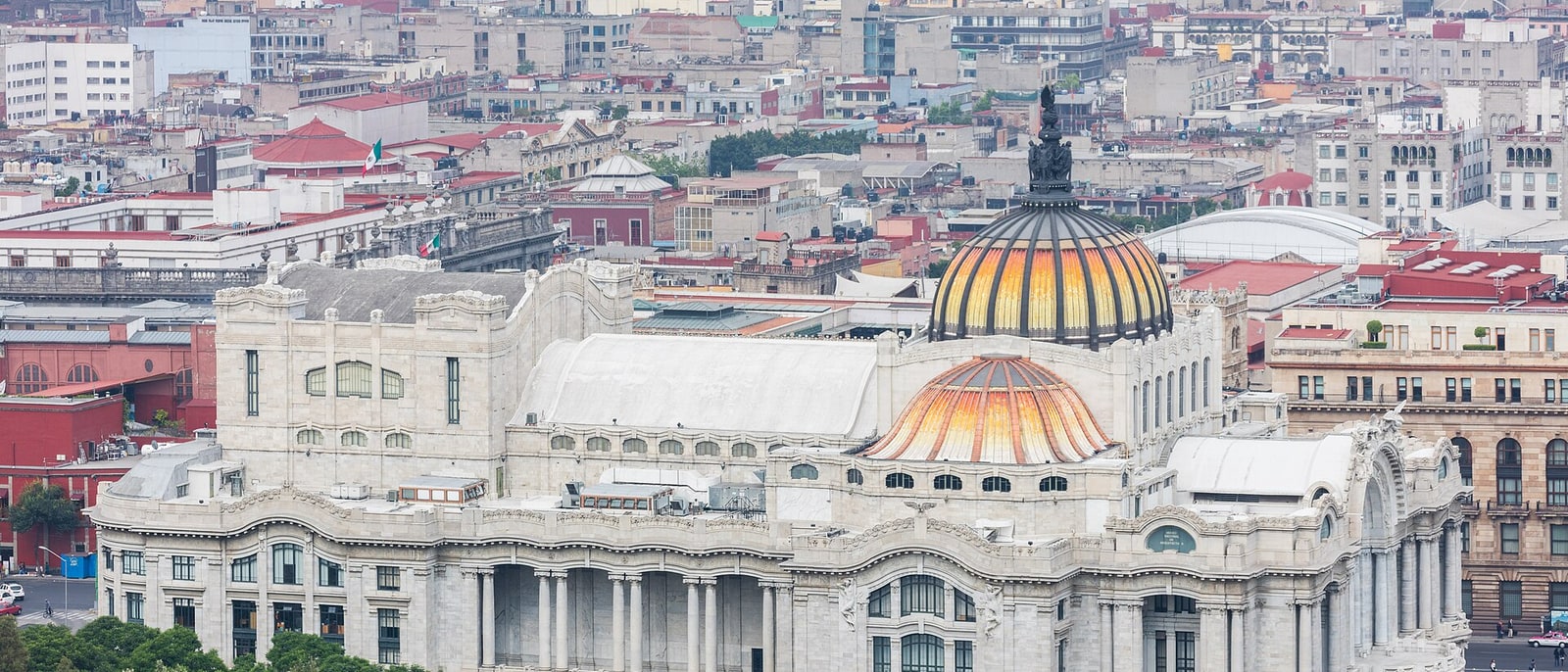
The Palacio de Bellas Artes was begun in 1904 in Carrara marble and weighed so much for ground that is lake mud that it began sinking during construction. Work stopped, was rethought, and it wasn’t finished until 1934, art deco inside by then. It has dropped several metres: you can tell because the entrance sits below street level.
Inside is the glass curtain made by Tiffany of New York from nearly a million pieces, depicting the Popocatépetl and Iztaccíhuatl volcanoes, plus murals by Rivera, Orozco and Siqueiros.
Opposite, the Alameda Central is the oldest public park in the Americas, from 1592.
Frequently asked
Why is Mexico City sinking?
Because it’s built on the bed of a drained lake, and for decades water has been pumped from below, compacting the clay ground. The city drops several centimetres a year and unevenly, which is why there are visibly tilted colonial buildings, like the cathedral or Bellas Artes.
How was the Templo Mayor discovered?
By accident, in February 1978: electricity company workers digging a trench behind the cathedral found the monolith of the goddess Coyolxauhqui. The buildings above were demolished and the Aztec double temple excavated. Today it’s visited with a museum of its own.