OZU /MEXICO /MEXICO CITY /GUIDE
What to see in Mexico City
14 h route4 stopsBest: March to May and October to NovemberUpdated July 2026
The Zócalo and its surroundings are the starting point, but the city has two things that set it apart from any other American capital: muralism, which was state policy for telling history to a largely illiterate country, and the scale of the pre-Hispanic, which keeps turning up underneath.
And then there’s what almost nobody visits and is among the best of it: a university campus built in the fifties that is UNESCO-listed in its entirety.
The route, stop by stop
4 STOPS- 01
Muralism, and where to see it
After the Revolution, the education minister José Vasconcelos commissioned painters to fill public buildings with murals: the country was largely illiterate and the idea was to tell national history on the walls, where reading wasn’t needed.
Out of that came the most important movement in twentieth-century Mexican art.
The big three were Rivera, Orozco and Siqueiros, and you see them free or nearly: in the Palacio Nacional, in the old Colegio de San Ildefonso, where it all began, in the Ministry of Public Education, which has over a hundred Rivera panels in its courtyards, and in Bellas Artes.
- 02
The University City (UNAM)
The University City was built between 1949 and 1952 on a field of volcanic lava south of the city, and has been UNESCO-listed since 2007 as an example of twentieth-century modernism. Over sixty architects took part, along with artists.
What you come for is the Central Library: a box-tower whose four façades are covered by a mosaic mural of natural stone by Juan O’Gorman, made from coloured stones gathered across the country, with no paint. It tells Mexico’s history on each face.
Beside it is the Espacio Escultórico, a ring of concrete blocks set on the lava, among the strangest and most beautiful things in the city.
- 03
The Basilica of Guadalupe
On the Tepeyac hill, to the north, stands the basilica of Santa María de Guadalupe, which receives millions of pilgrims a year and is the most visited Catholic shrine in the world after the Vatican. On 12 December several million arrive within a few days.
There are two churches: the old one, from the eighteenth century, so sunken and tilted it had to be closed and propped. And the new one, from 1976, circular, by Pedro Ramírez Vázquez, the same architect as the Anthropology Museum, designed so ten thousand people can see the altar at once.
The cloak bearing the image is behind the altar, above moving walkways that carry people past without stopping.
- 04
Lucha libre
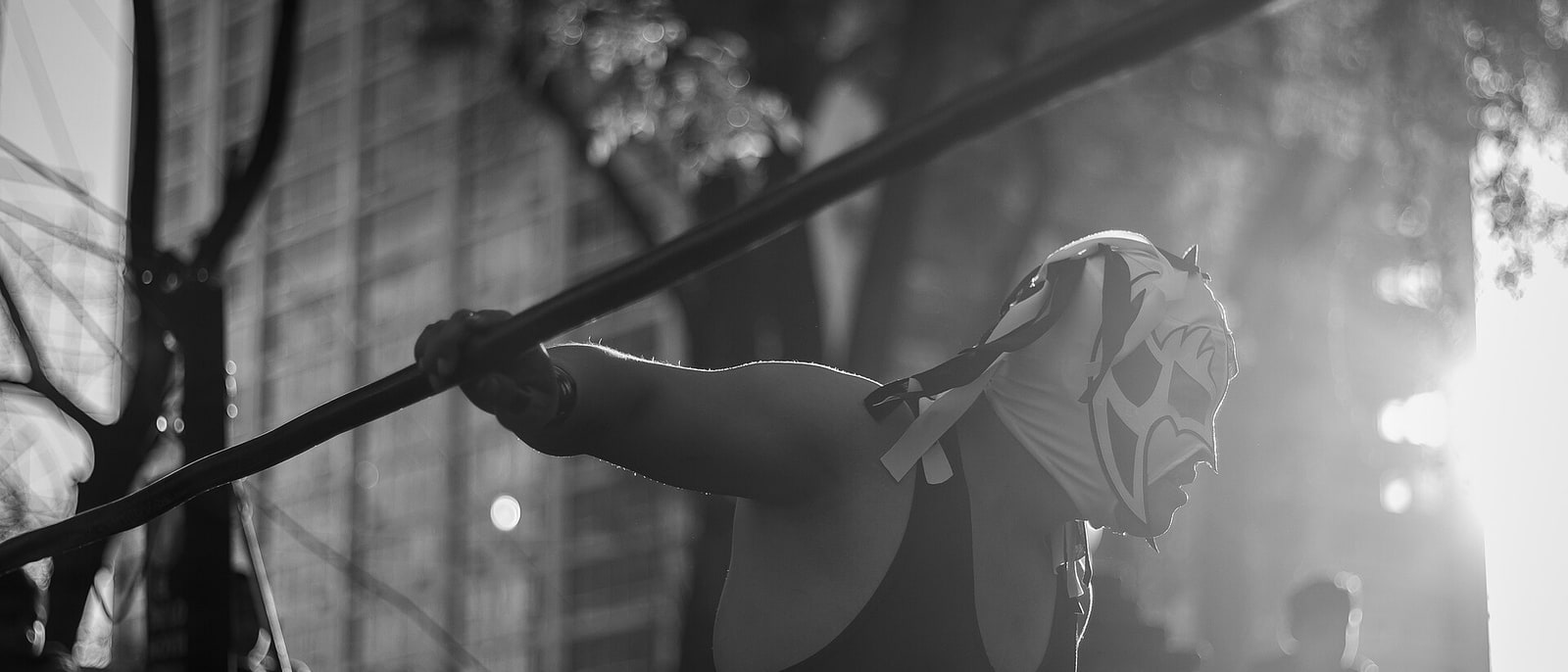
Mexican lucha libre has nothing to do with American wrestling: it follows its own tradition, with masked fighters whose real identity can stay hidden for an entire career, and a clear moral division between técnicos, who fight clean, and rudos, who cheat.
The most serious thing that can happen in a bout is a wager match: the loser removes the mask in public and states his real name, and never wears it again. It’s a moment with genuine weight, not a scripted trick.
You see it at the Arena México and the Arena Coliseo, and it’s a family show and hugely popular.
Frequently asked
Where do you see Diego Rivera’s murals in Mexico City?
On the Palacio Nacional staircase, with Mexican history in a single composition, in the courtyards of the Ministry of Public Education, with over a hundred panels, at the Colegio de San Ildefonso, where muralism began, and in Bellas Artes. Several are free or very cheap to enter.
Is lucha libre worth going to?
Very much, and it’s a cheap family outing. The Arena México is the main venue. It has rules of its own: técnicos against rudos, masks that hide the fighter’s real identity, and wager bouts where the loser unmasks in public and never wears one again.