OZU /MEXICO /MEXICO CITY /GUIDE
A weekend in Mexico City
20 h route4 stopsBest: March to May and October to NovemberUpdated July 2026
Saturday morning is Chapultepec, because that’s where the National Museum of Anthropology is, one of the world’s great museums of its kind, and it explains everything you’ll see afterwards. Going before rather than after changes the whole trip.
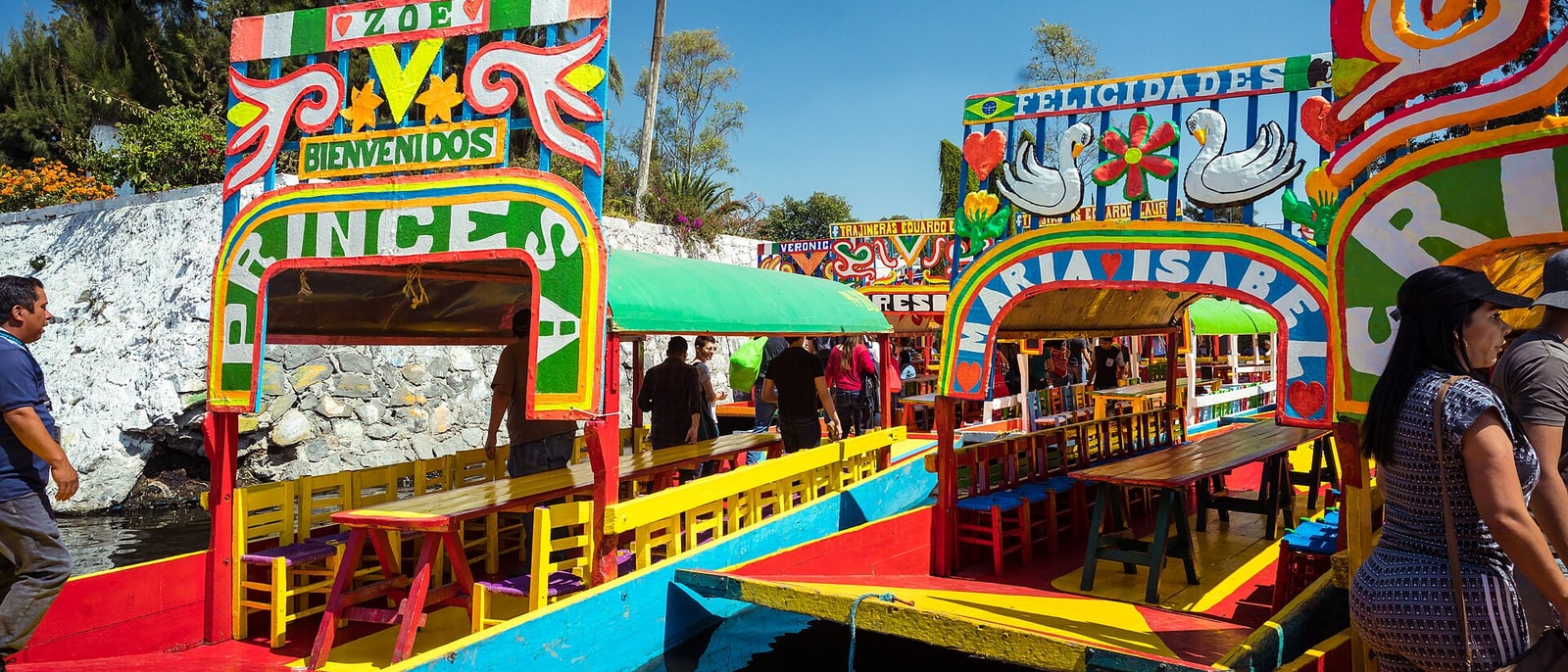
Sunday leaves the centre: Coyoacán, with Frida Kahlo’s house, and if there’s energy left, the canals of Xochimilco, the last remnant of the lake the city was built on.
The route, stop by stop
4 STOPS- 01
Saturday: the National Museum of Anthropology
Opened in 1964 and organised by culture: Mexica, Maya, Olmec, Teotihuacan, Zapotec, plus a whole floor devoted to today’s indigenous peoples. The most famous piece is the Sun Stone, the Mexica disc over three metres across and twenty-five tonnes that almost everyone wrongly calls the “Aztec calendar”. The central courtyard has an enormous umbrella-shaped fountain, held up by a single sculpted column, with a curtain of water falling from it. A couple of hours covers the essentials. Seeing all of it takes two visits and good legs.
- 02
Saturday afternoon: Chapultepec Castle
Few urban parks in the Americas match Chapultepec, and on top of its hill stands the castle, which began as a viceregal retreat and ended up an imperial residence: Maximilian of Habsburg and Carlota lived here between 1864 and 1867, in the very brief Second Mexican Empire that ended with Maximilian shot.
Today it’s the National History Museum, with the imperial rooms preserved, carriages, murals by Siqueiros and O’Gorman, and a terrace looking down the Paseo de la Reforma. You walk up a long slope to reach it.
- 03
Sunday: Coyoacán and the Casa Azul
Coyoacán worked as a separate village and still looks like one: tree-filled squares, low coloured houses, a market with tostada stalls and a Sunday atmosphere unlike anywhere else in the city.
There stands the Casa Azul, where Frida Kahlo was born, lived with Diego Rivera and died. It’s kept as it was: the studio, the bed with the mirror in its canopy fitted so she could paint herself while recovering, the painted orthopaedic corsets. One important practical warning: tickets sell out and must be bought online days ahead. Turning up without one almost always means not getting in.
A few streets away is the house where Leon Trotsky lived and was murdered in 1940, also a museum, with the bullet holes from the first attempt still in the wall.
- 04
Sunday afternoon: Xochimilco
Xochimilco keeps the last navigable stretch of the lake system, UNESCO-listed, and you travel it by trajinera, those flat brightly painted barges pushed along by a poler. Mariachis go from boat to boat and whole families eat on board: on Sundays it’s a floating party.
What matters isn’t the party but what you see from the water: the chinampas, artificial plots the Aztecs built by driving in stakes and piling up mud from the bottom, and which are still farmed.
It’s six-hundred-year-old agriculture, working.
Frequently asked
Do you need to book for Frida Kahlo’s Casa Azul?
Yes, and in advance. Tickets are bought online and sell out days ahead, especially at weekends. Turning up at the door without one usually means not getting in. It’s the commonest mistake of anyone visiting Coyoacán unplanned.
What are the chinampas of Xochimilco?
Artificial plots built over the water by the Aztecs, driving in stakes and piling up mud from the lake bed until fertile fields formed. They’re still farmed today and are why Xochimilco is UNESCO-listed, beyond the colourful barges.