OZU /MONTENEGRO /PODGORICA /GUIDE
Podgorica in a day
6 h route4 stopsBest: Spring or autumn. In July and August this is genuinely an ovenUpdated July 2026
For forty-six years this city wasn’t called Podgorica. It was Titograd, from 1946 to 1992, and the name wasn’t decorative: it described fairly accurately what had happened. In the Second World War Podgorica was destroyed by the Allied bombing of 1944, and what went up on top was a new socialist capital, of blocks and wide avenues, built fast on an empty site.
That explains the first impression, which is usually disappointment: there’s no old town worth hours of wandering, because it wasn’t left standing. What there is instead is a concrete city with two rivers running through it, a pine-covered hill in the middle and a few Ottoman remains that survived by being on the other side of the water. A day here isn’t a day of monuments. It’s a day of understanding how a European capital can have no visible past.
The route, stop by stop
4 STOPS- 01
Stara Varoš
Podgorica’s old town fits into an hour’s walk, and that alone tells you what happened here. It’s the Ottoman quarter, east of the Ribnica river, with narrow crooked streets, some low houses and two mosques. It survived by a miracle and by geography: it sat apart from the centre the planes were aiming at.
The quarter’s symbol is the Sahat Kula, the clock tower, eighteenth century, planted in a small square. It isn’t spectacular and doesn’t try to be, but it’s one of the very few things in the capital that was here before the war. That’s what orients you: for centuries Podgorica was an Ottoman frontier town, and all that remains of it is this tower, a couple of mosques and a few streets.
The rest was swept away in a few months of 1944.
- 02
The Cathedral of the Resurrection
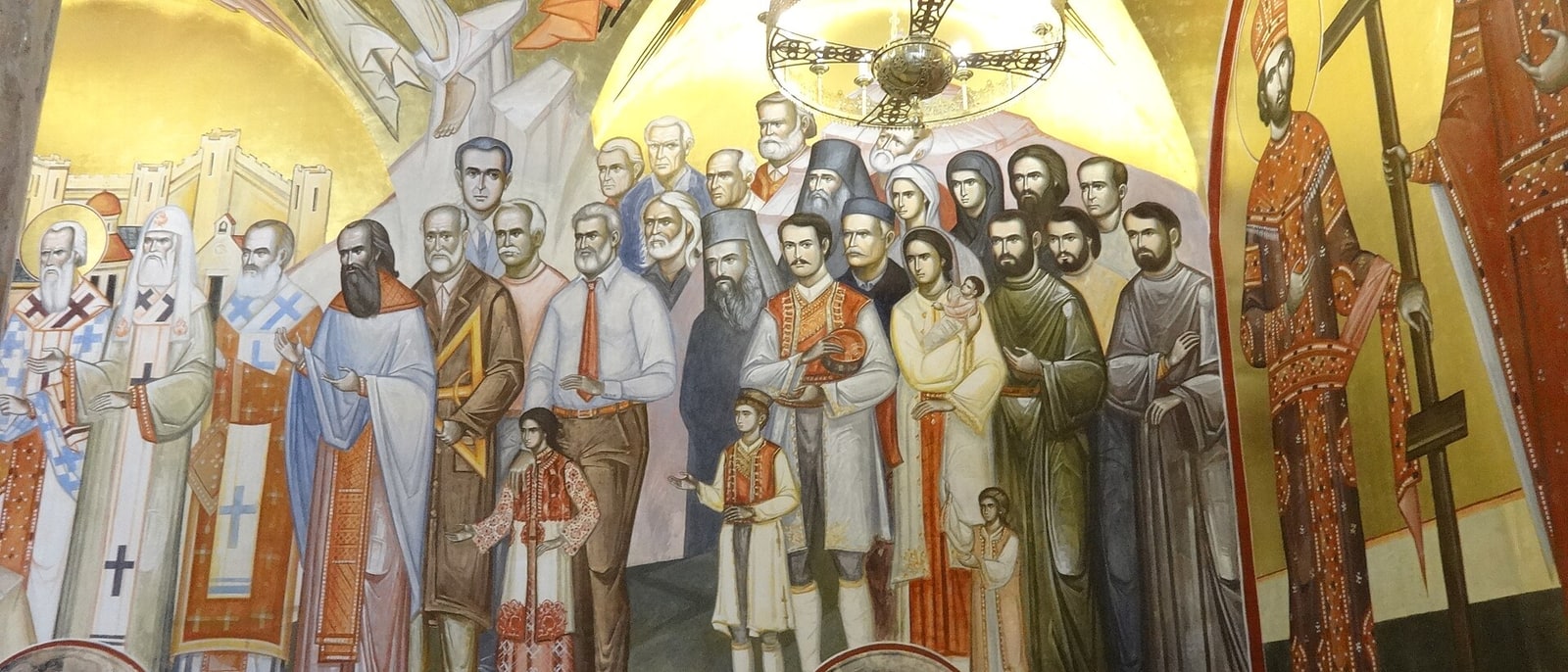
A vast new Orthodox cathedral, consecrated in 2014, with two bell towers and an interior covered in frescoes done the traditional way. You can go in and most people do, look up for ten minutes and leave. The whole visit is in one detail almost nobody looks for.
In the Last Judgement fresco, among the damned, Tito, Marx and Engels are painted burning in hell. It isn’t an urban legend or an interpretation: they’re there, identifiable, and when the church was consecrated it caused considerable controversy inside and outside the country.
Think about what that means: the city was called Titograd for nearly half a century and in its new cathedral they painted Tito in hell. That fresco tells this country’s politics better than any museum.
- 03
Gorica hill
The city’s name comes from here, literally: Podgorica means “under the Gorica”, and the Gorica is this small pine-covered hill planted in the middle of the urban fabric. It’s the answer to the question of what to do in Podgorica once you’ve seen the four monuments: go up.
It’s a forest park with paths, and from the top you understand the city at a glance: the grid of the new centre, the blocks to the west, the two rivers and, behind, the mountains that make this place an oven in summer, because Podgorica sits in a hollow. At the top there’s a Second World War partisan memorial. The climb is short, the shade is welcome and in the evening it’s full of locals running, which is itself a fact: it’s the city’s park, not an attraction.
- 04
The two rivers and the Millennium Bridge
Podgorica has two rivers, the Morača and the Ribnica, and they meet inside the city. That confluence is the original site: there you’ll find the remains of the Ribnica fortress and an old stone bridge, still crossing the water without going anywhere in particular. That bridge and the clock tower are almost all that’s left of the earlier Podgorica.
A little further on is the Millennium Bridge, from 2005, a white cable-stayed span that’s what the city puts on postcards and what gets lit at night. The comparison is the whole story in two kilometres of river: a stone bridge nobody can date precisely and another from twenty years ago that’s already the capital’s symbol.
In summer, besides, the Morača bank is where people get in to swim, because the water comes down cold from the mountains and at forty degrees that isn’t an anecdote.
Frequently asked
Is Podgorica worth stopping in?
For a day, yes. For three, no. The city was destroyed in the 1944 bombing and rebuilt as a socialist capital under the name Titograd, so there’s barely an old town: what remains is the Ottoman quarter of Stara Varoš with its eighteenth-century clock tower, Gorica hill and the two rivers. Its real value is as a base: the whole country fits into day trips from here.
Why was it called Titograd?
Because in 1946, after the Allied bombing of 1944 left the city flat, Yugoslavia rebuilt it as the capital of the republic of Montenegro and renamed it after Tito. It was Titograd until 1992, when it took back the name Podgorica. The curious part is that the new cathedral, consecrated in 2014, has a fresco painting Tito burning in hell.