OZU /MONTENEGRO /PODGORICA /GUIDE
Day trips from Podgorica
10 h route4 stopsBest: May, June, September. In August the coast jams solidUpdated July 2026
Almost nobody comes to Podgorica to see Podgorica, and there’s no need to pretend otherwise. You come because the airport is here, because it’s cheap and because from here you reach everything. That’s its function and it does it well: it’s the only European capital that works better as a base camp than as a destination.
The reason is the size of the country. Montenegro is under fourteen thousand square kilometres, and from Podgorica it’s an hour and a half to the Bay of Kotor, half an hour to the lake, forty minutes to the old royal capital, an hour to the monastery set into a cliff and about two and a half hours to Europe’s deepest canyon. All of those are day trips, with no night away. There are whole countries that fit inside a morning’s radius of here, and this is the only one of them that is also a country.
The route, stop by stop
4 STOPS- 01
Kotor
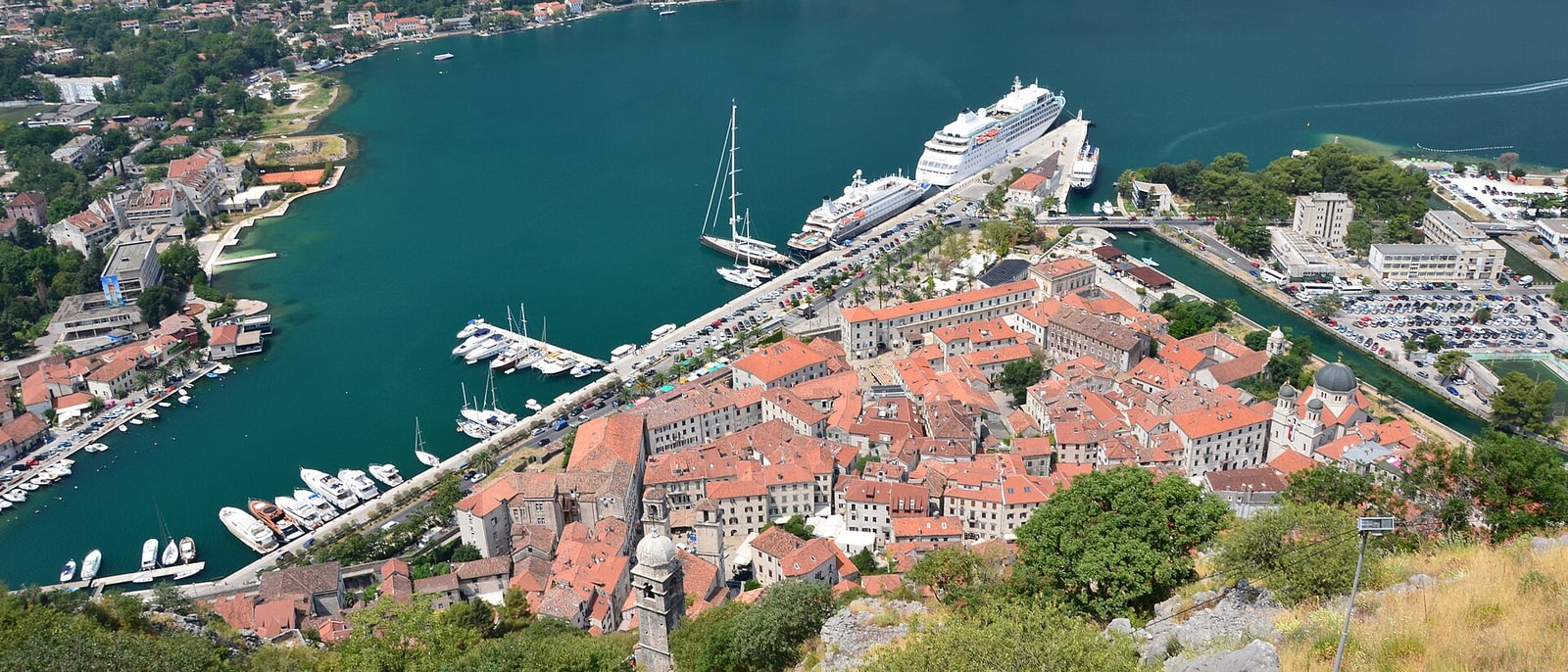
The Bay of Kotor explains why most people end up in Montenegro: a long crooked arm of sea, with mountains dropping sheer into the water and a walled medieval town at the far end. It’s a World Heritage Site and in summer it’s packed, which has to be accepted before you go.
Let’s dismantle the cliché first: it isn’t a fjord. It’s said and written constantly, but a fjord is carved by a glacier and no glacier carved this. It’s a ria, a river valley drowned by the sea, completely different geology with a superficial resemblance. Inside the walls, what to do is climb to the fortress of Saint John: over thirteen hundred steps hung off the cliff, and from the top you see the whole bay.
Go early and with water. At midday in August that climb is a bad idea with a view.
- 02
Ostrog monastery
An hour from the capital there’s a white monastery wedged inside a vertical cliff, nine hundred metres up. It isn’t beside the rock or leaning on it: it’s set into the wall, using two caves, which is why it only has a façade. The rest of the building is mountain.
It was founded in the seventeenth century and holds the relics of Saint Basil of Ostrog, making it the main pilgrimage site in this part of the Balkans: Orthodox believers come, but so do Catholics and Muslims, which is uncommon and worth pointing out. Some pilgrims climb the last kilometres barefoot.
The access road is narrow with tight bends, and on major feast days it fills to the point where it’s better to park below and walk up. It’s the most impressive trip you can make from Podgorica, and it isn’t on the sea.
- 03
Lake Skadar
The largest lake in southern Europe is half an hour from the capital and two countries share it: the Albanian border splits it down the middle. It’s protected wetland and one of the continent’s most important bird areas, with the Dalmatian pelican as the star, a huge bird in trouble almost everywhere.
The practical advantage almost nobody uses: the Podgorica-Bar train stops at Virpazar, the gateway village, so this trip can be done without a car and for very little money.
From there boats run through channels between water lilies and pull up at monasteries on islets.
And there’s a famous viewpoint, the horseshoe bend of the Crnojević river, which is the photo of Montenegro you’ve seen without knowing where it was. In summer the lake covers itself in flowering lilies. In spring and autumn there are more birds and less heat.
- 04
Cetinje and Lovćen
Cetinje served as the kingdom’s capital and keeps the official title of Old Royal Capital, though it has fifteen thousand inhabitants. It’s low, leafy and nineteenth-century: the opposite of Podgorica in every respect. What to see are the old embassies: when Montenegro was independent, the European powers planted their legations here, and those buildings still stand with their coats of arms, turned into schools and museums.
From there the road climbs Lovćen, the black mountain that probably gives the country its name, and at the top is the Njegoš mausoleum, the poet and prince-bishop this country treats as its founding figure. It’s at 1,657 metres and you reach it through a tunnel cut in the rock and 461 steps, which get counted because whoever climbs them counts. From the terrace you see half of Montenegro and, on a clear day, the coast.
And if you drop from there down to Kotor on the old road, the one with the hairpins stacked on the slope, the day becomes the best trip in the country.
Frequently asked
What day trips can you do from Podgorica?
Practically the whole country, because Montenegro is under fourteen thousand square kilometres: Lake Skadar half an hour away (by train, stopping at Virpazar), Cetinje and the Lovćen mausoleum forty minutes, Ostrog monastery an hour, Kotor and the bay an hour and a half, and the Tara canyon around two and a half hours. It all fits in a day and you come back to sleep here.
Is the Bay of Kotor a fjord?
No, though it gets repeated everywhere. A fjord is carved by a glacier, and there was none here: the Bay of Kotor is a ria, a river valley drowned by the sea. They look alike from a distance and the geology is different. That takes nothing away: it’s still the reason most people end up coming to Montenegro.