Lisbon in a day
9 h route5 stopsBest: March to June and September to OctoberUpdated July 2026
Lisbon fits into a day if you accept two things: that you’ll be climbing and descending slopes the whole time, and that Belém, with the monasteries and river towers, is for another moment, because it’s six kilometres off and eats half a day on its own. What does fit is the heart of it: the river, the Baixa rebuilt on a grid, and medieval Alfama climbing towards the castle.
The trick is to start low, by the water, and let the morning carry you upward. The descent, at the end of the day, gravity does for you.
The route, stop by stop
5 STOPS- 01
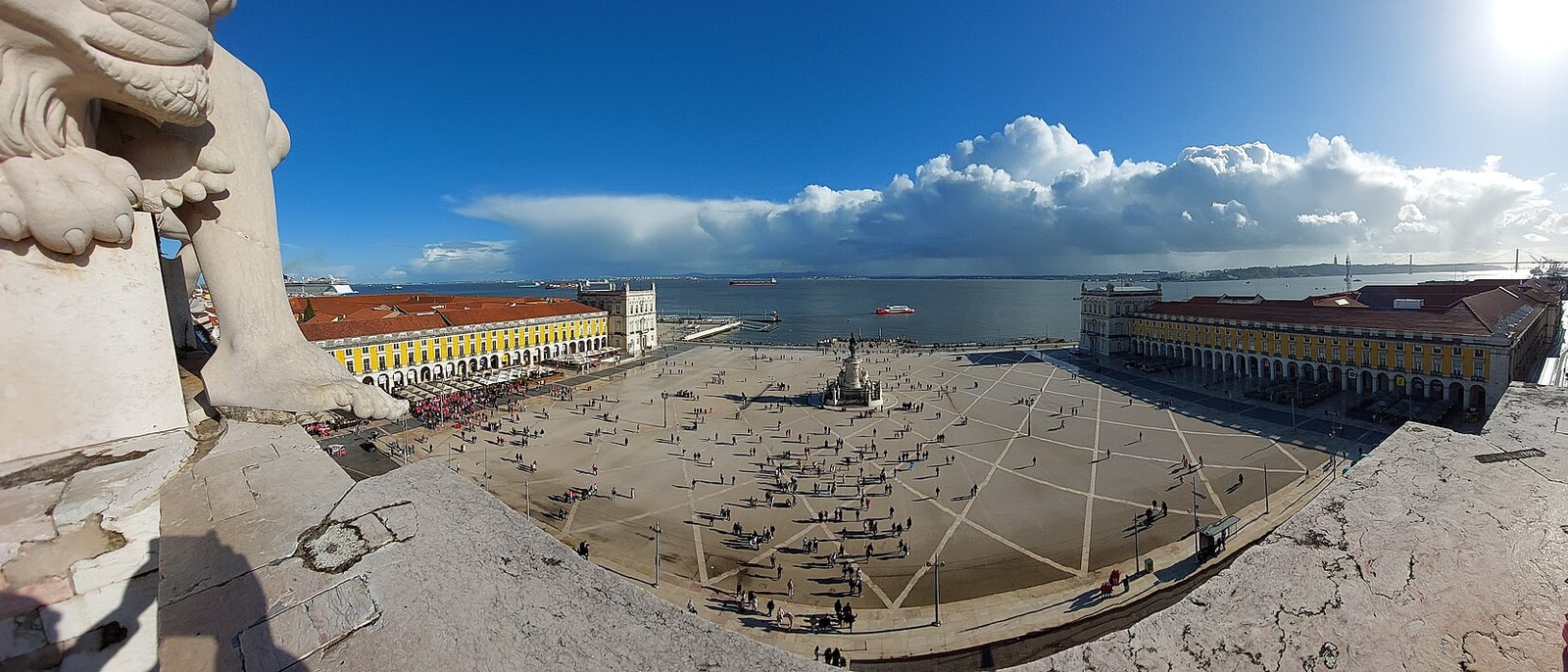
Praça do Comércio and the Baixa
This is where the Paço da Ribeira, the kings’ palace, stood until the 1755 earthquake and tsunami dropped it into the water.
In its place the Marquis of Pombal built an arcaded square open to the Tagus on three sides, with the equestrian statue of King José I in the middle and a triumphal arch at the far end opening onto Rua Augusta.
From there the Baixa begins, the district Pombal rebuilt from nothing on a grid of straight streets, when the rest of Europe was still making cities out of alleys. It’s flat, the one flat thing in Lisbon, and you cross it in ten minutes to the Rossio.
- 02
Chiado and the Santa Justa lift
The Santa Justa lift rises in wrought iron from 1902, wedged between buildings, with two wooden cabins that bridge the drop between the Baixa and Chiado. It’s often attributed to a pupil of Eiffel. In fact it was designed by the Portuguese engineer Raoul Mesnier du Ponsard, and the resemblance to Eiffel’s towers is a matter of period, not schooling.
At the top, next to the viewpoint, stand the ruins of the Carmo convent: a Gothic church that lost its roof in 1755 and was left that way, open to the sky, as a reminder.
The columns and arches still rise over nothing, and it’s one of the strangest and finest places in the city.
- 03
Alfama and the cathedral
Of pre-earthquake Lisbon, Alfama survived: a maze of alleys, stairs and courtyards spared because it sits on solid rock. The name comes from the Arabic al-hamma, “the springs”, and the layout is still that of the Muslim medina, impossible to follow with a map.
At the edge of the quarter is the Sé, the cathedral, begun in 1147 on the old mosque right after the crusaders took the city.
It’s low, massive and crowned with two battlemented towers: built as much to pray in as to withstand a siege.
- 04
Castelo de São Jorge and a viewpoint
The castle occupies the highest point of Alfama, where there was a Moorish fortress and, before it, a Roman one. Inside you pay for entry and for the walls you walk, with the whole city and the river at your feet. The peacocks roaming loose are the surprise nobody expects. If you’d rather not go in, the nearby miradouros (Portas do Sol, Santa Luzia) give almost the same view for free, with a café beside them. The picture of red roofs tumbling to the Tagus is taken there.
- 05
Tram 28, on the way back
Line 28 runs the wooden Remodelado trams from the 1930s, because they’re the only ones short and nimble enough for the curves and slopes of Alfama and Chiado. It isn’t an attraction staged for tourists: it’s real transport that happens to pass everything worth seeing.
It gets so full it’s become Lisbon’s prime pickpocketing ground, so wear the bag on your front.
And if the queue at the Martim Moniz terminus is long, it’s sometimes better to board at a stop further along.
Frequently asked
Can you see Lisbon in a day?
The centre, yes: the Baixa, Chiado, Alfama and the castle are walkable in a day, hills included. What doesn’t fit the same day is Belém, six kilometres off and asking for a half-day of its own. With only one day, choose between the centre and Belém.
Is the Santa Justa lift worth it?
For the view yes, but the queue for the cabin is usually long and pricey. The viewpoint at the top can be reached free and queue-free on foot from Chiado, via Largo do Carmo, taking in the convent ruins on the way. The cabin itself is a handsome but short 1902 lift.