From Beijing airport to the centre
3 stopsUpdated July 2026
Start with what will happen to you in the first ten minutes: the official taxi queue is outside the arrivals building and it’s signed in English. Anyone who approaches you inside the terminal offering a car is illegal and charges three to five times the fare. It isn’t a suspicion: it’s how it works, and it works because you’ve come off a ten-hour flight and someone speaks your language.
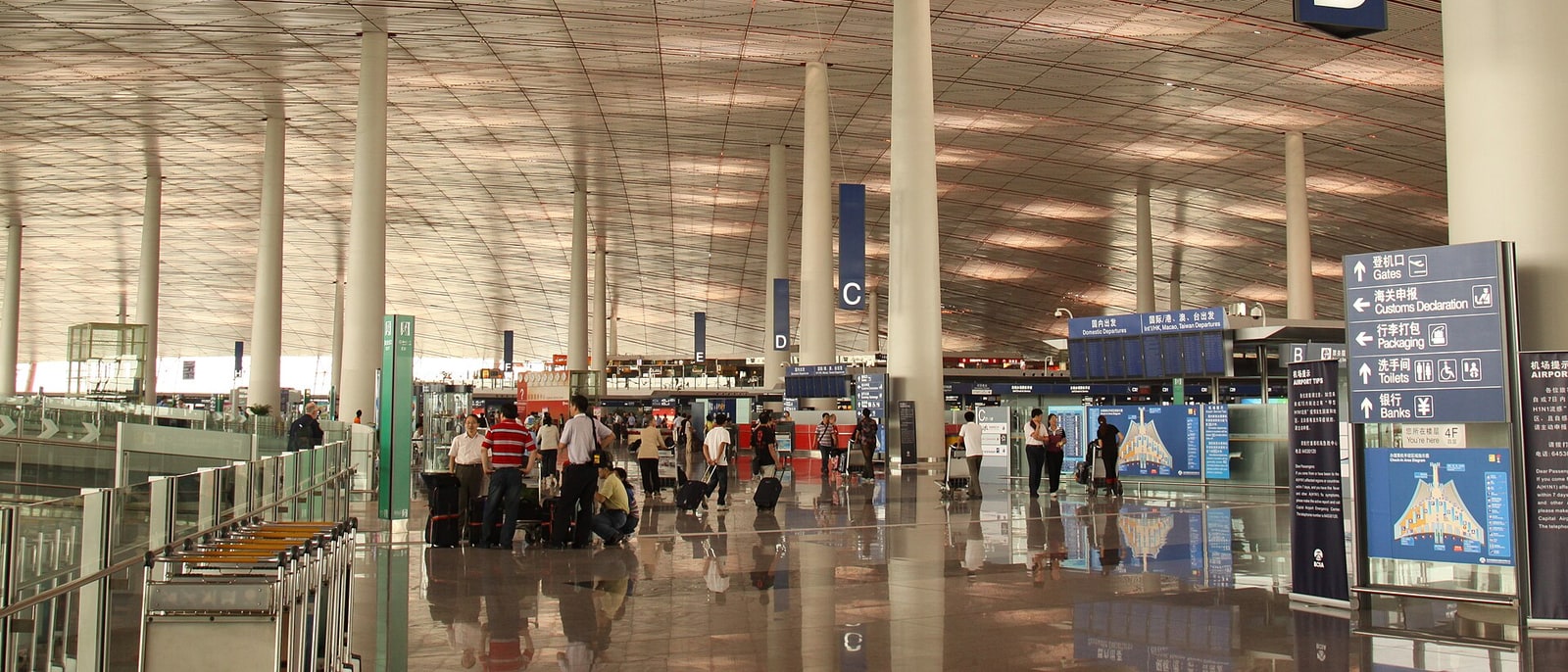
Second, and it also decides your arrival: carry your hotel’s address written in Chinese characters. Beijing’s drivers rarely read anything else, and the hotel’s English name means nothing to them. Take a screenshot before you leave home. And there’s an express train into the centre, which is the most comfortable option, with a timetable limit worth checking.
The route, stop by stop
3 STOPS- 01
The airport express
The Capital Airport Express leaves every ten minutes and runs a loop: it calls at both terminals and drops into the city, linking with the rest of the subway at Sanyuanqiao, on line 10, and Dongzhimen, on lines 2 and 13. From there the ordinary subway gets you anywhere. It’s clean, it’s fast and it’s cheap.
The limit is the timetable and it’s worth checking before you rely on it: it isn’t a twenty-four-hour service. The last ones leave the terminals around a quarter to eleven at night and the first around twenty past six in the morning, roughly.
If your flight lands later, the train isn’t there and the answer is the taxi queue. Better known before boarding than on landing.
- 02
The official taxi queue
Walk out of the arrivals building and look for the signed queue: it’s outside, there are signs in English and there’s a member of staff organising it. Official taxis have meters and use them, so there’s nothing to negotiate. It’s about twenty-five or thirty kilometres into the centre and between forty minutes and an hour depending on traffic, which in Beijing is a serious variable.
And here it is again, because it’s the advice on this page that saves the most money: never take anyone who approaches you inside the terminal. Those cars are illegal, they have no meter and they charge three to five times what an official one would.
The script is always the same: someone friendly, who speaks your language, telling you the queue is enormous or that the taxis don’t go to your hotel. It’s a lie. Go outside and join the line.
- 03
The address in Chinese, and the right app
Carry your hotel’s address written in Chinese characters, as a screenshot or on paper. It isn’t an over-cautious precaution: Beijing’s drivers rarely read the Latin alphabet and the hotel’s English trading name means nothing to them. With the characters, the ride resolves itself in silence and without trouble. Without them, it can be half an hour of gestures.
And a detail almost nobody knows that solves a lot: if you’d rather call a car on your phone, the app for foreigners is DiDi Rider, the international version, which works in English and takes foreign cards. Chinese DiDi is a different product, with a different registration, and it’s the one that will fail you.
At the airport, the pickup points for these cars are marked with the characters 网约车, which means exactly that.
Frequently asked
How do you get from Beijing airport to the centre?
On the Capital Airport Express, which leaves every ten minutes and links to the subway at Sanyuanqiao (line 10) and Dongzhimen (lines 2 and 13). It isn’t 24h, running roughly 06:20 to 22:50. Or from the official taxi queue, which is OUTSIDE the arrivals building and signed in English, with a meter.
Are taxis at Beijing airport safe?
The official ones, yes: they’re in the signed queue outside the building, they have meters and they use them. The ones who approach you inside the terminal are illegal and charge three to five times the fare. The script is always someone friendly who speaks your language telling you the queue is enormous. It’s a lie: go outside.
Does DiDi work in China for foreigners?
Yes, but with the right app: for foreigners it’s DiDi Rider, the international version, which works in English and takes foreign cards. Chinese DiDi is a different product with a different registration. At the airport, the pickup points are marked with the characters 网约车.