Beijing in a day
10 h route5 stopsBest: September and October: Beijing’s clear skies are an autumn thingUpdated July 2026
The Forbidden City sells out days ahead, has to be booked in your name with your passport number, and closes on Mondays. That isn’t advice, it’s the condition of entry: turning up at the gate doesn’t exist here. And once inside, the route is one-way: you enter from the south, you leave from the north, and you can’t double back. Plan accordingly.
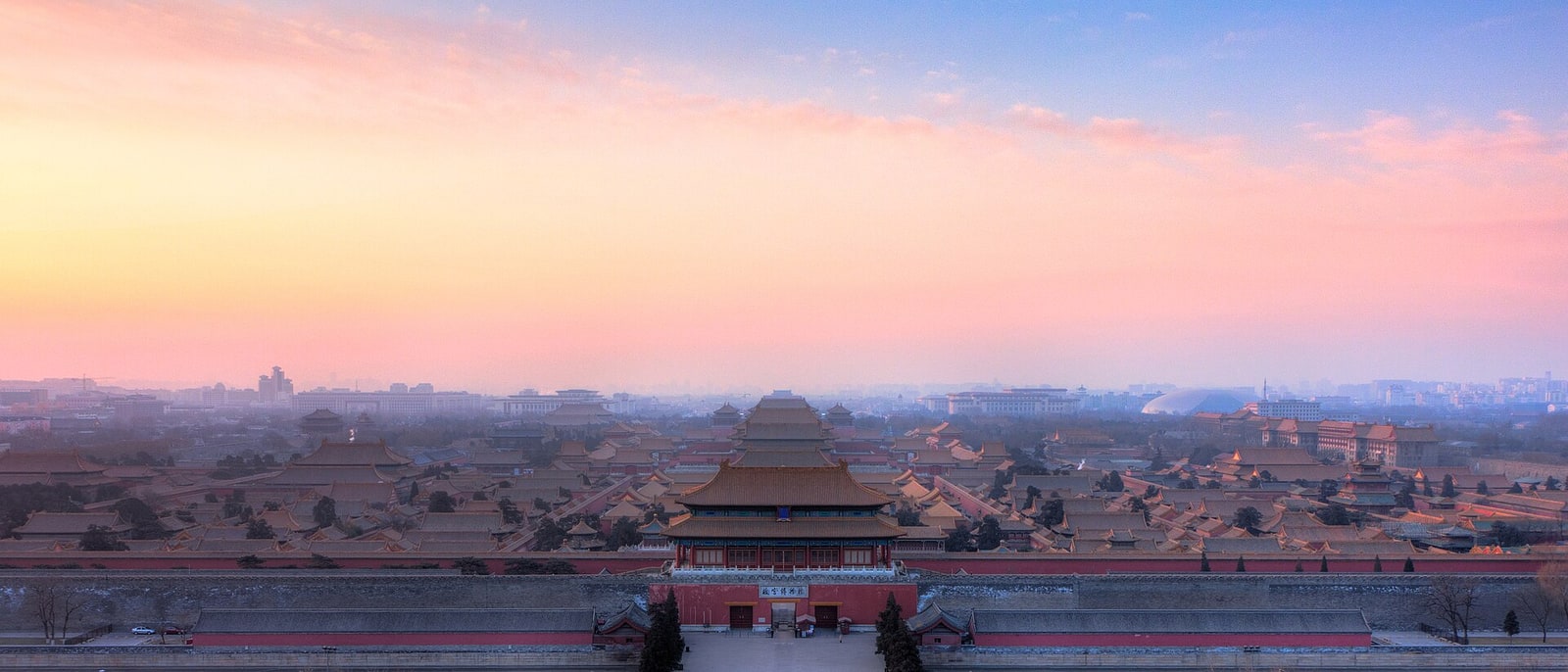
With that booked, the day sorts itself out because everything sits on the same axis. The whole of Beijing is laid out on a north-south line running through the middle of the Forbidden City, and the monuments hang off that line like beads on a string. You start at the bottom, at the Temple of Heaven, and work up. The city was designed this way six hundred years ago and it hasn’t changed.
The route, stop by stop
5 STOPS- 01
The Temple of Heaven at seven in the morning
The Hall of Prayer for Good Harvests is from 1420, it’s round, it has three stacked blue roofs and it’s built entirely of timber without a single nail: it’s all jointed. It burned down after a lightning strike in 1889 and was rebuilt identically, with the same techniques. The emperor came here once a year to ask for rain, and if the harvest failed, it was his fault.
But the real reason to come at seven in the morning isn’t the temple: it’s the park. Thousands of Beijing pensioners use it daily as their living room, and watching it is the best thing you can do in this city. There are tai chi groups, amateur orchestras, people singing opera at full volume, card games, ballroom dancing, and men writing calligraphy on the paving with a giant brush dipped in water, which evaporates in two minutes.
It isn’t for you. It’s been happening the same way for decades and you’re simply watching.
- 02
Tiananmen Square
Forty-four hectares of granite with no shade put it among the largest public squares in the world. To get in you have to book ahead and pass a security check with your passport in hand, and that isn’t negotiable or improvised. Count on a queue and on time.
The square is the axis everything hangs from: to the north, the Tiananmen gate with Mao’s portrait, which is the entrance to the Forbidden City, to the south, his mausoleum, on either side, two buildings from the fifties at a scale designed to flatten you.
Everything here is meant to make you feel small, and it works. It’s the place where you best see that Beijing wasn’t built for strolling, but for governing.
- 03
The Forbidden City
It was built between 1406 and 1420, fourteen years, with a million labourers, and it’s nine hundred and eighty buildings inside a three-and-a-half-kilometre wall ringed by a moat. Twenty-four emperors lived here across four hundred and ninety-two years, and for all that time an ordinary citizen couldn’t come in: hence the name.
Two practical points. One: the route is one-way, in through the Meridian Gate at the south and out at the north, and you can’t backtrack, if you miss something, you missed it.
Two: what you see is the courtyards and the palaces, not the treasures. The best of the imperial collection isn’t here: it was crated up in the thirties fleeing the war and ended up in Taipei, where it remains. Here is the container, the contents are seventeen hundred kilometres away.
- 04
Jingshan, the Coal Hill
Right outside the north gate there’s a forty-five-metre hill that isn’t natural: it’s made of the earth dug out of the Forbidden City’s moat. They put it there deliberately, to shield the palace from northern winds according to geomancy, and in passing solved where to put a million cubic metres of soil.
You climb it in fifteen minutes and it’s the only place from which you see the whole Forbidden City at once: a sea of golden roofs lined up along the axis, with the modern city behind. After three hours inside, looking down at it is when you understand what you just walked through.
And at the foot of the hill there’s a marker: this is where the last Ming emperor hanged himself from a tree in 1644, when the rebels entered the city.
- 05
A hutong at dusk
Hutongs, the alleys of low courtyard houses, were Beijing for centuries. In 1949 there were around three thousand. Today a few hundred remain, and the rest were demolished for avenues and towers. The ones left are protected, and walking one at dusk is the closest you get to seeing the city that existed before the city that exists.
One detail explains everything: notice how many public toilets there are, one every few metres. It isn’t a curiosity, it’s a necessity: the traditional houses have no bathroom, and their residents, who are elderly people who have lived there all their lives, still use the one on the street.
That detail is the difference between the tourist hutong of the shops and the real hutong, which is two streets further along and where someone is eating dinner in their doorway.
Frequently asked
Do you need to book for the Forbidden City?
Yes, and days ahead: the ticket is in your name, bought with your passport number, and it sells out. It closes on Mondays. And once inside the route is one-way: in from the south and out to the north, with no backtracking.
What to see in Beijing in a day?
The Temple of Heaven at seven in the morning (for the park, not the temple) Tiananmen, the Forbidden City, and Jingshan hill to see the whole thing from above. Plus a hutong at dusk. It’s all on the same north-south axis the city was laid out on six hundred years ago.
Where are the Forbidden City’s treasures?
The best of the imperial collection is in Taipei: it was crated up in the thirties to save it from the war and never came back. In Beijing you see the courtyards, the palaces and the architecture, which is nine hundred and eighty buildings raised between 1406 and 1420.