What to see in Beijing
5 stopsUpdated July 2026
Everything here faces south. Beijing didn’t grow, it was drawn: there’s a straight eight-kilometre axis running north to south through the exact centre of the Forbidden City, and everything that matters hangs off that line, facing south, because the emperor faced south. Around it, the city is a perfect grid oriented to the compass points.
That has a consequence that throws every foreigner: here people don’t say “turn left”, they say “go south”. Directions are given by compass point, street names have north or south built into them, and people orient themselves that way even inside a house. Once you understand the axis, Beijing stops being a giant chaos and becomes readable all at once.
The route, stop by stop
5 STOPS- 01
The Forbidden City
Nine hundred and eighty buildings, seventy-two hectares, a ten-metre wall and a fifty-two-metre moat. It went up between 1406 and 1420 with a million labourers, and the largest stone slabs, over a hundred tonnes, were brought seventy kilometres by dragging them in winter over ice roads made by wetting the route.
There was no other way and it worked.
Twenty-four emperors lived here across four hundred and ninety-two years and no ordinary citizen could cross the gate. You visit it one-way, south to north, and you book days ahead. What you won’t see is the treasures: the best of the collection was crated up fleeing the Japanese invasion in the thirties and ended up in Taipei. What’s left is the architecture and the scale, which are ninety per cent of the point.
- 02
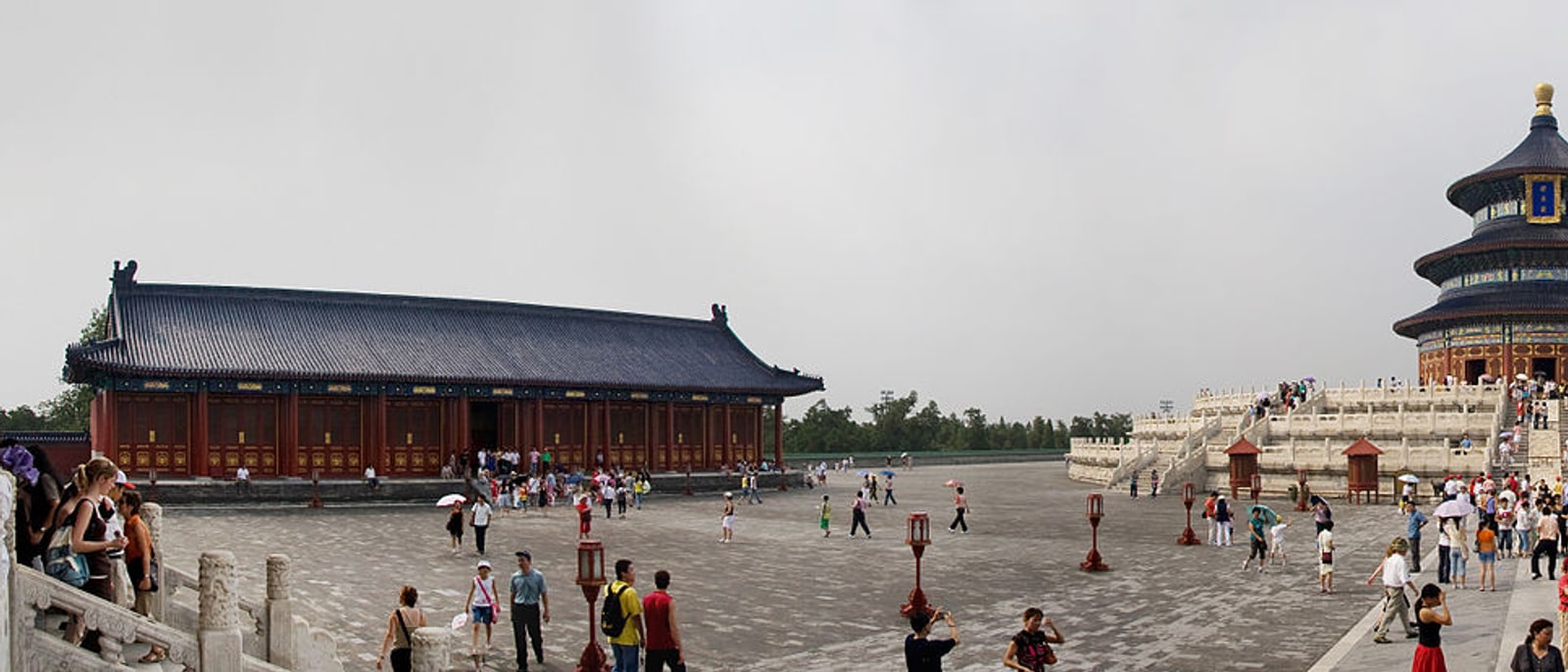
The Temple of Heaven
The round hall with the blue roofs dates from 1420, built entirely of jointed timber without a single nail, and it’s where the emperor came once a year to answer to heaven for the harvest. The roofs are blue because they represent the sky, and the whole compound is round on top and square below, because that’s how the world was thought to be.
There’s an acoustic toy almost nobody finds: the Echo Wall, a perfectly smooth circular wall where if you speak quietly against the stone, someone on the other side of the circle, sixty metres away, hears you. It genuinely works when there’s no noise, which today is difficult.
But the important thing about the place is still the seven-in-the-morning park, with thousands of pensioners doing tai chi, singing opera and writing calligraphy on the ground with water.
- 03
The hutongs
Hutong means alley, and along its sides are siheyuan: single-storey houses with the rooms arranged around a square courtyard, all facing the courtyard and none facing the street. That was the whole of Beijing. In 1949 there were around three thousand hutongs. A few hundred remain, because they were demolished in their thousands for avenues, towers and, in the fifties, to widen the axis.
The clue that tells a real hutong from one turned into a shopping street: the public toilets. Traditional houses have no bathroom, so there are communal lavatories every few metres and the neighbourhood’s older residents use them daily. Where you see that, people live. Where you only see cafés, they don’t any more.
And another clue: the steps and the stone drums at the doorways signalled the owner’s rank, so the street tells you who lived in each house.
- 04
The Summer Palace
Two hundred and ninety hectares, three quarters of it water: Kunming Lake was dug by hand and with the spoil they raised Longevity Hill behind it. It’s the largest surviving imperial garden and it’s where the emperors fled in summer, because the Forbidden City is a stone courtyard that at forty degrees is unbearable.
There’s a covered corridor seven hundred and twenty-eight metres long beside the lake with more than fourteen thousand scenes painted on its beams, none repeated: it was painted so the empress could walk on rainy days. And there’s the Marble Boat, which doesn’t sail and which Cixi rebuilt, according to popular accusation, with the money for modernising the navy. Six years later that navy was annihilated by Japan. In China that boat isn’t an anecdote: it’s a symbol.
- 05
The axis, and why it matters
Beijing’s central axis traces a straight line of almost eight kilometres running from the Drum Tower in the north to Yongding Gate in the south, through the exact centre of the Forbidden City and Tiananmen. It isn’t a pretty street: it’s the idea the city was built on, and it’s world heritage not for its buildings but for the alignment.
The logic is that the emperor was the centre of the world and faced south, so everything else was arranged around that line with obsessive symmetry: what stands to the east has its twin to the west. When the city walls were pulled down in the fifties to build the second ring road, the axis was respected. And when the Olympic park was built in 2008, it was placed on the axis’s extension, eight kilometres to the north.
Six hundred years on, the line still rules.
Frequently asked
What should you see in Beijing?
The Forbidden City (booked days ahead), the Temple of Heaven, above all its park first thing, a real hutong, the Summer Palace, and the Great Wall, which takes a whole day. Plus Jingshan hill, the only place you see the whole Forbidden City from.
Why do people in Beijing give directions by compass point?
Because the city didn’t grow, it was drawn: it’s a perfect grid oriented to the compass around a straight eight-kilometre axis running through the Forbidden City. Everything faces south because the emperor faced south. Nobody here says “turn left”, they say “go south”.
What is a hutong?
An alley of low courtyard houses, the siheyuan, which was how Beijing lived for centuries. In 1949 there were around three thousand and today a few hundred remain. To tell whether a hutong is still alive, look at the public toilets: traditional houses have none, and where they exist, people live.