Day trips from Beijing
4 stopsBest: Autumn, with clear skies. In winter the wall ices overUpdated July 2026
The wall isn’t one wall. It’s centuries of different walls, raised by different dynasties on different alignments over two thousand years: some of rammed earth that have all but vanished, some of brick still standing. The one in the photos, the one you visit, is the Ming of the fifteenth and sixteenth centuries, the last and best built, and even that isn’t complete.
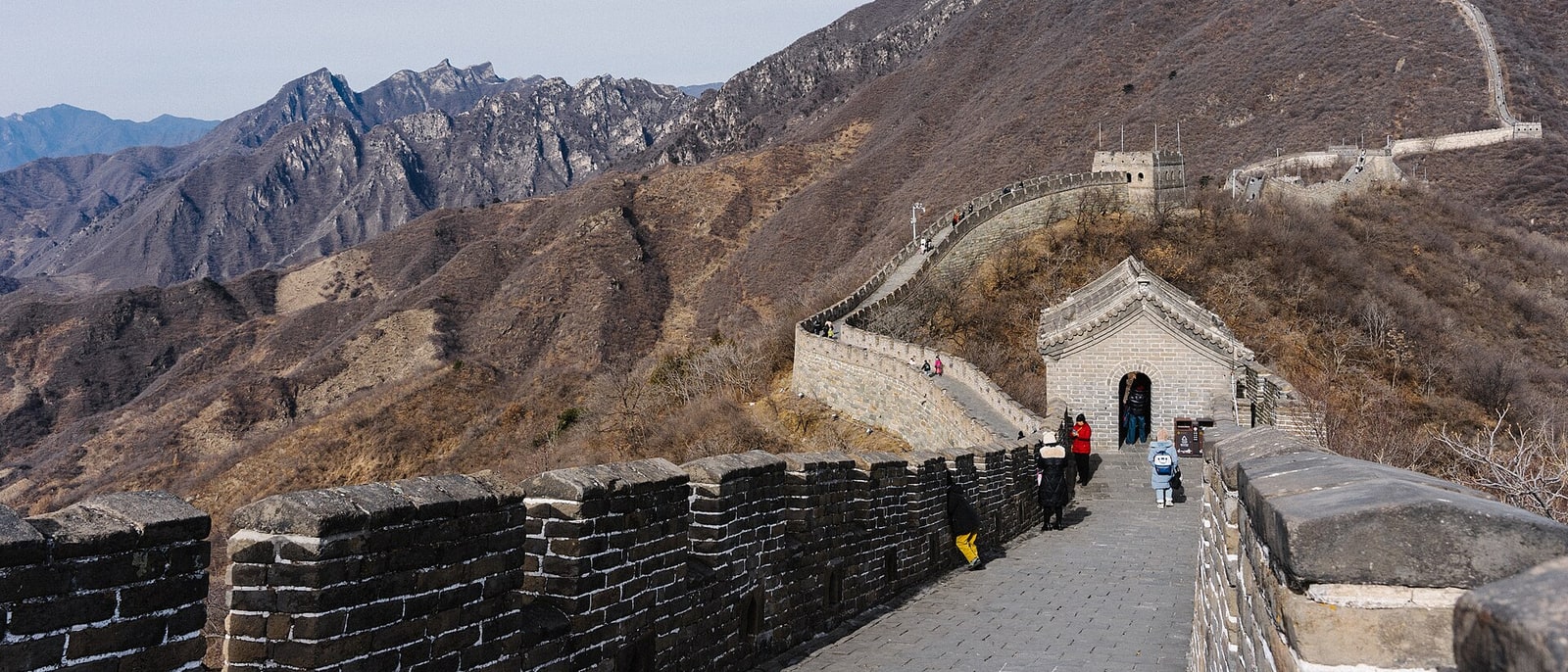
So the trip’s decision is which stretch, and it changes the day entirely: there are restored stretches with a cable car and half-collapsed ones with grass growing between the bricks and nobody around. There’s no right answer, there’s your answer. What they all share: it’s stairs, not a walk, because the wall runs along the mountain ridges.
The route, stop by stop
4 STOPS- 01
Mutianyu
This stretch we’d recommend to almost anyone. It’s restored, so you walk it comfortably and the battlements are complete, it has a cable car up and down, which with these stairs is more welcome than you expect, and it has considerably fewer people than Badaling because it’s a bit further and the train doesn’t reach it.
It’s a couple of kilometres of wall with twenty-two watchtowers, climbing and dropping along the ridge with forest on both sides: in autumn the colour is postcard stuff and that isn’t an exaggeration.
And there’s one thing that’s pure tourism and is a delight anyway: you can come down on a toboggan, on a sled in a metal chute. It’s absurd, it’s fun and it saves your knees.
- 02
Badaling
Everyone goes to this stretch, and there’s a reason: it’s the closest, there’s a high-speed train from the city taking a little over half an hour, and it’s the most restored of all of them. It was the first opened to tourism, in 1957, and it’s where every head of state visiting China has been taken.
And that’s also the problem. On public holidays and in summer there are days you can’t move: it’s a human queue on top of the wall, shuffling along.
If your dates are high season or a Chinese public holiday, avoid it without thinking. If you come midweek in low season and want the easy train journey, it works. And one thing in its favour: it’s the only one you can reach without booking anything or negotiating with a driver.
- 03
Jinshanling and the wild wall
Here the wall stays as it was left: bricks loose, towers half collapsed, grass and shrubs growing between the stones and stretches where the floor has gone. There’s no cable car, no souvenir shop, and there are days when you don’t pass anyone in four hours. It’s the real wall, the one nobody touched for five hundred years.
It’s a serious hike and it needs saying plainly: several hours along ridges, with hard climbs, broken steps of irregular height, and no shade and no water. With hiking boots, water and appetite, it’s the best thing you can do in northern China. In city trainers in August, it’s a bad idea.
The trade-off of restoration is exactly this: the restored is walkable and packed. The authentic is empty and costs you.
- 04
The Ming Tombs
The same valley north of Beijing holds thirteen of the sixteen Ming emperors, and geomancy chose it: mountains to the north to block the bad wind, water to the south, and the whole thing aligned like the Forbidden City. It’s the same idea, applied to the dead.
What to see is the Sacred Way: seven kilometres of avenue the funeral processions came up, flanked by pairs of larger-than-life stone animals and officials, some standing and some kneeling.
Walking it is free for most of its length and there’s almost nobody, because everyone arrives on a tour that only stops at the tomb. It combines well with Badaling because it’s on the way, and it’s the calm half of a wall day.
Frequently asked
How long is it from Beijing to the Great Wall?
Between an hour and a half and two and a half hours depending on the stretch: Badaling is the closest and has a high-speed train, Mutianyu is ninety minutes and Jinshanling two and a half hours. Either way it takes the whole day: nothing else fits.
Is the Great Wall hard to walk?
Harder than people expect: the wall follows the mountain ridges, so it isn’t a level stroll, it’s stairs, and some steps are half a metre high. On restored stretches like Mutianyu there’s a cable car. On wild ones like Jinshanling it’s a serious multi-hour hike with no shade and no water.
What are the Ming Tombs?
The valley north of Beijing where thirteen of the sixteen Ming emperors are buried, chosen by geomancy and aligned like the Forbidden City. The best part is the Sacred Way, seven kilometres of avenue flanked by stone animals and officials, almost empty because the tours don’t stop there.