OZU /DOMINICAN REPUBLIC /SANTO DOMINGO /GUIDE
What to see in Santo Domingo
5 stopsUpdated July 2026
The Colonial Zone fits into ten blocks and inside it is a whole continent’s list of firsts: first cathedral, first university, first hospital, first monastery, first fortress, first paved street. It isn’t marketing, they’re checkable dates between 1502 and 1541, when the rest of the Americas didn’t have a single European city.
What makes this old town special isn’t the list, though: it’s that it’s still a neighbourhood. There are five-hundred-year-old ruins in the open air in the middle of a street people walk down on their way to work, and colmados with the music up hard against the cathedral. They didn’t empty it of residents in order to show it off, and that’s why it beats almost any colonial quarter in the Americas.
The route, stop by stop
5 STOPS- 01
The Ozama Fortress
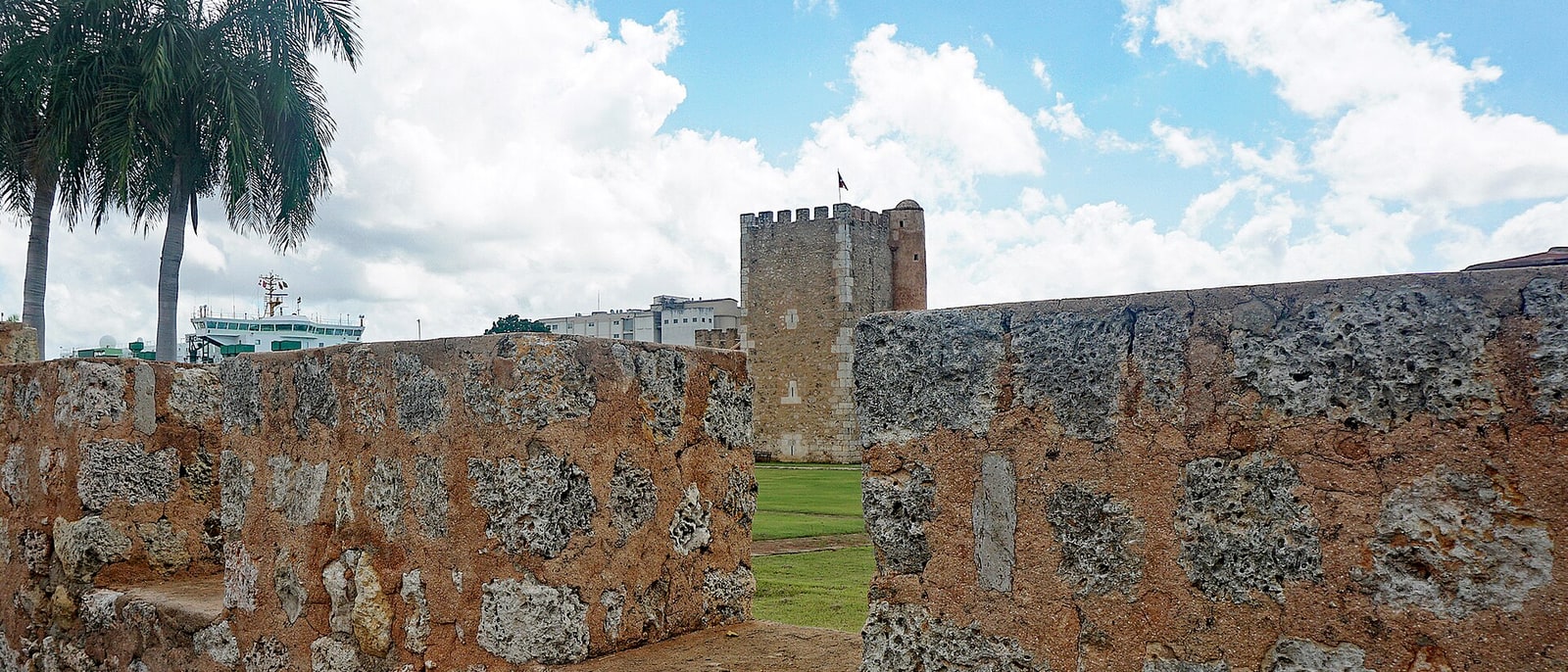
Begun in 1502 over the Ozama river to defend the city from pirates, it’s the oldest European military structure on the continent and it has never stopped being used: fortress, then barracks, then political prison under Trujillo, and now a museum. Five centuries without an empty year.
The Tower of Homage, square and massive, has two-metre walls and you go up an alarming spiral stair to a roof from which you see the river, the port and the whole quarter. Below there are cells.
The combination, a colonial fortress that in the fifties was still locking people up for their opinions, is the kind of history this city doesn’t hide, and it’s what makes going in worthwhile.
- 02
The Primada de América cathedral
Begun in 1512 and finished in 1541, it’s the oldest cathedral in the Americas. It’s built of coral stone, fossilised coral taken from the sea, which is why it has that golden colour that shifts with the light. The façade is plateresque and the interior late Gothic, plain and cool.
Notice two things almost nobody looks at. One: in 1586 the pirate Francis Drake took the city, moved into this cathedral and used it as barracks for a month while he negotiated the ransom. He took everything worth anything. Two: the lead box at the centre of the Columbus bones argument turned up in here, in 1877, during building works.
It’s still a working church, with mass and a congregation, not a monument.
- 03
The San Francisco ruins
The first monastery on the continent was begun in 1508 and had bad luck with everything: an earthquake knocked it down, Drake sacked it, another earthquake finished it, and it ended up as an asylum in the nineteenth century. Today it’s arches and high walls open to the sky at the top of the quarter, no roof and no door.
And that skeleton is now the best place in Santo Domingo, for a reason that has nothing to do with stone: on Sunday afternoons a band sets up inside it and plays son until dark.
It’s called Bonyé, it’s free, and the neighbourhood dances. That the ruin of the first monastery in the Americas is the neighbourhood dance floor on Sundays sums this city up better than any plaque.
- 04
The Columbus Lighthouse
Across the river is a two-hundred-metre concrete mausoleum in the shape of a lying-down cross, opened in 1992 for the fifth centenary, holding the remains this city maintains are Columbus’s. It’s imposing and it is, by a distance, the most argued-over building in the country.
The reasons: building it evicted thousands of people from their homes and a wall was raised around it so the poor neighbourhood next door couldn’t be seen, and it cost a fortune in a country that then had daily blackouts. And the topper: it has a hundred and forty-seven floodlights projecting a cross of light into the sky, and they draw so much power that switching them on cuts the electricity in the surrounding neighbourhoods. Which is why they almost never do.
Go, look at it, and hold both readings: it’s a monument to 1492 and also a monument to what celebrating it cost.
- 05
Amber and larimar
Two stones that only make sense on this island. Dominican amber is fossilised resin millions of years old and one of the few in the world with insects trapped inside visible to the naked eye: it’s exactly the material the Jurassic Park mosquito idea came out of, and there are pieces in the Amber Museum in the old town.
Larimar is rarer still: a blue variety of pectolite that exists nowhere else on the planet. It’s taken from a single mine, in the Barahona hills in the south-west of the country, and it was discovered in 1974. It’s sky blue with white veining and looks like frozen water.
If you’re buying a stone on this trip, make it this one, because you literally will not find it anywhere else.
Frequently asked
What should you see in Santo Domingo’s Colonial Zone?
The Ozama Fortress (1502), the Alcázar de Colón, the Primada de América cathedral (1541), the ruins of the San Francisco monastery and of the continent’s first university, and Calle Las Damas. It all fits in ten blocks and it’s been World Heritage since 1990.
What is the Columbus Lighthouse?
A 200 m concrete mausoleum shaped like a cross, from 1992, holding the remains Santo Domingo maintains are Columbus’s. It’s the most argued-over building in the country: thousands were evicted to build it, and its 147 floodlights draw so much power that switching them on cuts electricity in the surrounding neighbourhoods.
What is larimar?
A blue variety of pectolite that exists nowhere else on the planet: it comes from a single mine in the Barahona hills and was discovered in 1974. It’s sky blue with white veining. Along with Dominican amber, the kind with insects trapped inside, it’s the one thing you can’t buy off this island.