OZU /DOMINICAN REPUBLIC /SANTO DOMINGO /GUIDE
Where to stay in Santo Domingo
4 stopsUpdated July 2026
Santo Domingo has three million people counting the metropolitan area and you, almost certainly, are going to see ten blocks. That simplifies the decision a lot: either you sleep inside the Colonial Zone, which is what nearly everyone does and rightly, or you sleep in the real city and come in every day.
The city has a metro, which is a rarity in the Caribbean, only San Juan and here have one, and it works well, it’s clean and it costs almost nothing. The detail that throws you: it doesn’t reach the Colonial Zone. So if you sleep far out, your daily life is taxis, through traffic that is one of the serious ones. That weighs more than any consideration of charm.
The route, stop by stop
4 STOPS- 01
The Colonial Zone
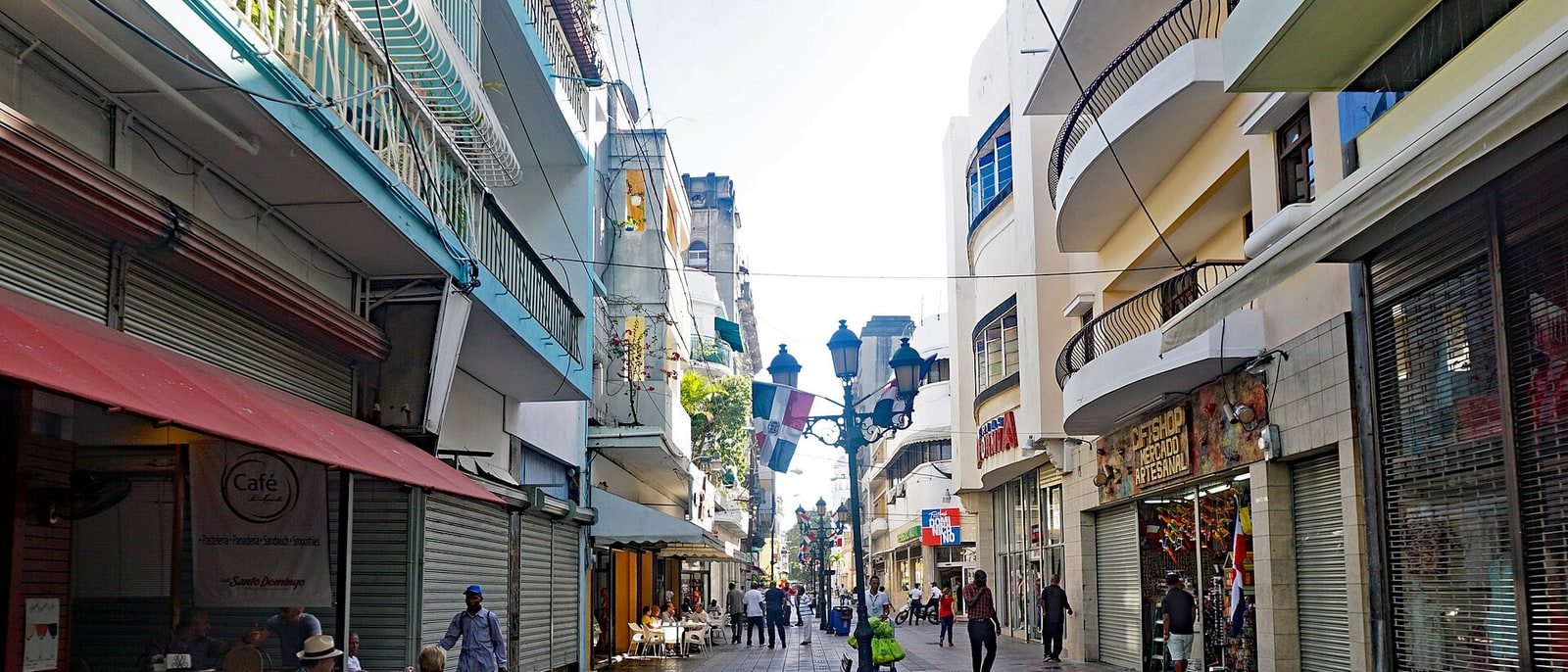
The obvious answer gets it right: everything you came to see is here, you walk all of it, and there are small hotels built inside genuine colonial houses, with a courtyard, the original well and metre-thick walls. For what an ordinary room costs in the Caribbean you sleep in a sixteenth-century building.
And the best part is the one you don’t expect: it’s still a neighbourhood with people in it. There are colmados, women bringing chairs out to the pavement, children. They didn’t empty it out to show it off. The catch is the obvious one: El Conde is noisy until late, and in the most touristed corners dinner prices have stopped being Dominican.
Ask for a room facing an inner courtyard and it’s solved.
- 02
Gazcue
Pressed against the Colonial Zone on the west, between the old town and the Malecón, Gazcue is a residential quarter from the thirties and forties: low villas, big trees, quiet streets and not one tourist. It’s a fifteen-minute walk to the old town and five to the Malecón. It’s where you stay if you want to see how Santo Domingo’s middle class lives without giving up the distance. There are mid-sized hotels and apartments, dinner costs city prices rather than postcard prices, and at night you hear crickets instead of El Conde. The Plaza de la Cultura is here too, with the national museums, which almost nobody visits and which holds the Museo del Hombre Dominicano and the little that remains of the Taíno.
- 03
The Malecón
Along the fourteen kilometres of seafront are the big chain hotels, the casinos and the towers with Caribbean views. It’s where the business traveller and the conference delegate stay, and it works: big rooms, a pool, the sea in front.
Two honest warnings. One: there’s no beach here. The Malecón is an avenue with the sea breaking on the shore reef, and to swim you have to go to Boca Chica, half an hour away. Two: between your hotel and the water there are six lanes of traffic.
As a base for seeing the city, the Colonial Zone is better. As a place to be comfortable with a view, this.
- 04
Piantini and Naco
To the north, the city that isn’t in the photographs: apartment towers, offices, shopping centres and the capital’s best restaurants, which are here and not in the old town. It’s the Santo Domingo with eleven million people behind it rather than five hundred years.
There isn’t one touristic reason to sleep here and there is one practical one: if you came for work, this is where the work is. And if you’re back for a second or third time and you’ve done the Colonial Zone, eating here one night shows another face of the country, the one no feature ever covers. It’s twenty minutes from the old town if the traffic behaves, which is assuming a lot.
Frequently asked
Where should you stay in Santo Domingo?
The Colonial Zone, almost always: everything you’ll see is there, you walk all of it, and there are small hotels inside sixteenth-century houses. Gazcue is the quiet quarter next door, the Malecón has the big hotels with views but six lanes between you and the sea, Piantini is the modern city.
Is there a metro in Santo Domingo?
Yes, and it’s a rarity in the Caribbean: only San Juan and this city have one. It works well, it’s clean and it costs almost nothing. The detail that throws you is that it doesn’t reach the Colonial Zone, so it’s of limited use to a visitor and daily life ends up being taxis.
Is there a beach in Santo Domingo?
No. The Malecón is fourteen kilometres of avenue with the sea breaking on the shore reef, and no sand. The nearest beach is Boca Chica, half an hour east, which has a reef-protected lagoon and is where the capital goes on Sundays.