OZU /DOMINICAN REPUBLIC /SANTO DOMINGO /GUIDE
Santo Domingo in a day
8 h route5 stopsBest: Sunday, so you end up hearing son in the monastery ruinsUpdated July 2026
Everything that came after started here. Santo Domingo is the oldest continuously inhabited European city in the Americas, and the continent’s list of firsts fits into ten blocks: the first cathedral, the first university, the first hospital, the first fortress and the first paved street. You walk it in a long morning.
And the other half needs saying from the start, because it’s the same sentence: everything else started here too. This is the city from which the conquest of the continent was organised, and of the Taíno population living on this island when the caravels arrived there is essentially nobody left. The old town is magnificent and it is exactly that. Both things are true at once and they don’t cancel out.
The route, stop by stop
5 STOPS- 01
Calle Las Damas
The first paved street on the continent went down here, in 1502, while the rest of the Americas didn’t yet know what a cartwheel was. It runs from the fortress to the Alcázar and its two hundred metres hold half of what you came to see.
The name has a literal and lovely explanation: it was called that because the ladies of the court of María de Toledo, the vicereine, came out to walk along it at dusk.
At the end, the Ozama Fortress, from 1502: the oldest European military structure in the Americas, with its square Tower of Homage looking over the river. It was a fortress, then a barracks, then a political prison under the dictatorship, which is the country summarised in one building.
- 02
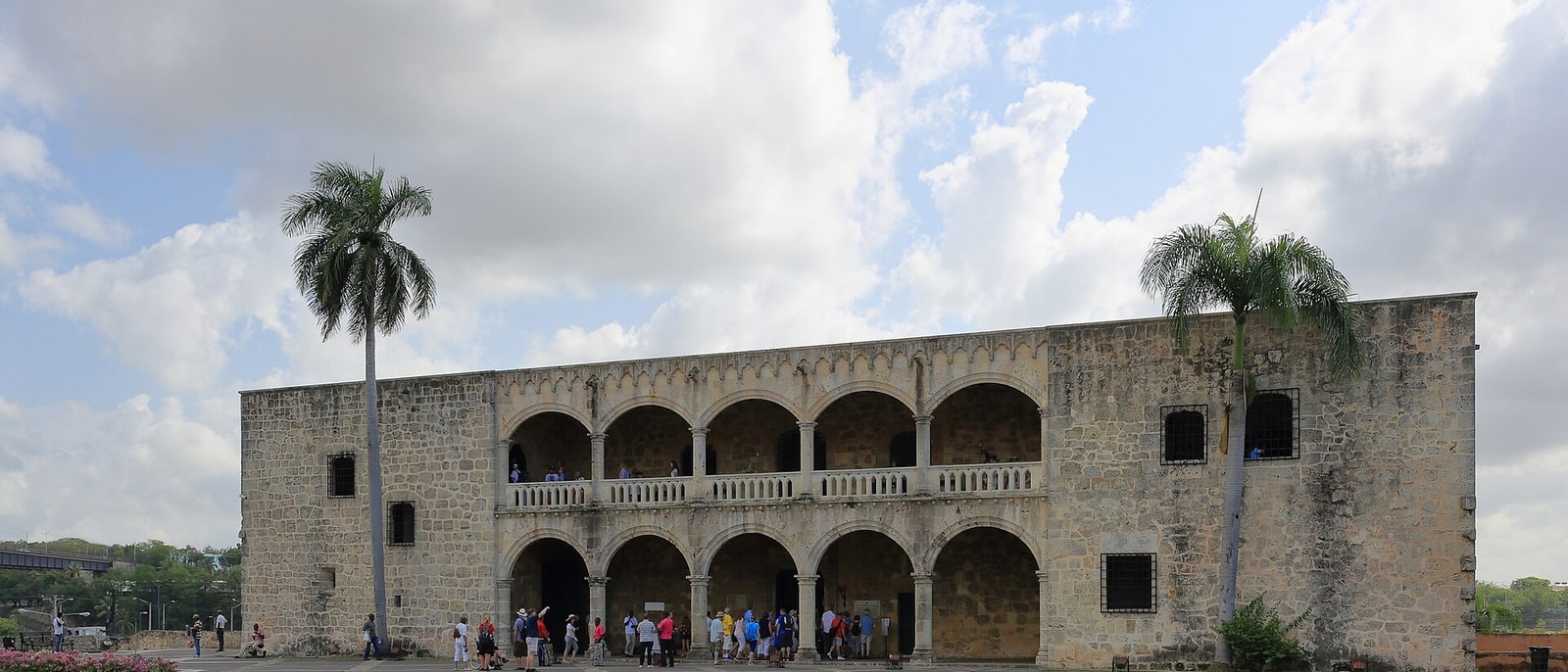
The Alcázar de Colón
The palace of Diego Columbus, Christopher’s son and the second viceroy, went up between 1510 and 1512 and boasts one real constructional detail: it doesn’t contain a single nail. Everything is jointed in stone and timber. The continent’s first viceregal court lived here, and from these rooms the expeditions that went out to conquer everything else were organised. It stood abandoned and half-ruined for centuries until it was restored in the twentieth century, and today it holds period furniture and objects, though almost none of it belonged to this house. In front is the Plaza España, which late in the afternoon fills with people from the city rather than tourists, with the river behind. It’s the best place in the old town to do nothing.
- 03
The cathedral, and the fight over the bones
The Primada de América cathedral was finished in 1541 and is the oldest on the continent, with a golden coral-stone façade and a Gothic interior that surprises you by how plain it is. It stands on the Parque Colón, the exact centre of the old city and where the people who no longer have to go to work sit.
And here is one of history’s great open arguments: where are Christopher Columbus’s bones. In 1877 a lead box turned up in this cathedral inscribed “illustrious and distinguished gentleman Don Cristóbal Colón”, and since then this city has maintained it has them.
Seville says the same, and in 2006 DNA analysis confirmed the Seville remains are a Columbus. Santo Domingo has never allowed its own to be tested. It’s perfectly possible both have part, because the bones travelled a great deal.
- 04
The first university in the Americas
In 1538 the Universidad Santo Tomás de Aquino was founded here, the first on the American continent, almost a century before Harvard and when North America didn’t have a single European city. Its heir, the UASD, still runs and is today the country’s public university, with over a hundred thousand students.
Little of the original building survives, but that isn’t the point: the point is the date.
Opposite are the ruins of the San Nicolás de Bari hospital, the first in the Americas, of which a few stone arches stand in the open air in the middle of an ordinary street, with people walking past on their way to work. That ease with which the city lives alongside five hundred years of ruins is the most characteristic thing about Santo Domingo.
- 05
The Malecón at dusk
The Malecón runs fourteen kilometres of avenue facing the Caribbean, with no beach, the water breaking on the shore reef and spraying the road when there’s swell. There’s nothing to see in the monument sense, and it’s still where you want to be at six in the evening.
It’s the living room of three million people: runners, families, dominoes on plastic tables, someone with a speaker, motoconchos, fry stalls. In summer the Carnival and the merengue festival happen here. You walk a stretch, stop at a stall, look at the sea, and understand that Santo Domingo isn’t a colonial quarter with a city around it, but an enormous city with a colonial quarter inside.
Frequently asked
What to see in Santo Domingo in a day?
The whole Colonial Zone fits into a long morning on foot: Calle Las Damas, the Ozama Fortress, the Alcázar de Colón, the cathedral, the first in the Americas, and the ruins of the continent’s first university and first hospital. In the afternoon, the Malecón.
Where are Christopher Columbus’s remains buried?
It’s an open argument. Santo Domingo says it has them, since a lead box with his name turned up in its cathedral in 1877. Seville says the same, and in 2006 DNA confirmed its remains are a Columbus. Santo Domingo has never allowed its own to be tested. The bones travelled a great deal: both may have part.
What is the oldest city in the Americas?
Santo Domingo is the oldest continuously inhabited European city in the Americas: founded in 1498 and moved to the west bank in 1502 after a hurricane. Its ten colonial blocks hold the continent’s first cathedral, first university, first hospital and first paved street.