Budapest in a day
9 h route4 stopsBest: April to June and September to OctoberUpdated July 2026
Budapest is two cities stitched by six bridges, and the day organises itself once you accept that: the morning in Buda, the hill with the castle and the view over everything, and the afternoon in Pest, the flat side, the monumental one, the one still alive at eleven at night.
The natural ending is a thermal bath, which here isn’t a spa indulgence but the reason there’s a city at this point on the map at all. It pays to know which ones are still open before turning up at the door.
The route, stop by stop
4 STOPS- 01
The Castle district and the Fishermen’s Bastion
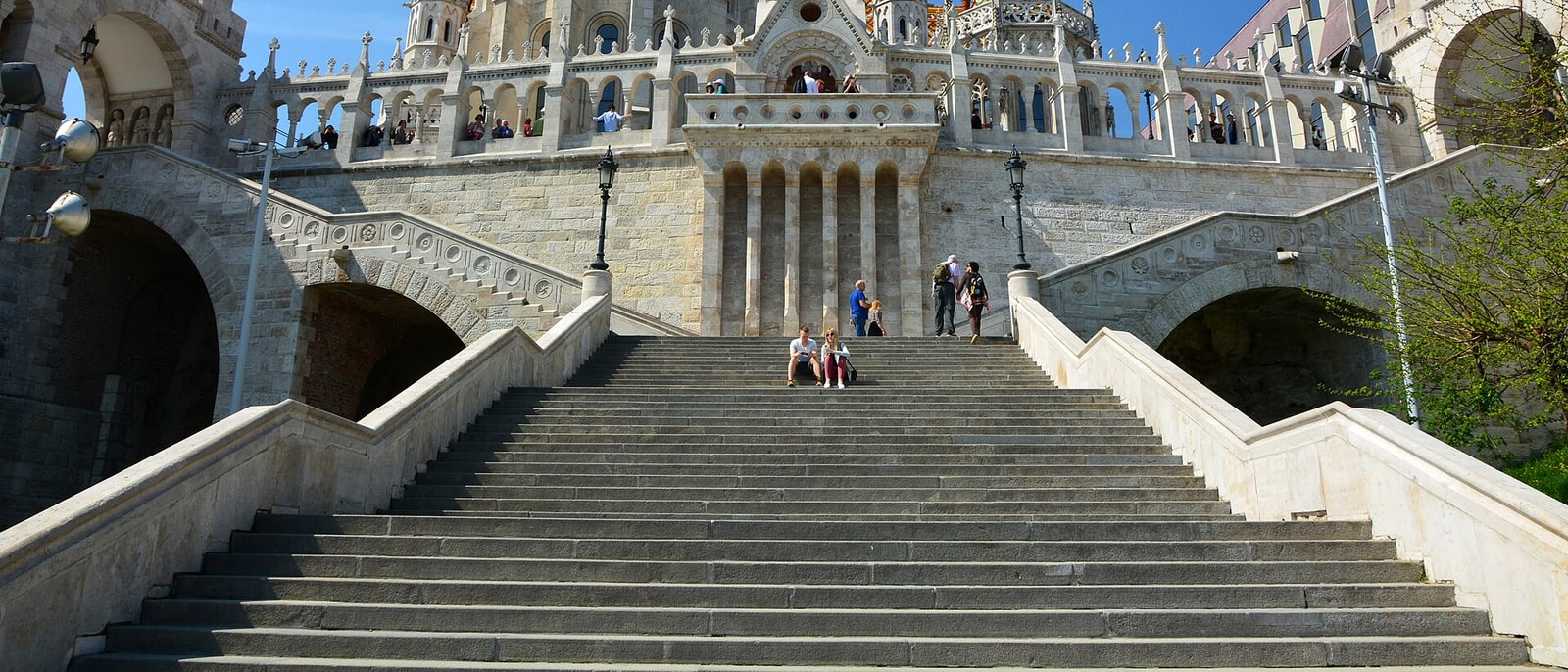
The Buda hill gathers the royal palace, the Matthias church with its patterned glazed-tile roof, and the Fishermen’s Bastion, that white gallery of turrets that looks medieval and dates from 1902: it was built as a viewpoint, not a defence. Its seven towers stand for the seven Magyar tribes that reached the Carpathian basin in the ninth century.
From the terrace you see the whole Danube with the parliament opposite, and it’s the view in every photograph of Budapest.
You go up by funicular from the Chain Bridge, or on foot up the slope if there’s no queue and your legs agree.
- 02
The Chain Bridge
Until 1849 there was no fixed bridge between the banks: you crossed by boat, and in winter, when the Danube froze, over the ice or not at all. Count Széchenyi drove this suspension bridge through after being stuck for a week, unable to cross for his father’s funeral, and with it the real union of the two cities began, made official in 1873.
The stone lions at each end carry a stubborn legend: that the sculptor forgot to carve their tongues and threw himself into the river in shame. It’s false (they have tongues, you just can’t see them from below) but it’s still told.
The bridge reopened in 2023 after a long restoration.
- 03
The Parliament and the Pest bank
The Országház was finished in 1902 and remains one of the largest parliament buildings in the world: nearly seven hundred rooms, and a dome ninety-six metres high. The figure isn’t chance, 896 is the year the Magyars arrived, and St Stephen’s basilica is exactly as tall, because an ordinance forbade going higher. Inside is kept the Hungarian Holy Crown.
Two hundred metres along the embankment are the Shoes on the Danube Bank: sixty pairs of cast-iron shoes, men’s, women’s and children’s, placed in 2005 where Arrow Cross militiamen shot Jews in the winter of 1944-45, having made them take their shoes off first because shoes had value.
There’s no large sign and no ticket, you walk past and you understand.
- 04
A thermal bath, to end the day
Here you need the fact fresh, because it changed recently. The Gellért, the Art Nouveau bathhouse on every list, has been closed since 1 October 2025 for a restoration expected to be long, with reopening announced for 2028. The Király is under works too. Turning up there is this year’s commonest mistake.
What is open: the Széchenyi, the enormous yellow one in the park, with its steaming outdoor pools and the men playing chess in the water. Though since 1 August 2025 it admits only those aged fourteen and over, so it’s no good with children, the Rudas, Ottoman, from the sixteenth century, with its octagonal pool under a dome, and the Lukács, the most local of the three.
Frequently asked
Can you see Budapest in a day?
The essentials yes: the castle hill in Buda in the morning, crossing the Chain Bridge, the parliament bank in Pest in the afternoon, and a thermal bath to finish. What doesn’t fit is the city park with Heroes’ Square, which asks for another half-day.
Are the Gellért Baths open?
No. It closed on 1 October 2025 for a full restoration, with reopening expected in 2028. The Király is also under works. The Széchenyi, over-14s only since August 2025, the Rudas and the Lukács remain open.