What to see in Budapest
14 h route4 stopsBest: All year. The baths rescue winterUpdated July 2026
Budapest’s parliament dome is ninety-six metres, and St Stephen’s basilica is exactly the same. That’s neither chance nor rivalry: 896 is the year the Magyar tribes reached the Carpathian basin, and the city built itself in 1896 (underground, Heroes’ Square, Vajdahunyad Castle) as one enormous millennium celebration.
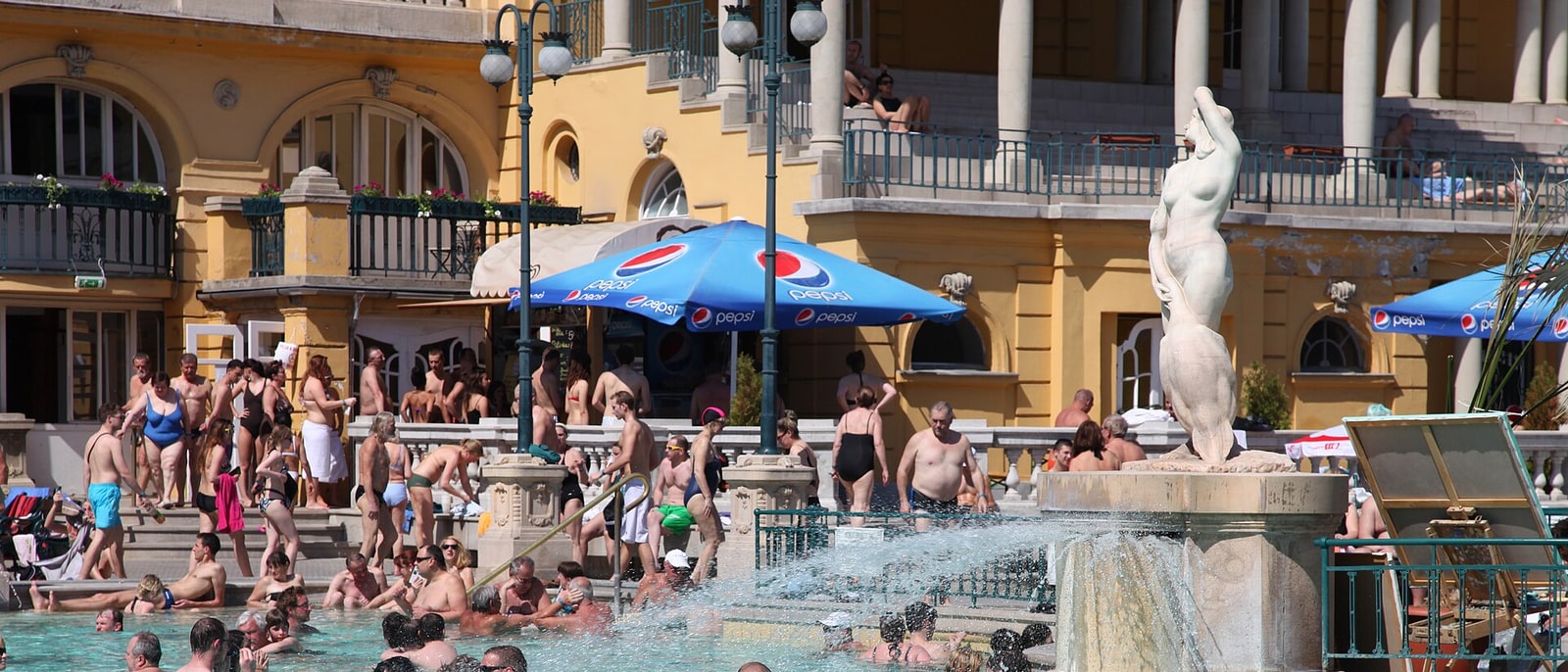
The other key is below ground: Budapest sits on a geological fault up which some hundred and twenty thermal springs rise. The Romans already bathed here, the Ottomans put domes over them, and the city still runs on that water.
The route, stop by stop
4 STOPS- 01
The baths, and which are still open
Read this part with the date in front, because the right answer changed a few months ago and almost no guide has updated it. The Gellért baths, the 1918 Art Nouveau ones that illustrate half the covers about Budapest, closed on 1 October 2025 for a major restoration and aren’t expected to reopen before 2028. The Király, Ottoman and small, is under restoration too.
Of those open, the Széchenyi is the big one: 1913, yellow neo-Baroque, in the city park, with outdoor pools that steam in midwinter and chess games played in the water. Since 1 August 2025 only over-fourteens are admitted, a change that shuts families out and is worth knowing before you buy.
The Rudas is the oldest in use: the Ottomans built it in the sixteenth century and it keeps its octagonal pool under a dome pierced with holes that let the light in. And the Lukács is where the neighbourhood goes, with less staging and more routine.
- 02
Inside the Parliament
Finished in 1902 after nearly twenty years of building, it’s among the largest parliaments in the world: some six hundred and ninety rooms, almost half a kilometre of façade to the Danube, and a main staircase covered in gold. It’s visited by guided tour only and must be booked. The route takes in the staircase, the dome and one of the chambers.
Under the dome, the Hungarian Holy Crown is displayed, its cross bent to one side.
It’s the crown Hungary’s kings were crowned with, and its history includes thefts, burials and a spell in American custody at Fort Knox, until it was returned in 1978.
- 03
The Great Synagogue and the Jewish quarter
The Dohány Street synagogue, from 1859, is the largest in Europe and one of the largest in the world: it holds nearly three thousand people. Its style is Moorish, with two onion-domed towers, and from outside it looks more like a church or a mosque than a synagogue, a deliberate choice by the Neolog community that built it.
In the courtyard behind is the Holocaust memorial: a metal weeping willow whose leaves are engraved with victims’ names.
Beneath it lies a cemetery, which in a synagogue is an anomaly: those who died in the Budapest ghetto in the winter of 1944-45 were buried there, because there was no way to take them anywhere else.
- 04
Gellért Hill and the Citadel
The hill takes its name from Bishop Gerard, an Italian missionary whom, tradition says, pagan Hungarians killed in the eleventh century by rolling him down the slope inside a barrel. On top is a citadel the Habsburgs built in 1854 pointing at the city, after the 1848 revolution: it wasn’t to defend Budapest, it was to watch it.
The Liberty Statue, a woman holding a palm aloft, was put up by the Soviet regime in 1947 as a liberation monument.
In 1989 they didn’t pull it down: they removed the Soviet soldier figures, which are today in Memento Park with the rest of the communist statuary, and changed the inscription. It’s the Hungarian solution to the awkward-monument problem.
Frequently asked
Which Budapest bath should you choose?
The Széchenyi for the big one with outdoor pools, bearing in mind it has admitted only over-14s since August 2025, the Rudas for the sixteenth-century Ottoman one under its dome, and the Lukács for a local feel. The Gellért is closed for restoration until 2028 as things stand.
Why is Budapest’s Parliament ninety-six metres tall?
Because 896 is the year the Magyar tribes reached the Carpathian basin. St Stephen’s basilica is exactly the same height, and much of the monumental city (the M1 underground, Heroes’ Square) was built for the 1896 millennium.