Delhi in a day
9 h route4 stopsBest: October, February or March. May hits 45 degrees and December is unbreathableUpdated July 2026
In the courtyard of a ruined mosque in south Delhi there’s a seven-metre iron pillar driven into the ground. It was raised in the fourth century, some sixteen hundred years ago, and in all that time, out in the open, under the monsoons, it hasn’t rusted. We now know it has to do with the phosphorus content of the iron, which forms a protective layer, but the fact remains what it is: an anonymous metalworker around the year 400 did something still being studied.
That pillar is the best way into Delhi, because the whole city works like that: things of an age that’s hard to absorb, in the middle of ordinary life, with no display case. Delhi is seven imperial cities built on top of each other across a thousand years, and what’s here today is all of them at once, mixed. A day here can’t see it all. What it can do is take one thread (the stone, the Mughals, the British empire) and pull.
The route, stop by stop
4 STOPS- 01
The Qutub Minar
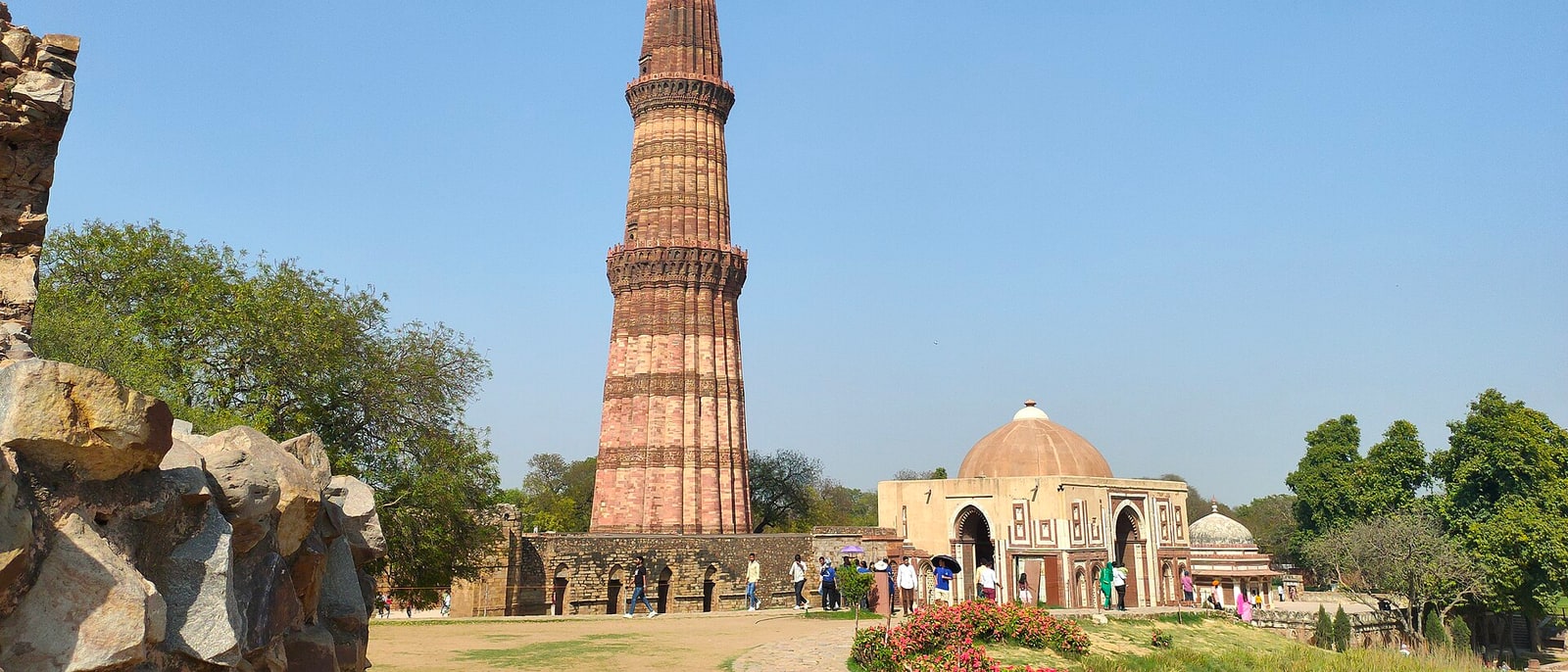
A seventy-three-metre brick minaret, begun in 1193, the tallest brick tower in the world, narrowing as it rises like a telescope. It marked the beginning of Muslim rule in northern India, which is why it’s where it is: in Lal Kot, the first of Delhi’s cities.
Beside it is the mosque, and that’s where the visit gets interesting and slightly uncomfortable. It was built from the material of twenty-seven demolished Hindu and Jain temples, and you don’t have to take my word for it: you can see it. The cloister columns are reused temple columns, with their carved figures, their bells and their garlands, set into a mosque that in principle shouldn’t have figures at all. In some places the faces are chipped away and in others they aren’t.
It’s a building that narrates a conquest with total literalness, and in its courtyard stands the iron pillar that doesn’t rust, a thousand years older than everything around it.
- 02
Humayun’s Tomb
If you’ve seen photos of the Taj Mahal, this will look familiar, and that isn’t a coincidence: it’s its direct ancestor. It was finished around 1570, commissioned by the widow of the emperor Humayun, and it was the subcontinent’s first great Mughal garden tomb: a symmetrical building of red sandstone and white marble, domed, planted in the centre of a square garden quartered by water channels. Eighty years later, a great-grandson of Humayun copied the scheme in Agra and made the whole thing marble.
The story of this place closes on itself in a way that’s almost literary. Humayun died in 1556 falling down his library stairs loaded with books, tripping on his own robe when he heard the call to prayer. And three hundred years later, in 1857, the last Mughal emperor, Bahadur Shah Zafar, hid here, in this tomb, and here the British captured him before exiling him to Burma. The dynasty began and ended in the same building.
- 03
Chandni Chowk
The main street of Mughal Delhi, laid out in 1650 by Jahanara Begum, Shah Jahan’s eldest daughter. The name means “moonlight square”, and it was literal: a water canal ran down the middle of the avenue, and at night the moon reflected in it. The canal disappeared long ago.
Today it’s one of the densest markets in existence and there’s no point trying to “see” it: you go in, you walk and you let it happen. Each perpendicular lane specialises in one thing (weddings, books, paper, silver, spices) and that guild order goes back centuries. One practical tip worth ten: don’t go in by car or taxi, because you can’t. Arrive by metro, which runs underneath, and walk.
And if you make only one stop, make it Khari Baoli, the spice market, the largest in Asia, working wholesale since the seventeenth century. Fair warning: the air in there carries so much ground chilli that you genuinely sneeze.
- 04
The Delhi the British built
In 1911 the British moved the capital from Calcutta to Delhi and commissioned an entire new city beside the old one: enormously wide avenues, roundabouts, bungalows with gardens and government buildings on a hill. It took twenty years. It’s textbook imperial planning, made to impress, and today it’s India’s power district.
The best part of all this is an anecdote you can see with your own eyes. The two architects, Lutyens and Baker, fell out over the gradient of the avenue climbing the hill. Baker got his way, and the result is that the Viceroy’s House, which was meant to dominate the perspective, sinks and disappears behind the slope as you approach. Lutyens, who considered it an irreparable disaster to his work, called it his Bakerloo. It still happens: walk up and watch the building hide.
And at the end of the avenue is India Gate, an arch bearing the names of over seventy thousand Indian soldiers killed in the First World War.
Frequently asked
What to see in Delhi in a day?
The Qutub Minar, with its mosque built from the stones of twenty-seven demolished temples and the sixteen-hundred-year-old iron pillar that hasn’t rusted, Humayun’s Tomb, the direct ancestor of the Taj Mahal, Chandni Chowk, the Mughal street from 1650, on foot and arriving by metro, and the British imperial Delhi of Lutyens. A day doesn’t stretch further, and that’s fine.
Why doesn’t Delhi’s iron pillar rust?
Its composition: the iron has a high phosphorus content that forms a protective layer on the surface and slows corrosion. It was raised in the fourth century, has spent some sixteen hundred years in the open under the monsoons and it’s still there, in the courtyard of the Qutub Minar mosque. That someone achieved this around the year 400 is still being studied today.