What to see in Delhi
9 h route4 stopsBest: Eight to eleven in the morning. After that, the sun and the crowdsUpdated July 2026
The tomb that inspired the Taj Mahal is in Delhi, and it’s eighty years older. The widow of the emperor Humayun had it raised around 1570, and when his great-grandson Shah Jahan wanted to build the most famous mausoleum in the world for his wife, what he did was take this scheme, the symmetrical domed building at the centre of a garden quartered by channels, and execute it in white marble. People pass through Delhi on the way to Agra without stopping to see the rough draft.
That sums up this city’s problem: it has three World Heritage Sites, a thousand years of imperial architecture and a density of monuments almost no capital can match, and it’s still treated as a stopover. Delhi isn’t the anteroom to the Taj Mahal. It’s one of the cities with the most built history on the planet, and a couple of days and an air-conditioned metro are all it takes to see it.
The route, stop by stop
4 STOPS- 01
Humayun’s Tomb
The subcontinent’s first great Mughal garden mausoleum, finished around 1570: red sandstone inlaid with white marble, a tall double dome and a square garden cut into four by water channels, which is the paradise described in the Quran set out as a floor plan. Everything that comes afterwards in Mughal architecture, the Taj Mahal included, comes from here.
It’s worth knowing that what you see wasn’t always like this. Through the twentieth century the complex was a wreck, the channels dry, the gardens turned into vegetable plots and the building decayed. In 1947, during Partition, the grounds were used as a refugee camp and held thousands of people. The restoration of the last two decades has been enormous and has brought the water system back into operation.
Go early: first light on the red sandstone is why this building gets photographed.
- 02
The Red Fort
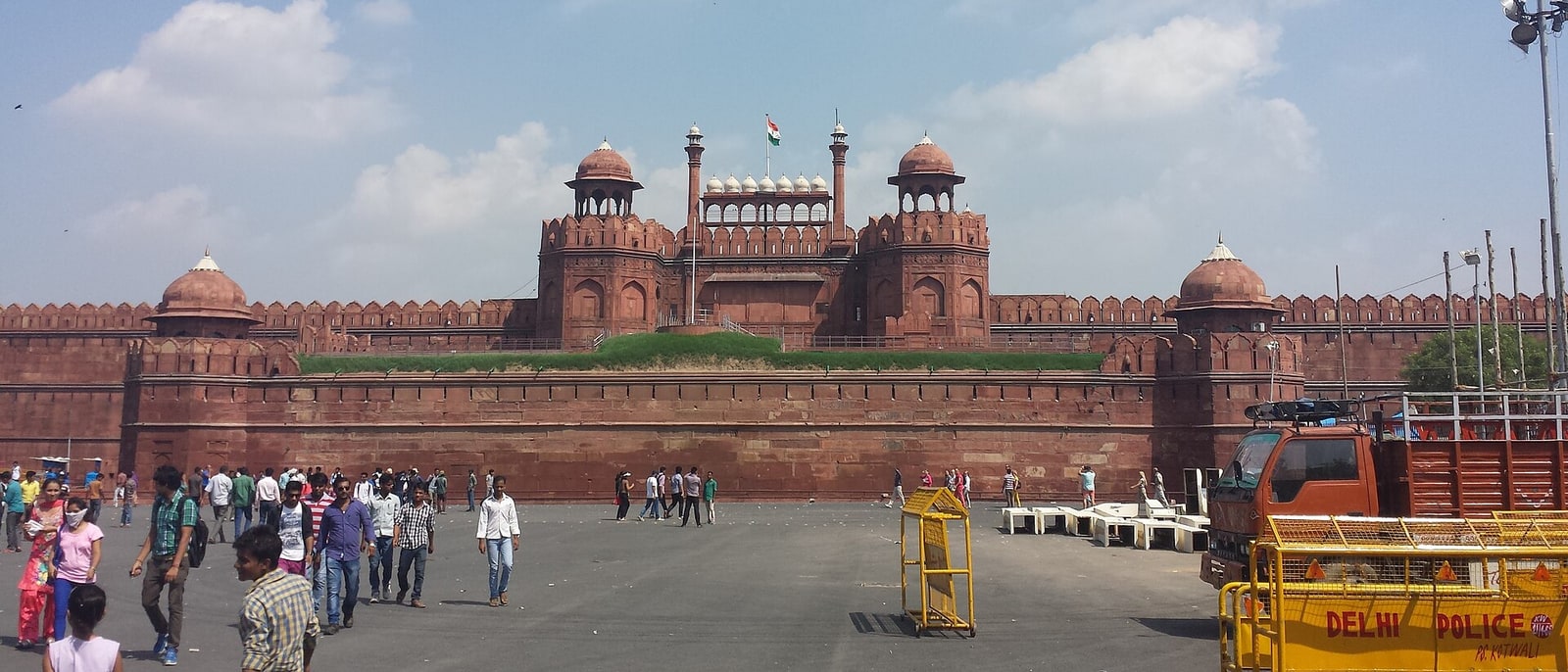
Shah Jahan’s palace-fortress, finished in 1648, which was the centre of Delhi’s sixth city: two kilometres of red sandstone wall around a compound of marble palaces, gardens and audience halls. It’s a World Heritage Site and it’s India’s most symbolic building.
That symbolism has to be understood for the visit to be worth it: every 15 August, the anniversary of independence, the country’s prime minister raises the flag and addresses the nation from that wall. It was chosen precisely because it was the seat of Mughal power and later the place where the British humiliated the dynasty.
Inside, look for the Diwan-i-Khas, the private audience hall, with a Persian inscription saying that if there is a paradise on earth, it is this. The Peacock Throne stood there, taken by the Persians in 1739 and never returned.
- 03
The stepwell in the middle of town
Five minutes’ walk from Connaught Place, the square of colonial arcades, boxed in between office buildings, there’s a rectangular stone hole sixty metres long with over a hundred steps descending in three flights to the bottom. It’s Agrasen ki Baoli, a medieval stepwell, and you’re inside it while traffic passes overhead.
Stepwells are an invention of northern and western India, and they’re social engineering as much as hydraulic: instead of hauling water up in a bucket, you walked down to it, and because the level rose and fell with the season, many steps were needed.
They were also cool places where people sheltered from the heat and gathered.
This one is in the middle of the centre, it’s free and almost nobody looks up from Connaught Place to find it. Going down to the bottom with forty degrees outside and feeling the temperature drop explains what it was for better than any sign.
- 04
The places of 1947 and 1948
Modern India is born in Delhi and there are two places where you can touch that. The first is Gandhi Smriti, the house where Gandhi spent his last months and where he was assassinated on 30 January 1948. His room is preserved, with his glasses, his sandals and his spinning wheel. And in the garden, stone footsteps set into the ground mark the exact route he took that afternoon from the house to the spot where he was shot, on his way to prayer. You walk that route. It’s thirty metres and it feels very long.
The second is the Partition Museum, devoted to what happened in 1947 when the border with Pakistan was drawn: some fifteen million people displaced within weeks, in both directions, and hundreds of thousands dead. Delhi changed its skin then: part of its Muslim population left and hundreds of thousands of refugees arrived from Punjab, and they are the ones who made the city that exists today, its commerce and its food.
It’s a hard museum and it’s told through the objects and testimony of the people who lived it.
Frequently asked
What must you see in Delhi?
Humayun’s Tomb, from around 1570, the direct ancestor of the Taj Mahal and eighty years older, the Qutub Minar with its iron pillar that doesn’t rust, Shah Jahan’s Red Fort, from whose wall the prime minister addresses the nation every 15 August, the Agrasen stepwell, five minutes from Connaught Place and free, and Gandhi Smriti, where he was assassinated in 1948.
Is Delhi worth it or just a stopover for the Taj Mahal?
It’s worth it in its own right: it has three World Heritage Sites and a thousand years of imperial architecture from seven different capitals. The tomb that inspired the Taj Mahal is here and it’s eighty years older, and almost nobody stops for it. With two days and the metro, which is air-conditioned, you see a great deal.