Delhi’s neighbourhoods
6 h route4 stopsBest: Old Delhi in the morning. The south at duskUpdated July 2026
Chandni Chowk means “moonlight square”, and the name came from a water canal running down the middle of the avenue in which the moon reflected. Jahanara Begum, Shah Jahan’s daughter, laid it out that way in 1650, and it was the most elegant street in the empire. The canal has been gone for over a century and today that street is the densest market in the city. Between those two images sits the whole history of Delhi.
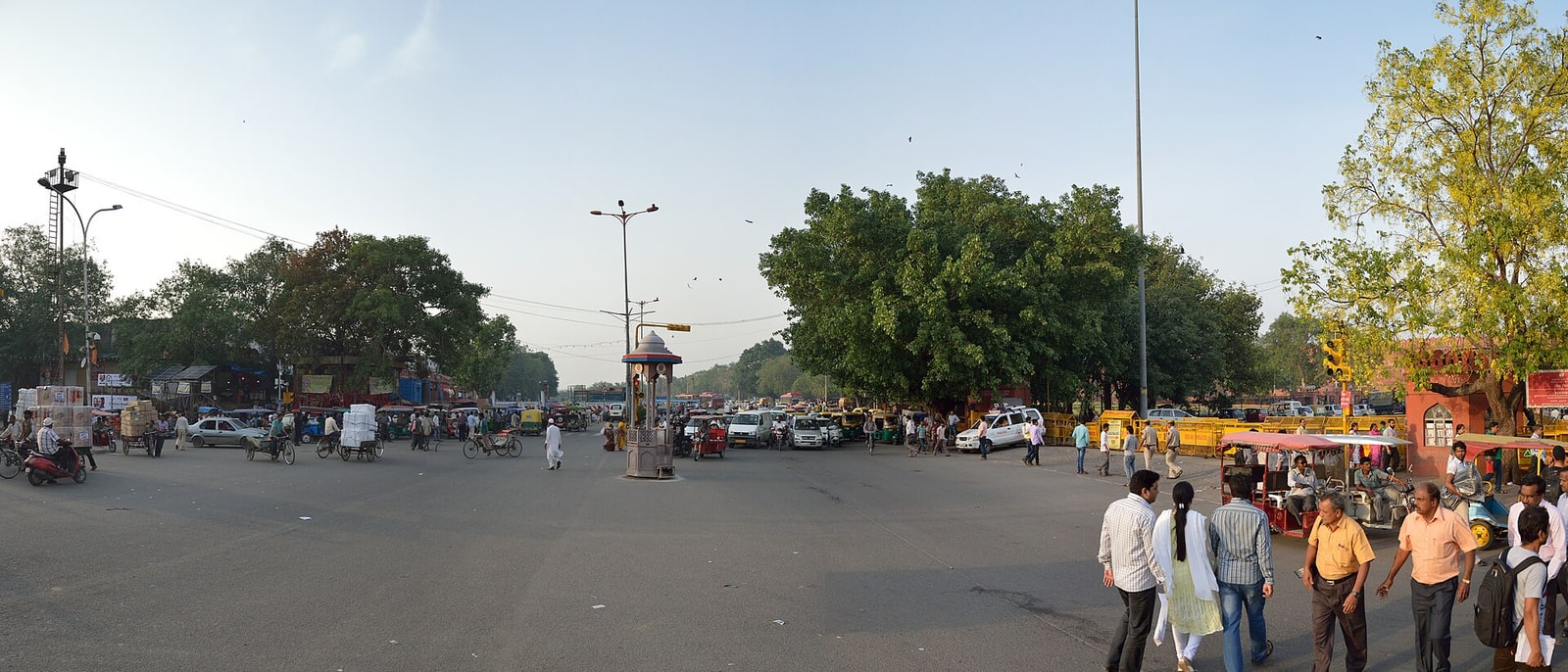
This city’s neighbourhoods aren’t neighbourhoods: they’re different cities from different centuries, stuck together. Old Delhi is the seventeenth-century one, with the Mughal grain intact. New Delhi is the British one, from 1911, with hundred-metre-wide avenues. The south is the ancient and the wealthy at once. And around it all is a city of thirty million people. Moving between them isn’t crossing the street: it’s taking the metro, and the metro is what makes Delhi visitable.
The route, stop by stop
4 STOPS- 01
Old Delhi
Shah Jahan’s city, founded in 1638 and then called Shahjahanabad, with the Red Fort at one end, the Jama Masjid beside it and Chandni Chowk as its spine. The urban grain is the original: two-metre lanes, courtyards, houses with lattice screens and a density that’s hard to describe.
The key to understanding it is the guild order, still standing since the seventeenth century: each perpendicular lane sells one thing only. One is wedding dresses, another paper, another musical instruments, another electrical parts, another dried fruit. Khari Baoli, the spice one, is the largest spice market in Asia and has run since then. Knowing this turns the apparent chaos into a readable map.
Go in the morning, go by metro, I insist: a car doesn’t get in there, and walk with no destination. And don’t be in a hurry: hurry is the one thing that doesn’t work here.
- 02
Lutyens’ Delhi
South of the old city spreads the New Delhi the British designed from 1911, when they moved the capital from Calcutta: avenues of preposterous width, giant roundabouts, lines of trees, bungalows with half-hectare gardens and sandstone government buildings on top of a hill. It’s the lowest-density district of a city of thirty million people.
All of it is designed for one thing: to impress and to make clear who was in charge. It’s planning as a political statement, and it should be read that way. The curious part is that after 1947 independent India didn’t demolish it: it moved in. Today ministers live in those bungalows and the government sits in those buildings.
The irony is completed by the Bakerloo business: the Viceroy’s House, today the residence of India’s president, disappears behind the slope as you climb the avenue, because the two architects fell out over the gradient and the wrong one won. Walk up and see.
- 03
Hauz Khas and the south
The middle and upper classes live in South Delhi, and the contemporary city lives there too: cafés, galleries, design shops, bars. And where that contrast shows best is Hauz Khas: a water tank dug in the thirteenth century to supply Delhi’s second city, with a madrasa complex and tombs around it, and above, in the houses of the old village, a row of bars and restaurants with terraces looking at the ruins.
You can have a beer looking at a seven-hundred-year-old tomb. That’s Delhi in one image. Around it are the neighbourhoods holding the country’s contemporary cooking, which is one of the most interesting things happening here right now: Indian chefs trained abroad who have come back and are reinterpreting regional cuisines that Indian restaurants overseas have never even heard of.
If you have one good night in Delhi, spend it here and not in a hotel.
- 04
Paharganj, and where to sleep
Opposite New Delhi station is Paharganj, the long-standing cheap guesthouse quarter, which has been the first stop for anyone arriving in India with a backpack for half a century. It’s cheap, it’s next to the station and the airport metro, and it has everything you need ten metres away.
It’s also loud, chaotic and exhausting, and it’s the place with the most people per square metre trying to sell you something in the city. It isn’t dangerous. It’s insistent. Going in knowing that changes the experience completely.
The alternatives: the south, in Hauz Khas or nearby, is quiet, green and well connected by metro, though it leaves you far from Old Delhi. And the Connaught Place area is the middle ground: central, on the metro and considerably more civilised. Choose according to what you can take, but choose knowingly.
Frequently asked
Where to stay in Delhi?
Connaught Place is the middle ground: central, on the metro and fairly civilised. Paharganj, opposite the station, is the long-standing cheap option: loud, chaotic and insistent, not dangerous. Go knowing that. And the south, Hauz Khas and around, is quiet, green and has the best contemporary food, though it leaves you far from Old Delhi. It all connects by metro.
How do you get around Old Delhi?
On foot, arriving by metro: a car doesn’t get into those lanes, so don’t try it by taxi. The key to understanding it is the seventeenth-century guild order, still standing: each perpendicular lane sells one thing only. Weddings, paper, silver, spices. Khari Baoli is the largest spice market in Asia. Go in the morning and without hurrying.