What to see in Osaka
14 h route4 stopsBest: March to May and October to NovemberUpdated July 2026
The castle and Dotonbori are the obligatory visit, but Osaka keeps two things almost everyone skips that are better than half the famous ones: a shrine predating the arrival of Buddhism, in an architectural style of its own unlike anything else, and a temple among the oldest in the country.
And the Expo needs clearing up, because in 2025 it was why a lot of people came and today the answer has changed entirely.
The route, stop by stop
4 STOPS- 01
Sumiyoshi Taisha
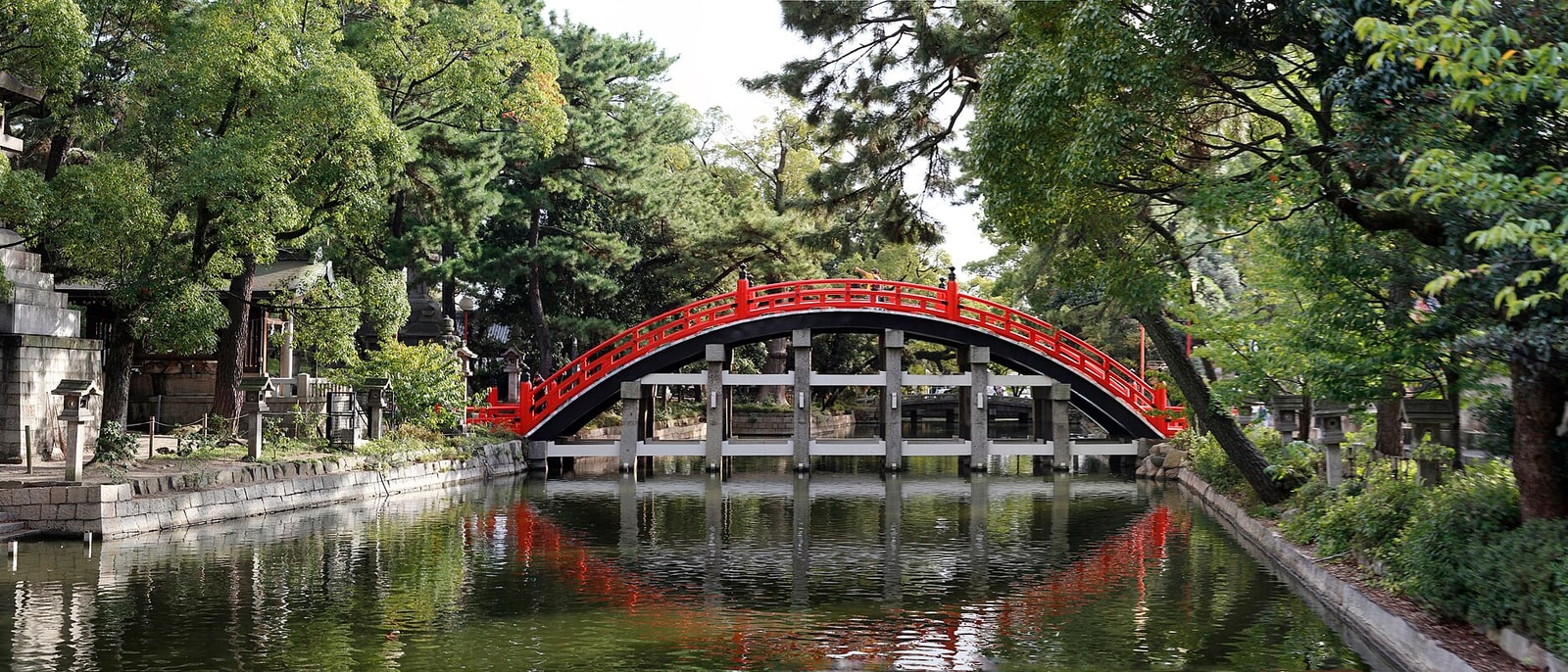
Sumiyoshi Taisha has stood longer than almost any shrine in Japan, and its interest is architectural: the sumiyoshi-zukuri style predates the arrival of Buddhism from the continent, so it has none of the Chinese influence visible in almost everything else. Straight roofs, with no curve, and four halls arranged in a way repeated nowhere else. In front of it stands a red arched bridge so steep that you climb rather than cross it. That isn’t a whim: climbing it is traditionally understood as an act of purification before entering. It’s in the south of the city, reached by tram or on the Nankai, and there are almost no tourists.
- 02
Shitenno-ji
Prince Shotoku had it built in 593, when Buddhism had just reached Japan and was in dispute with the local religion: it’s among the country’s first Buddhist temples and the first raised by the state. The arrangement of its buildings in a straight line (gate, pagoda, main hall, lecture hall) is the oldest surviving model.
The present buildings are reconstructions, because it burned many times, most recently in the 1945 bombing. But they’ve always been rebuilt to the original layout. On the 21st of each month a large market fills the grounds, with antiques and food, which is when it’s most worth going.
- 03
Yumeshima: what’s left of the Expo
The 2025 World Expo was held on the artificial island of Yumeshima from 13 April to 13 October, and for two years it was why many guides recommended coming to Osaka. Today there’s nothing to visit: dismantling began in December 2025 and continues.
What does remain is an interesting story. Sou Fujimoto’s Grand Ring, a two-kilometre timber ring that broke the world record for a wooden structure, hasn’t been pulled down whole: some two hundred metres of the north-eastern stretch are being kept, with part of its rooftop walkway, for a future municipal park. The rest has been distributed: some four thousand cubic metres of timber have gone to more than sixty places in twenty prefectures, including the city of Suzu, on the Noto peninsula, for public housing.
The island is earmarked for a leisure complex with a casino planned for around 2030. If someone recommends going to Yumeshima, the recommendation predates October 2025.
- 04
Universal Studios and the Nintendo world
Universal Studios Japan sits out west by the port, and plays its strong card with Super Nintendo World, which opened here in 2021 before Hollywood or Singapore: a Mushroom Kingdom built to scale with blocks that chime when you hit them, and an augmented-reality kart race. It’s a full day and it’s worth checking the timed-entry system beforehand, because in high season access to the Nintendo area is limited. It’s about fifteen minutes by train from Osaka station.
Frequently asked
What’s left of the Osaka Expo’s Grand Ring?
Some two hundred metres of the north-eastern stretch, out of the two kilometres it measured, kept in place for a future municipal park. The rest was dismantled and its timber, around four thousand cubic metres, distributed to more than sixty places in twenty prefectures for reuse.
What to see in Osaka besides the castle and Dotonbori?
Sumiyoshi Taisha, a shrine in an architectural style predating Buddhism with a very steep arched bridge, and Shitenno-ji, founded in 593 and among the oldest Buddhist temples in the country. Both have remarkably few visitors for what they are.