Osaka in a day
9 h route4 stopsBest: March to May and October to NovemberUpdated July 2026
Osaka isn’t visited for its monuments, and it’s worth knowing that up front: if you’ve come looking for temples and gardens, Kyoto is fifteen minutes away by bullet train and that’s where they are. What Osaka has is street, food, and a way of being that resembles nowhere else in Japan.
A day splits neatly in two: the morning at the castle and the little that is monumental, and the afternoon and evening in the south, between Dotonbori and Shinsekai, which is where the city is most itself.
The route, stop by stop
4 STOPS- 01
Osaka Castle
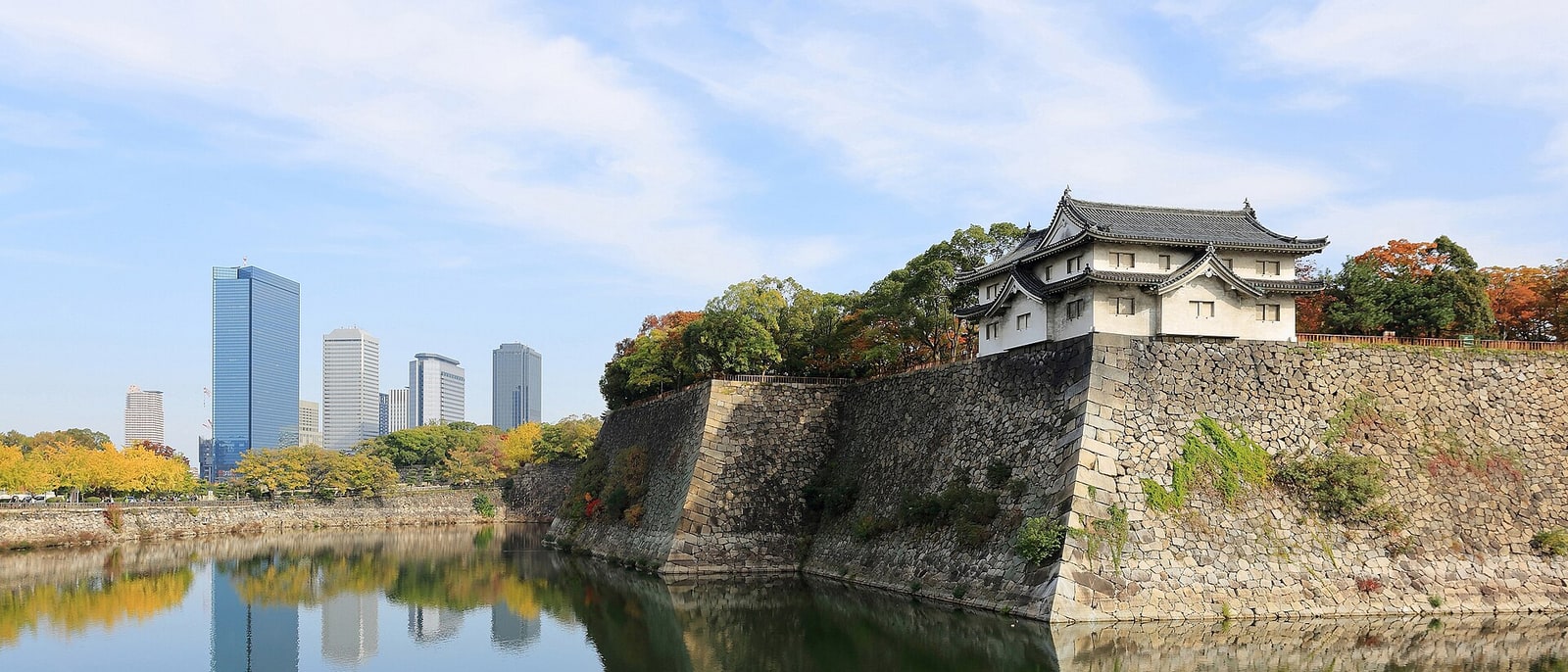
Toyotomi Hideyoshi had it built in 1583 as the most imposing castle in Japan, and from it came the power that unified the country. It burned in the siege of 1615, was rebuilt, burned again after a lightning strike, and what you see today is a 1931 reconstruction in reinforced concrete, paid for by public subscription in the middle of a slump.
Worth knowing before you go in, so you aren’t disappointed: outside it’s a five-storey keep with gilded finials, inside a modern museum with a lift. What is genuinely old is what’s below: the walls and moat, with granite blocks of hundreds of tonnes brought by sea, some still marked by the clans that supplied them.
The surrounding park is enormous and free, and in spring it’s one of the best places in the city for the cherry blossom.
- 02
Dotonbori
Dotonbori piles up along a canal, a walkway on each side, the illuminated signs, the giant mechanical crabs and the restaurants that make up the image everyone has of Osaka. It was the theatre district from the seventeenth century, and that’s where the racket comes from. The Glico runner sign went up in 1935 and is now in its sixth version, LED since 2014. The Ebisubashi bridge in front of it is where half the city takes the photo with arms raised in imitation. Around it are the takoyaki stalls and the queues outside the restaurants that appear everywhere.
- 03
Shinsekai and the Tsutenkaku tower
Shinsekai, “new world”, was built in 1912 copying two models at once: the northern half imitated Paris, with a tower inspired by the Eiffel, and the southern half Coney Island. The area was then left behind for decades and today keeps a 1950s air you won’t find anywhere else in Japan.
The present Tsutenkaku dates from 1956, because the original was dismantled during the war for its iron. At the top sits the Billiken, a grinning figure of American origin adopted here as a god of luck: you rub the soles of its feet to make a wish. This is the kushikatsu district, and where the no-double-dipping rule lives.
- 04
The Umeda Sky Building
To the north, in Umeda, two forty-storey towers are joined at the top by a circular platform, the Floating Garden, assembled on the ground and hoisted whole with hydraulic jacks in 1993. You go up on glazed escalators that cross the void between the towers more than a hundred metres up, and that’s half the visit right there. At the top is an open roof deck with the whole city below and, on a clear day, the sea. It’s the view of Osaka, and it works especially well at dusk, when the lights of the north come on.
Frequently asked
Is Osaka Castle worth it?
Yes, knowing what it is: the present keep is a 1931 concrete reconstruction with a lift and a museum inside, not a historic building. What is genuinely old are the walls and moat, with granite blocks of hundreds of tonnes. The park is enormous, free and spectacular in spring.
Can you visit the Expo 2025 site in Osaka?
No. The Expo ran from 13 April to 13 October 2025 and the Yumeshima site has been under dismantling since December 2025. Some two hundred metres of the Grand Ring will be kept for a future municipal park, but there’s no visit today: the island is earmarked for a casino resort around 2030.