Eating and drinking in Osaka
3 h route4 stopsBest: All yearUpdated July 2026
In Osaka two words explain the whole city. One is kuidaore, which means eating yourself into ruin and which locals use as a point of pride. The other is tenka no daidokoro, “the kitchen of Japan”, the nickname it earned in the Edo period, when all the country’s rice passed through here before being distributed.
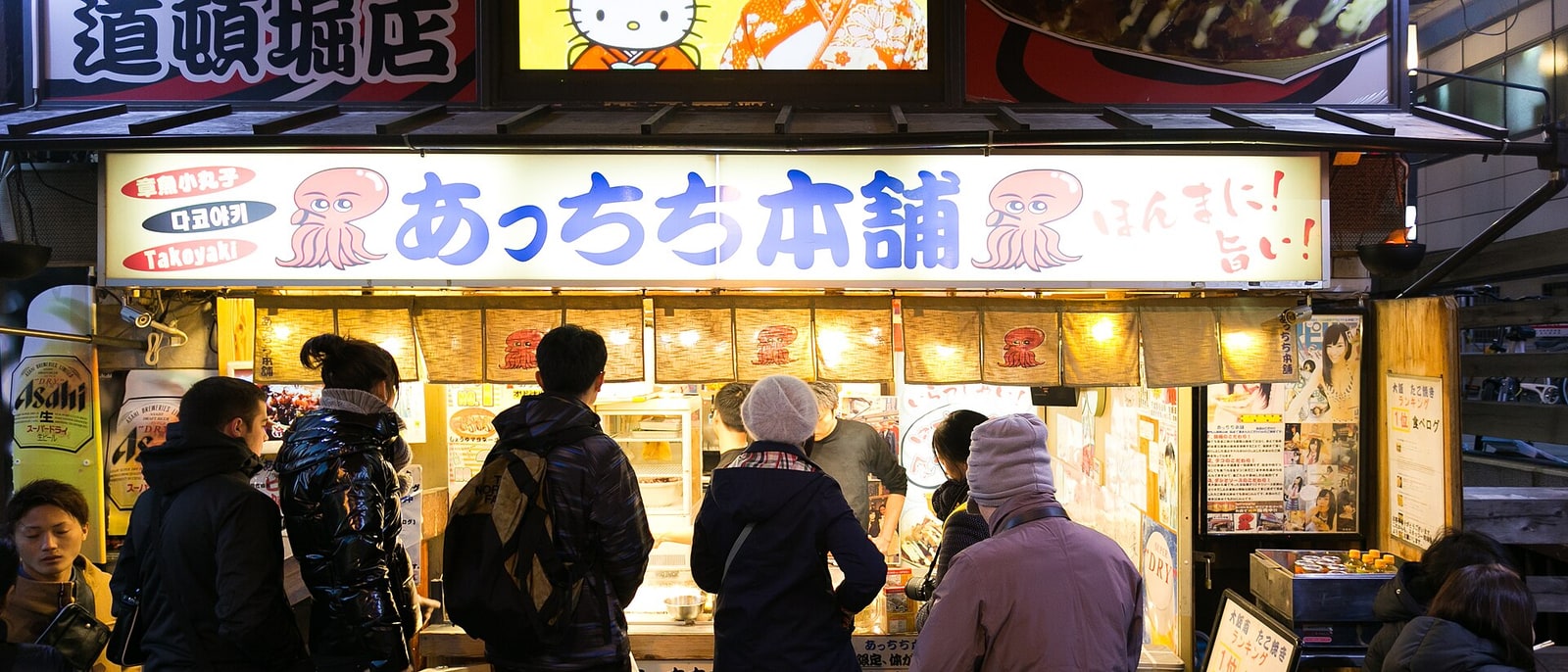
The practical consequence is that here you eat standing, at stalls, and change places every couple of mouthfuls. High-end cooking exists, but it isn’t what defines Osaka.
The route, stop by stop
4 STOPS- 01
Takoyaki
Balls of batter with a piece of octopus inside, made on a griddle of half-spherical dimples that the cook turns with two picks at a speed that looks like a trick. They were invented in Osaka in 1935 and are the city’s street symbol.
They come with thick sauce, mayonnaise, powdered seaweed and bonito flakes that move in the heat and look alive.
Serious warning: inside they’re nearly liquid and at lava temperature. You have to wait, and even then the first one always burns.
- 02
Okonomiyaki, the Osaka way
Okonomiyaki means roughly “grilled how you like”. In Osaka the batter, chopped cabbage and the rest of the ingredients are mixed in a bowl and everything goes on the griddle together. In Hiroshima, by contrast, it’s layered and made with noodles. Saying in Osaka that Hiroshima’s is better starts a long argument.
Many places have the griddle set into your table and let you cook it yourself, with varying degrees of supervision. It comes with sauce, mayonnaise, seaweed and bonito, like takoyaki.
A close relative is negiyaki, thinner and with spring onion instead of cabbage.
- 03
Kushikatsu and the sauce rule
Kushikatsu come as skewers of meat, vegetable, cheese or whatever else, coated in fine breadcrumbs and fried. You order them one at a time and they’re the food of Shinsekai, the district where they were born.
The rule: on every table there’s a communal pot of sauce and you dip the skewer ONCE, before the first bite. No dipping again after biting, for obvious shared-hygiene reasons.
If you want more sauce, take a piece of the raw cabbage they put out free and use it as a spoon. It’s on signs everywhere and they’ll tell you kindly if you forget.
- 04
Kuromon market and the butaman
Kuromon market has been running for some two hundred years and was where the city’s restaurants bought. Today it’s half market, half takeaway street: grilled scallops, tuna cut in front of you, expensive perfect fruit, sea urchins opened on the spot. It has become very touristy, but the quality holds.
And there’s a queue you’ll see all over the city, in the stations above all: the one for 551’s butaman, steamed pork buns that are Osaka’s standard afternoon snack and travel gift.
They come with mustard and soy sauce, and are eaten walking.
Frequently asked
What should you eat in Osaka?
Takoyaki at a street stall, invented here in 1935, okonomiyaki Osaka style, everything mixed before it hits the griddle, and kushikatsu in Shinsekai. For a snack, a steamed butaman. And all of it standing and moving on, which is what kuidaore means.
Why can’t you double dip with kushikatsu?
Because the pot of sauce on each table is shared and everyone uses it. You dip the skewer once, before the first bite. If you want more, use a piece of the free raw cabbage to spoon it over. It’s posted on signs in every place.