OZU /BRAZIL /RIO DE JANEIRO /GUIDE
Rio in a day
9 h route4 stopsBest: Do Christ and Sugarloaf on separate days: both need a clear skyUpdated July 2026
There is no river in Rio de Janeiro. The Portuguese expedition that came in here on 1 January 1502 saw an enormous mouth of water between mountains, assumed it was the outflow of a large river and wrote it down that way: river of January. It was a bay. Nobody corrected the error, the name stuck, and five hundred years later Brazil’s most famous city is named after a geographic feature that doesn’t exist.
That error is the best way in here, because it warns you of something: in Rio, almost nothing is what it looks like at first glance. The forest around the city is planted by hand. Christ was manufactured in France. The cliff photo is a perspective trick. And carnival isn’t a party, it’s a competition with judges. A day here is done by looking at the landscape, which is colossal, and knowing what you’re actually looking at.
The route, stop by stop
4 STOPS- 01
Christ the Redeemer
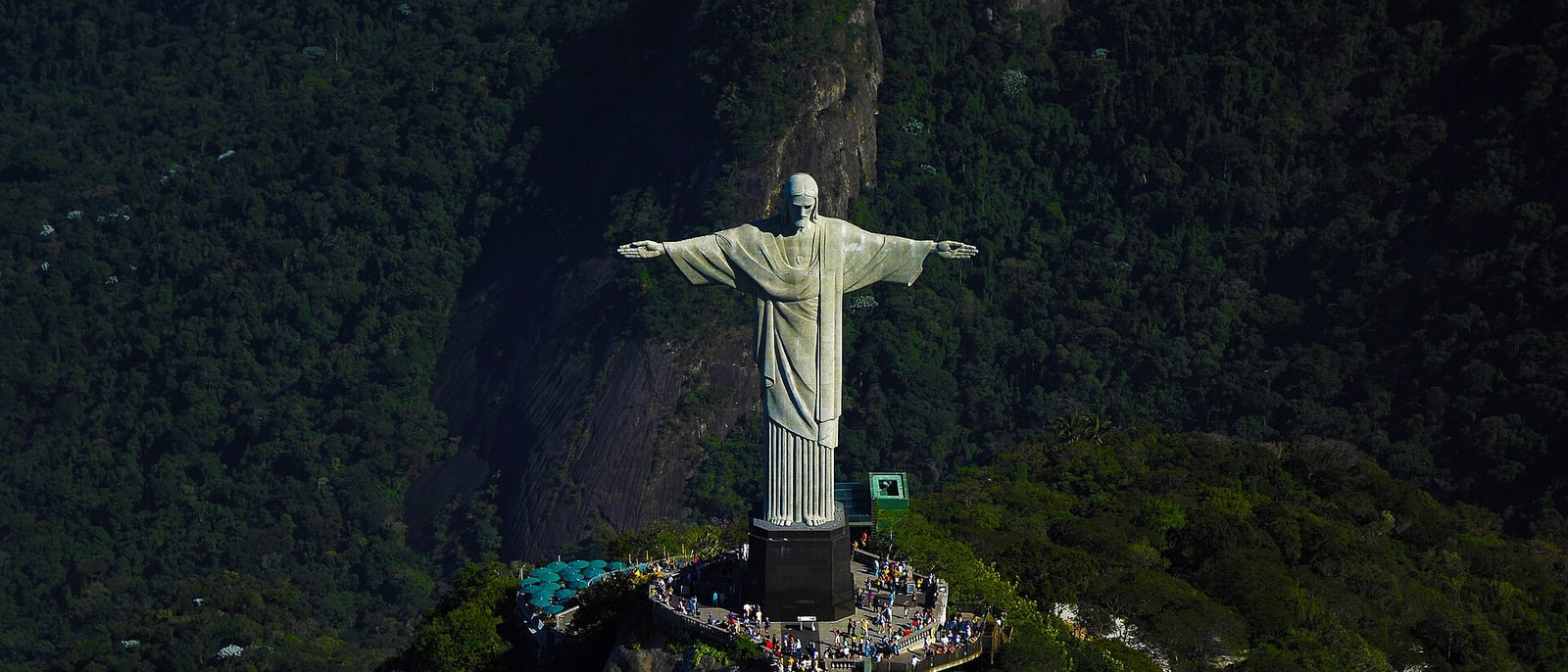
Thirty metres of figure on an eight-metre pedestal, on top of a seven-hundred-metre peak, finished in 1931. What almost nobody knows is that it wasn’t made here: the sculptor was French, the head and hands were modelled in France and the pieces arrived in Brazil by ship, to be assembled up top. The funding didn’t come from the state: it came from a public subscription and the Church.
And there’s a detail that justifies the trip. The statue is reinforced concrete covered in thousands of soapstone tesserae, a soft stone from Minas Gerais that cuts easily and survives the weather. They were stuck on by hand, one by one, and the women volunteers doing that work wrote messages on the backs of the stones before laying them: names, prayers, dedications. They’re there, against the concrete, unreadable. Thousands of hidden messages inside the most photographed monument in the southern hemisphere.
Go early and with a clear sky: if there’s cloud, you’ll see nothing and there’s no refund.
- 02
Sugarloaf
A block of granite nearly four hundred metres high rising from the sea at the mouth of the bay. You go up in two cable car stages, and the good fact is the date: the first stage opened in 1912, which makes it one of the first passenger cable cars in the world. Hanging cables from a granite wall over the sea in 1912, without helicopters, is a feat that’s hard to picture today.
The name comes from a shape that no longer exists: in colonial times, refined sugar was sold in conical blocks, moulded in clay vessels called sugarloaf forms. The rock has that exact shape, hence the name. It’s a vanished industrial object turned into a place name.
And the tip that decides the visit: go up at dusk. You see the city, the bay, the beaches and Christ facing you on the other peak, and as the sun drops the lights come on while you’re up there. It’s one of the few things in the world that justify the queue and the price.
- 03
Copacabana and Ipanema
Start with the first thing: real neighbourhoods, with residents, schools and bakeries, not sets. And the beach here doesn’t work as it does in Europe, so it pays to know the rules before turning up with a cool box.
Nobody brings anything. You arrive with what you’re wearing, you ask the kiosk man for a chair and an umbrella, he plants it, and from then on everything comes to you: ice-cold beer, coconut water, corn, grilled cheese, prawns, bikinis, sunglasses. A constant parade of vendors across the sand. You don’t get up.
And there’s a social map cariocas read and you don’t: the beach is divided by numbered lifeguard posts, and each has its tribe. In Ipanema, post nine is the young alternative crowd, post eight is the LGBT scene, and so on. Ask or look before dropping your towel. And don’t take anything valuable down: no phone, no watch, no wallet. Just the day’s cash in your swimming shorts.
- 04
The tiled staircase
Between Lapa and Santa Teresa there’s a staircase of two hundred-odd steps covered entirely in coloured tiles, with over two thousand pieces brought from sixty countries. One person made it: Jorge Selarón, a Chilean artist who came to Rio, moved into a house on that staircase and started tiling it in 1990 as a personal project.
He never stopped. He worked on it for over twenty years, changing it constantly, taking tiles off and putting them on, funding it by selling his paintings and with pieces people sent him from all over the world. He said it was a homage to the Brazilian people and that the work would only finish on the day of his death.
He was found dead on that staircase in 2013, in circumstances never fully clarified. The staircase is kept exactly as he left it.
It’s free, it’s always full of people and it takes less than half an hour, but knowing the story it stops being a colourful photo and becomes something else.
Frequently asked
What to see in Rio in a day?
Christ and Sugarloaf, but both demand a clear sky, so do them on separate days or check the forecast and decide in the morning. The Sugarloaf cable car is from 1912, one of the first in the world, and you should go up at dusk. Copacabana or Ipanema, knowing that here you don’t bring a towel or a cool box: you rent a chair and everything else comes to you. And the Selarón staircase, which one Chilean made alone over twenty years.
Why is it called Rio de Janeiro if there’s no river?
An error nobody corrected. The Portuguese expedition came in here on 1 January 1502, saw an enormous mouth of water between mountains, assumed it was the outflow of a large river and wrote it down that way: river of January. It was a bay, Guanabara. The name stuck, and five hundred years later Brazil’s most famous city is named after a geographic feature that doesn’t exist.