Athens in a day
9 h route4 stopsBest: April-May or October. In summer the marble at midday is uninhabitableUpdated July 2026
The Parthenon was practically intact until 1687. That’s the first thing to get out of your head on the way up: the ruin you’re about to see wasn’t made by twenty-three centuries of wind. In 1687 the Venetians were besieging Athens, which was Ottoman, the Ottomans kept their gunpowder inside the temple, because they reckoned it the most solid building in the city, and a Venetian mortar found it. The building had stood for two thousand years and it broke in an afternoon.
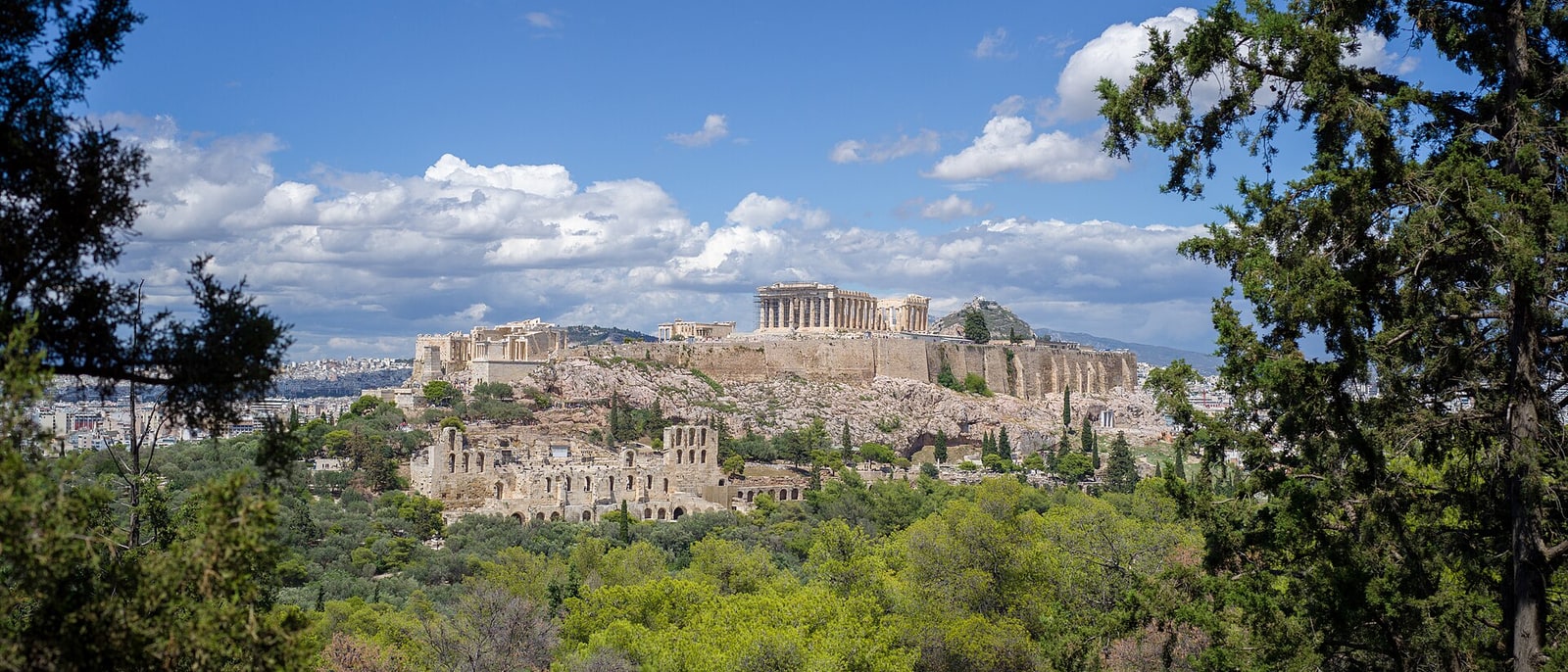
With that in mind, the Acropolis stops being a heap of old stones and becomes what it is: a building that was a Greek temple, then a church, then a mosque, then an ammunition store, and which had its middle blown out by a shell. A day in Athens starts up there, early, and then comes down into the city. And it genuinely comes down: almost everything else is at the foot of the rock, within a twenty-minute walk.
The route, stop by stop
4 STOPS- 01
The Acropolis
Go up first thing or last thing, and that isn’t comfort advice: in summer the marble and the rock throw back heat in a way you have to feel to believe, and at midday the place isn’t visitable, it’s a punishment. With the gate just open, besides, you get the rock nearly empty for half an hour.
And up there, look for what almost nobody looks at: the Parthenon doesn’t have a single straight line. The columns swell in the middle, the platform it stands on curves upward, and every column leans inward, so slightly you can’t see it, but if you extended them into the sky they’d meet a kilometre and a half up. None of that is an error or a coincidence: they’re deliberate optical corrections, calculated so the human eye reads it as straight.
It was built crooked on purpose so it would look perfect. That, in the fifth century BC.
- 02
The Acropolis Museum
At the foot of the rock, few museums are better conceived than this one, for two reasons. The first you see on walking in: the building was raised over an excavated ancient neighbourhood, and instead of covering it they laid glass floors, so you walk above streets and houses two thousand years old as you go up.
The second is the top floor, and it’s a political argument built in concrete. That hall was constructed to the exact dimensions and orientation of the Parthenon, and the surviving friezes are placed in it. The missing ones (those Lord Elgin took in the early nineteenth century, now in the British Museum) are replaced by white copies, obvious, different. They aren’t disguised: they’re underlined. The whole hall is a permanent accusation without a single word.
Going up the rock first and coming down here after is the right order, not the other way round.
- 03
The ancient Agora
Below the Acropolis, on the north side, is the Agora: the public square of ancient Athens, where the real things happened (politics, trials, trade) while the gods were up above. Today it’s a large park of low ruins and olive trees, far calmer than the rock and with far fewer people.
And there stands the Hephaisteion, the best-preserved Greek temple in existence: it has its roof, it has its columns, it’s whole. The reason it survived is the key: for some thirteen hundred years it was a Christian church, and so it was maintained, repaired and never turned into a quarry like all the others. The temples that survived in the Greek world are almost always the ones somebody reused. The Parthenon was a church and a mosque too, and it would have done fine but for the gunpowder.
- 04
Plaka at dusk
The quarter at the foot of the Acropolis, of narrow lanes, bougainvillea and steps. It’s the most touristed part of the city and it needs saying plainly: the main streets are taken over by restaurants with laminated menus in six languages and a man at the door inviting you in. Eat there and you’ll eat badly and expensively.
What to do is climb. The closer to the rock and the higher, the better: the lanes narrow, the touts disappear and the real quarter appears, with cats, geraniums and residents. And right at the top is Anafiotika, which deserves the stop.
Dusk is the hour: the rock turns orange, the Parthenon’s floodlights come on and from any rooftop in the quarter you get the view people pay expensive covers for. Have a drink at one and eat two streets away afterwards.
Frequently asked
What to see in Athens in a day?
The Acropolis first thing (in summer, at midday, the marble is uninhabitable) the Acropolis Museum after, with its top floor built to the Parthenon’s exact dimensions and the gaps for what’s missing marked on purpose, the ancient Agora, with the Hephaisteion, the best-preserved Greek temple in existence, and Plaka at dusk, climbing the upper lanes.
Why is the Parthenon in ruins?
Not from the passage of time: it was practically intact until 1687. That year the Venetians were besieging Ottoman Athens, the Ottomans kept their gunpowder inside the temple because they reckoned it the city’s most solid building, and a Venetian mortar found it. Two thousand years standing and it broke in an afternoon. Before that it had been a temple, a church and a mosque.