What to see in Athens
8 h route4 stopsBest: Start at eight in the morning. Genuinely, the heat is in chargeUpdated July 2026
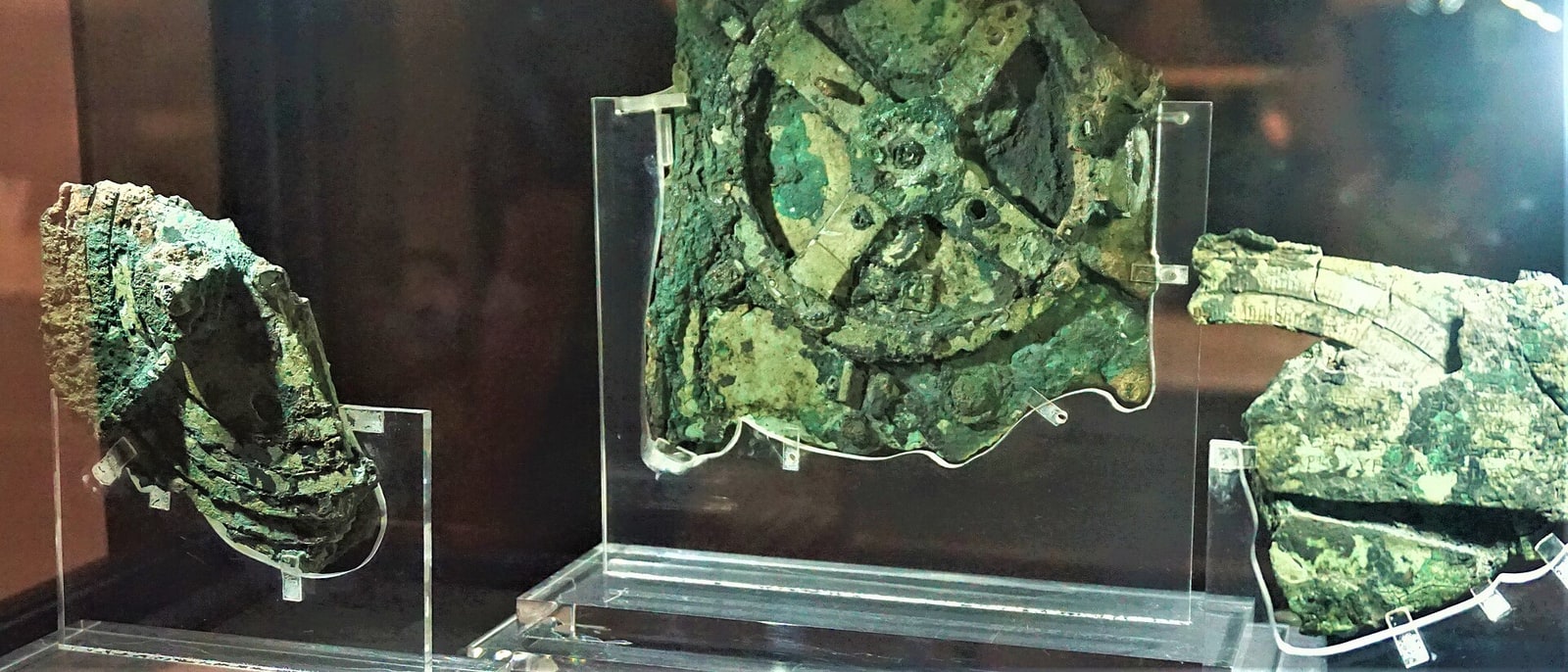
In one case at the National Archaeological Museum there’s a bronze computer over two thousand years old, and almost nobody goes into that room. That happens all the time in Athens: the Acropolis takes all the attention and two hundred metres away there are equally extraordinary things with half the queue. It’s worth spreading your time better.
What to understand about this city is that its heritage isn’t arranged into a pretty route: it’s scattered among apartment blocks, sometimes in a bare lot, sometimes under a metro station, almost always with no staging. A huge temple beside a six-lane avenue, an ancient cemetery behind a workshop. It’s a modern city with two and a half thousand years stuffed inside it, and you have to go and find them.
The route, stop by stop
4 STOPS- 01
The Antikythera mechanism
At the National Archaeological Museum, far from the rock and with no queues, there’s a case with some fragments of corroded bronze full of tiny gears. It came out of a shipwreck off the island of Antikythera in 1901, was made around the first or second century BC, and served to calculate the positions of the sun, moon and planets and predict eclipses. It’s an analogue computer.
The disturbing part isn’t that it existed: it’s what came after. Nothing with that gearing complexity is known until the astronomical clocks of medieval Europe, over a thousand years later. Which is to say, it was lost. Somebody knew how to do this and the knowledge vanished for a millennium.
That object, in that case, is the best history lesson in Athens, and it’s in a museum most visitors to this city never enter. The same museum has the mask Schliemann attributed to Agamemnon, an attribution that doesn’t hold, and bronzes pulled from the sea.
- 02
The Panathenaic Stadium
A horseshoe stadium, with white marble stands from the ground to the last row, wedged into a dip in the middle of the city. It’s the only stadium in the world built entirely of marble, and it’s one of those things photos don’t convey and proximity does: fifty thousand seats of polished stone.
The history is three layers. The original stadium is fourth century BC, of earth, in the second century AD a rich Athenian rebuilt it in marble, it was abandoned, stripped and vanished underground for centuries.
And in the nineteenth century it was excavated and remade, with marble from the same mountain as the Parthenon, for the first modern Olympic Games of 1896. It’s still used: it’s where the Athens marathon finishes and where the Olympic flame is handed over before every Games.
- 03
The changing of the guard
In front of parliament, on Syntagma square, two soldiers stand motionless in pleated skirts, white stockings and red shoes with an enormous pom-pom. Every hour they change over with an extremely slow, exaggerated step that looks like choreography and throws everyone seeing it for the first time.
None of it is decorative. The uniform is the clothing of the fighters of the war of independence against the Ottomans: the pleated skirt is called a fustanella and tradition holds that its pleats number four hundred, one for each year of Ottoman rule. The shoes have nails in the sole so they sound against the marble, and they’re genuinely heavy.
And the slow step isn’t theatre: it keeps the blood moving when you’ve been nailed to a spot for an hour. Sunday at eleven is the big change, with the whole unit and the band.
- 04
What they found digging the metro
When Athens built its modern metro, ahead of the 2004 Games, it ran into the predictable: you can’t dig in this city without hitting something. The works became the largest archaeological excavation in Athens’ history, with years of delay and tens of thousands of objects recovered.
And instead of putting it all in a store, they left it in view where it came out. At Syntagma station there’s a stratigraphic wall: a slice of ground cut vertically, with two and a half thousand years of layers stacked on each other, graves included, protected behind glass. It’s in the concourse, free, and passers-by look at it.
It’s the best way to understand this city: it isn’t an ancient city with modern buildings, it’s a modern city standing on top of the other one, and every time it opens a hole, it shows.
Frequently asked
What to see in Athens besides the Acropolis?
The National Archaeological Museum, home of the Antikythera mechanism, a bronze analogue computer over two thousand years old, which almost nobody visits, the Panathenaic Stadium, the only one in the world made entirely of marble, from the 1896 Games, the changing of the guard at Syntagma, and the stratigraphic wall at Syntagma metro station, free, with 2,500 years of layers behind glass.
What is the Antikythera mechanism?
A bronze artefact full of gears, recovered from a shipwreck in 1901 and made around the first or second century BC, which calculated astronomical positions and predicted eclipses: an analogue computer from antiquity. The disturbing part is that nothing of that mechanical complexity is known for over a thousand years afterwards. It’s in the National Archaeological Museum in Athens.