OZU /UNITED ARAB EMIRATES /ABU DHABI /GUIDE
What to see in Abu Dhabi
8 h route4 stopsBest: The mosque at dusk. The Louvre at midday, when the light comes inUpdated July 2026
The prayer hall carpet in the Grand Mosque was hand-knotted by over twelve hundred people in Iran, over years. It arrived in Abu Dhabi in pieces, in several shipments, and was sewn together inside until it formed one single carpet of thousands of square metres: the largest hand-knotted one in the world. The seams exist, but they’re made so you neither see them nor feel them underfoot.
That fact says how this city works: things here aren’t made at a reasonable scale, they’re made at whatever scale is needed for them to be the biggest of their category, and the world’s best craftsmen are brought in to make them. What to see in Abu Dhabi is four or five big pieces, all from this century bar one, and that one, a mud tower over a well, is what gives the other four their meaning.
The route, stop by stop
4 STOPS- 01
The Louvre’s dome
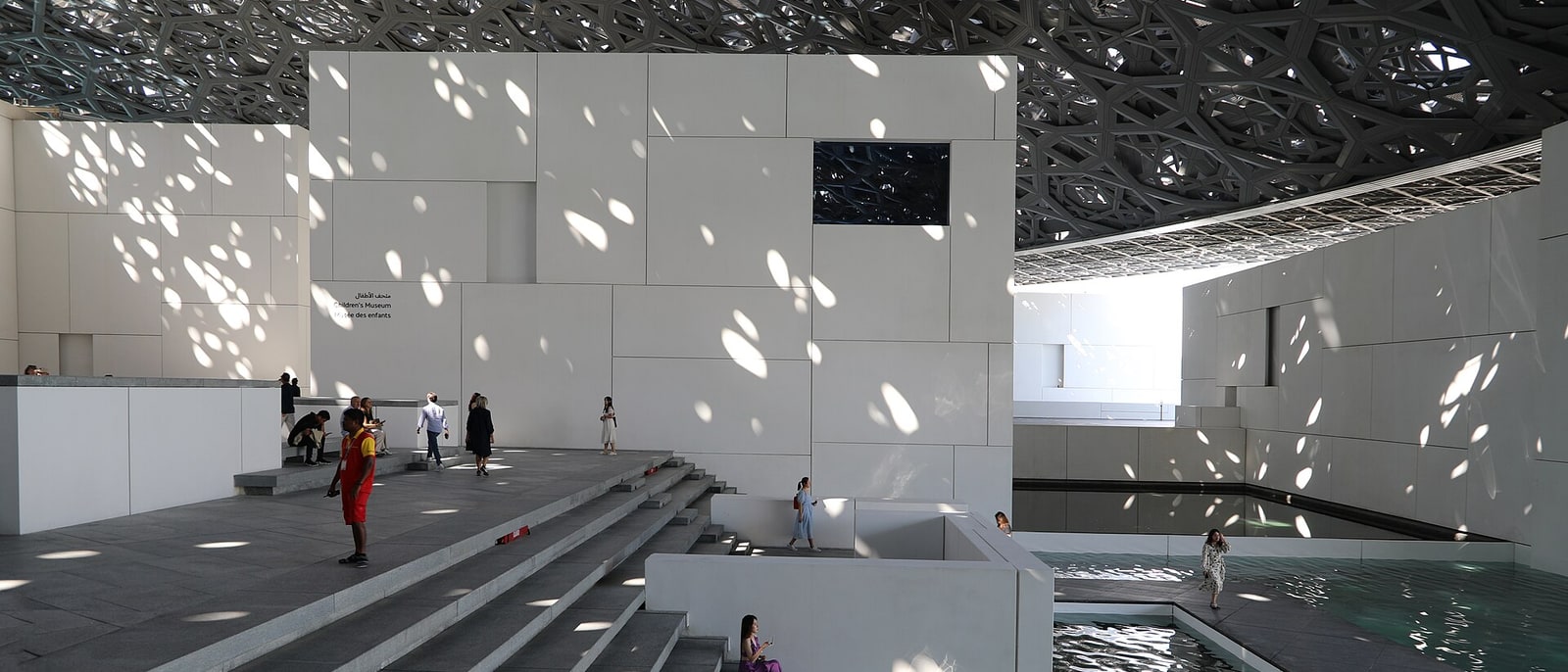
The dome is nearly two hundred metres across and is made of eight superimposed layers of perforated metal stars, four outside and four inside, rotated against each other. Sunlight passes through all eight, and what falls to the ground isn’t a beam but thousands of points moving through the day with the sun’s position. It’s called a rain of light and it’s inspired by how light comes through the leaves of a palm grove.
The structure weighs roughly what the Eiffel Tower weighs and rests on just four pillars, hidden inside the buildings below, so from outside it appears to float. Beneath it are fifty-odd white buildings separated by water channels connected to the sea, imitating a medina.
Go at midday, against all intuition: that’s when the sun is highest and the dome’s effect works at full strength. Inside, give time to the first room, where they place ritual objects from different religions made in the same period side by side. That’s the whole museum’s argument.
- 02
The Grand Mosque, up close
From a distance it looks like an enormous white mass. Up close it’s craftsmanship, and you should crouch and look at the courtyard floor: the flowers and garlands covering it aren’t painted and aren’t mosaic. They’re set into the marble, piece by piece, with the Florentine technique of stone intarsia, using lapis lazuli, jade, amethyst and mother-of-pearl. That courtyard is a single painting of thousands of square metres made from coloured stone.
Inside, the carpet and the lamps. Outside, eighty-two domes and four minarets deliberately mixing three different architectural traditions of the Islamic world, because this country had none of its own. Sheikh Zayed, founder and first president of the Emirates, is buried here and there are people praying for him at all hours.
It’s free, you must be covered, robes lent at the door, and there are behaviour rules enforced firmly, photo poses included. It’s an active place of worship before it’s a monument, and that shows.
- 03
The palace you can visit
Qasr Al Watan, the presidential palace of the Emirates, still receives heads of state. In 2019 they decided to open much of it to the public, and that gesture is unusual: it isn’t a palace museum, it’s the active seat of this country’s power, and you can go in and walk the rooms where things get signed.
Inside it’s white marble, domes and a central hall with a giant chandelier and an Islamic geometry you can follow with your eyes for a long while. There’s the council chamber, the banqueting hall and a library with manuscripts. It’s brazenly ostentatious and that’s the point: it’s built so that whoever enters understands who’s in charge here.
It’s recent, finished in 2017, and it pretends nothing else. Go in the afternoon and stay for the façade light show, which is free with the ticket and rather better than it sounds.
- 04
The mangroves
No postcard shows this, Abu Dhabi’s best surprise: the city has a mangrove forest inside its boundary, with saltwater channels between the roots, and you cross it by kayak. Silence, herons, flamingos in season and fish jumping, with the centre’s towers showing above the trees.
Gulf mangroves are a brutal ecosystem: they’re trees living with their roots in salt water that expel the salt through their leaves. Here they protect the coast, filter the water and are the nursery for much of the marine life in this stretch of sea. They’re protected, there are restricted areas and a fair amount has been replanted in recent decades, within the tree-planting policy this country has run since its founding.
You go out first thing or at dusk, which is when the wildlife is about and when you don’t roast. After a Louvre and a mosque for forty thousand people, getting in there to paddle is the best possible contrast.
Frequently asked
What must you see in Abu Dhabi?
The Sheikh Zayed Grand Mosque, free, with its courtyard of flowers set into marble and the largest hand-knotted carpet in the world, the Louvre Abu Dhabi and its dome of eight perforated layers that makes light rain, the Qasr Al Watan presidential palace, which can be visited, the Qasr Al Hosn fort, over the well that explains the city, and the mangroves, crossed by kayak inside the city boundary.
Is the Abu Dhabi Grand Mosque free?
Yes, entry is free, and they lend robes at the door to anyone who needs them: you must be covered, men and women. It’s an active place of worship before it’s a monument, with behaviour rules enforced firmly, photo poses included. Go at dusk: the exterior lighting changes colour according to the moon’s phase that night.