OZU /UNITED ARAB EMIRATES /ABU DHABI /GUIDE
Day trips from Abu Dhabi
10 h route4 stopsBest: November to March. In summer the interior is simply lethalUpdated July 2026
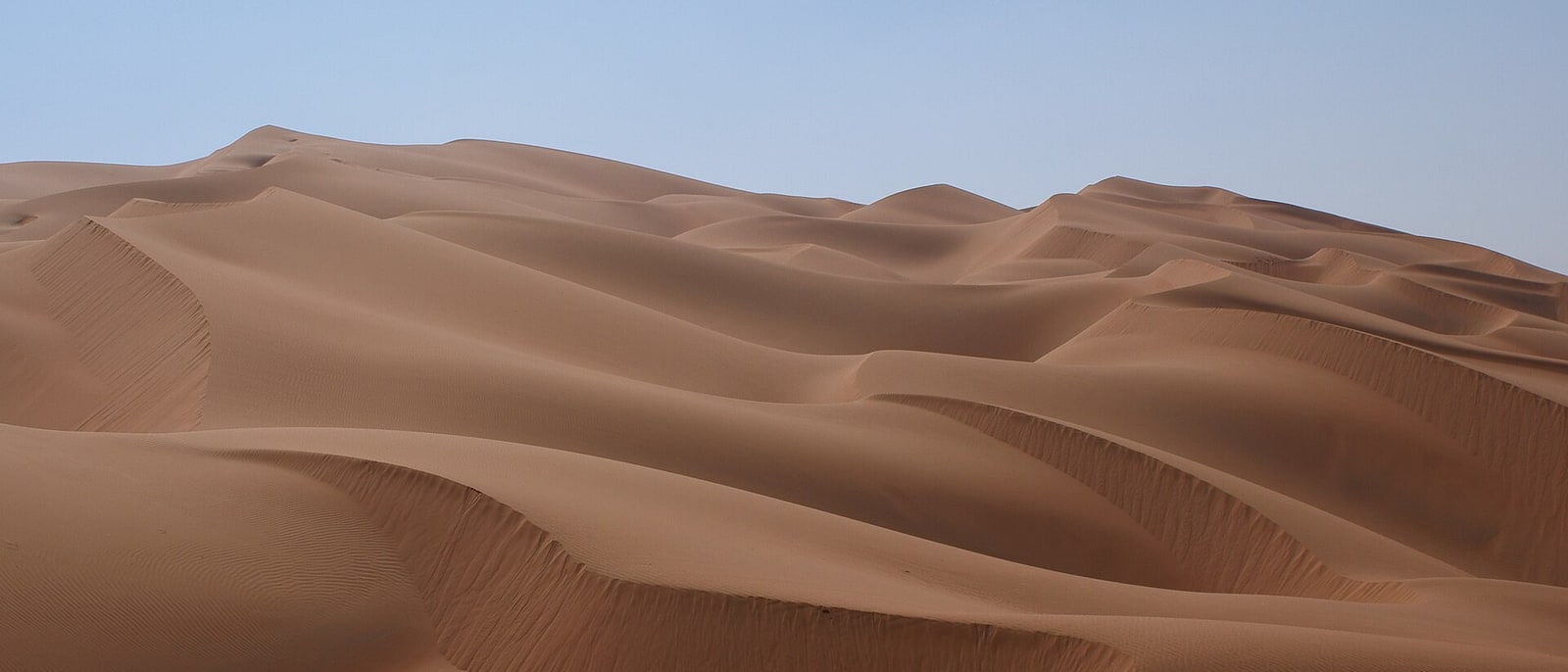
A couple of hours from the Corniche the Rub’ al Khali begins, the Empty Quarter: the largest continuous sand desert on the planet, a sea of dunes the size of France covering much of the Arabian peninsula and in which practically nobody lives. The Arabs named it themselves and it describes exactly what’s there. The dunes reach heights that are hard to believe and the silence inside is a physical phenomenon.
That’s Abu Dhabi’s neighbour, and it’s the best trip you can make from here alongside the other one: Al Ain, the oasis on the Omani border where water has been shared through gravity channels for three thousand years. Both tell the same story from opposite sides: how you live in a place with no water. And both have the same condition, which isn’t negotiable: from May to September, this isn’t done.
The route, stop by stop
4 STOPS- 01
Liwa and the Empty Quarter
Two and a half hours to the southwest is Liwa, an arc of oases on the edge of the great sand desert, and behind it the real dunes begin: some of the tallest in the world, three-hundred-metre mountains of sand you can climb in a 4×4.
And here’s the fact that gives all of Abu Dhabi its meaning: from this oasis came the Bani Yas tribe, which is where the family ruling the country comes from. They lived here, off dates and camels, and moved to the coast in summer to dive for pearls. When they found the well on the island, they settled there. Which means the straight line runs from these palm groves to the Louvre in two and a half generations.
You can sleep in the desert, you can climb the big dune and there’s a road to the top of one of them. Take plenty of water, don’t go into the sand without a guide and never do it in summer: the heat here kills and that isn’t a figure of speech.
- 02
Al Ain
A real oasis with over a hundred thousand palms, World Heritage, an hour and a half from the coast. You walk inside it, between the plots, in shade, and it’s several degrees cooler than outside: it’s the original air conditioning.
What to understand is the falaj, the irrigation system, which has run for three thousand years and still waters this today. They’re channels bringing water from aquifers and mountains kilometres away, by gravity, without a single pump, calculating a minimal gradient across enormous distances. And it isn’t only engineering: it’s law. The water is shared between families in turns measured in time, a system that is inherited, bought and sold, and that has worked for millennia without a computer.
Beside it is Jebel Hafeet, twelve hundred metres with a hairpin road to the top, and at its foot are tombs five thousand years old, also World Heritage. Al Ain is the best of this emirate and almost nobody goes.
- 03
The animal island
About three hours west, and then a ferry, there’s an island that is one of this country’s oddest stories: Sir Bani Yas. Sheikh Zayed, the founder, turned it in the seventies into a private wildlife reserve and set about planting trees and releasing animals on an island that was bare rock and salt.
Today there are tens of thousands of animals running free: Arabian oryx (the species that went extinct in the wild in 1972 and was brought back by breeding, and for which this island was a key piece) gazelles, giraffes, cheetahs, hyenas. You cross it by 4×4 or by bike and there are no fences around the animals.
That a Gulf country should have a safari of its own, with fauna partly not from here and partly from here and extinct, is a matter you could argue about.
But the oryx is undeniable: fifty years ago not one ran free on the planet and now there are herds, and programmes like this are why. It’s a long day and you have to sleep nearby or there.
- 04
The camel races
In winter there are camel races at inland tracks, early in the morning, and it’s a genuinely local spectacle attended by people from here rather than tourists. Racing camels are worth fortunes, there are bloodlines and there are auctions, and the following is serious.
The first thing you see throws you: the jockeys are robots. Small devices strapped to the hump, with a mechanical arm holding the whip, radio-controlled from the 4×4s racing alongside the track, owners at the wheel giving instructions.
It looks like science fiction and it has a reason that needs telling in full: until the two-thousands, the riders on those camels were children, many brought from South Asia and Africa, the smaller and lighter the better. It was an international scandal documented over years, and under that pressure it was banned and the children were replaced by robots. Which means that ridiculous gadget strapped to the hump is the end of a very ugly story. Seeing it knowing that is another thing entirely.
Frequently asked
What day trips can you do from Abu Dhabi?
Al Ain, an hour and a half away, with its World Heritage oasis watered by three-thousand-year-old channels running on gravity alone, and Jebel Hafeet mountain with five-thousand-year-old tombs, Liwa and the edge of the Empty Quarter, two and a half hours away, the largest continuous sand desert on the planet and where the ruling family came from, and Sir Bani Yas island, with oryx and cheetahs running free. From May to September, none of this.
Why are camel race jockeys robots?
Because they used to be children. Until the two-thousands, the riders on racing camels were minors, many brought from South Asia and Africa, the smaller and lighter the better. It was an international scandal documented over years and under that pressure it was banned and they were replaced by radio-controlled robots operated from the 4×4s racing alongside the track. That device strapped to the hump is the end of a very ugly story.