What to see in Rome
6 stopsUpdated July 2026
Nobody here ever threw anything away: they built on top. That sentence explains the whole of Rome, including the awkward part. It explains why the Forum spent a thousand years buried under ten metres of earth with cows grazing on it. It explains why Piazza Navona is shaped like a racetrack. And above all it explains why this city’s metro has three lines at a generous count: you can’t dig without finding something, and when you find something, the works stop.
The other thing to understand before looking at anything: this was in colour. The temples, the statues, the friezes, all of it was painted in strong colours, and the bare white marble we associate with classical Rome is simply what was left when the paint fell off. Our idea of Roman elegance is, literally, a conservation misunderstanding.
The route, stop by stop
6 STOPS- 01
The Colosseum
From the year 80, fifty thousand spectators and an evacuation system still studied in engineering: seventy-six numbered gates and fired-clay tickets giving sector, row and seat, exactly as today. The stadium emptied in fifteen minutes. Plenty of modern stadiums can’t manage it.
Underneath was the hypogeum, two storeys of tunnels, cages and thirty-six hand-operated lifts that made animals appear in the middle of the arena through trapdoors. You see it exposed today because the wooden floor is gone.
And about the gladiators: most fights didn’t end in death, because a trained gladiator cost a fortune and his owner didn’t want to lose him. The thumbs-down is an invention of a nineteenth-century painting.
- 02
The Pantheon
No building of Roman antiquity has come down in better shape, and the reason is prosaic: in the year 609 it was made a church, and churches didn’t get dismantled to build palaces. Everything else was cut up. This wasn’t.
The dome is still the largest unreinforced concrete dome in the world, nineteen hundred years on. The trick is twofold: Roman cement with volcanic ash, which also sets underwater and self-repairs, and aggregate that lightens as it climbs, basalt at the bottom and pumice at the top, with the thickness dropping from six metres at the base to a metre and a half at the oculus.
Entry is free, it takes twenty minutes, and it’s probably the most impressive building in Europe per square metre.
- 03
The Forum and the Palatine
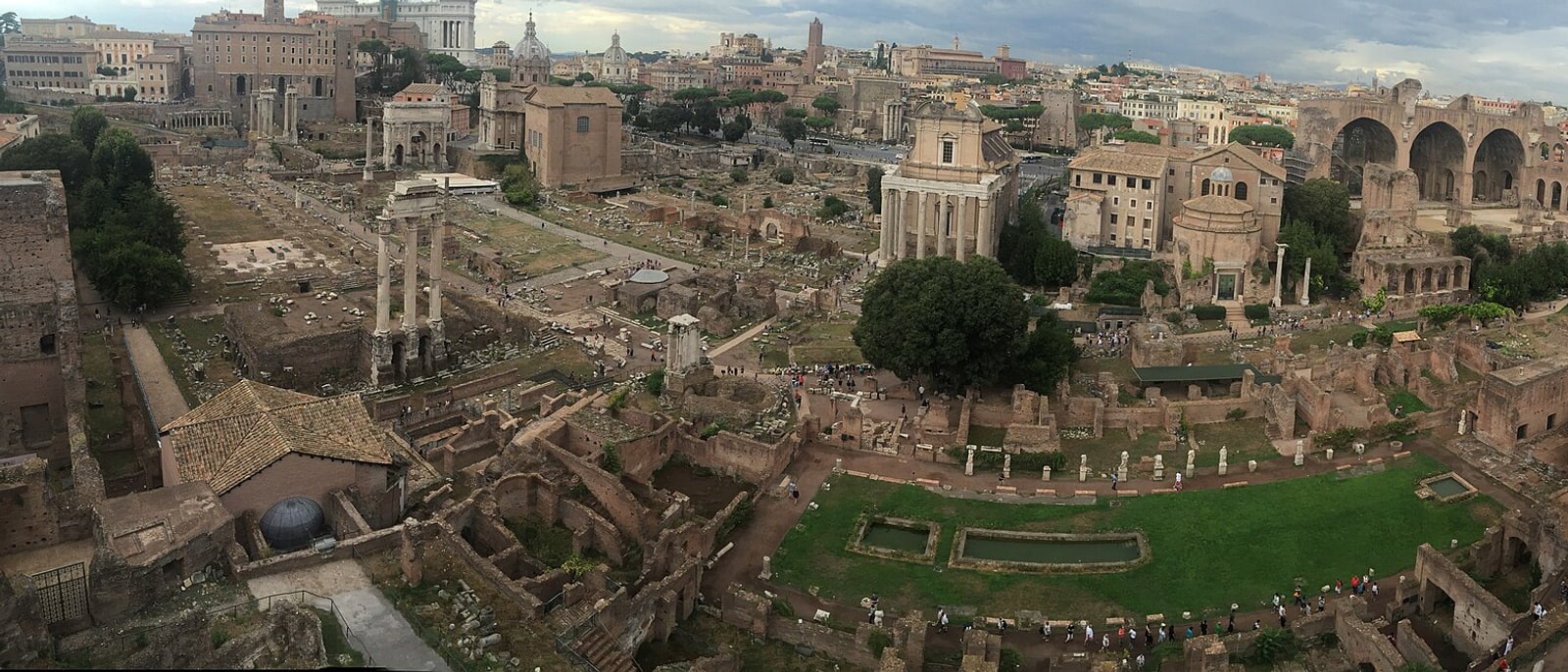
This is where what happened from Scotland to the Euphrates got decided, and then it spent a thousand years buried under ten metres of rubble, with cows grazing on top and a name that says it all: Campo Vaccino, the cow field. Rome forgot its own centre. It wasn’t seriously excavated until the nineteenth century.
The Palatine, next door and on the same ticket, is the hill where the emperors lived and where the word palace comes from in every European language. Almost nobody goes up, and that’s a double mistake: it’s the only overall view of the Forum and it’s where the domestic remains are, which teach you more about how people lived than any temple.
Go first thing or last: there isn’t one patch of shade in the whole site.
- 04
The Vatican
The smallest sovereign state in the world takes up forty-four hectares, with its own stamps, currency, newspaper and an army of about a hundred and thirty Swiss. Crossing the border is crossing a line in the paving of the square. Inside are the Vatican Museums, seven kilometres of galleries, with the Sistine Chapel at the end.
Two warnings. Book a slot for the museums: without one, the queue runs along the wall. And don’t sprint for the Sistine: the map gallery is a hundred and twenty metres of sixteenth-century cartography in fresco that in any other city would be the main attraction, and people cross it looking at their phones.
St Peter’s Basilica, by contrast, is free and needs no booking. What it needs is you arriving with shoulders and knees covered.
- 05
Castel Sant’Angelo and the secret corridor
It started as the emperor Hadrian’s tomb in the year 139, then was a fortress, then a papal prison, then a museum: two thousand years without one empty year. Inside you climb an original helical ramp that was how the funeral procession came in, and at the top there’s a terrace with the best view of the Tiber and St Peter’s.
The best part is the Passetto di Borgo: an eight-hundred-metre raised passage, inside a wall, linking this castle to the Vatican. It isn’t a legend: it exists, you can see it from the street and it was genuinely used.
In 1527, during the Sack of Rome, Pope Clement VII escaped along it while soldiers came into the basilica. A secret corridor that worked when it had to.
- 06
Why the metro only has three lines
A European capital of nearly three million people with three metro lines looks like negligence and is exactly the opposite: it’s what happens when your city’s subsoil is a continuous archaeological site. Every time you dig, something turns up, and when something turns up, the law obliges you to stop and excavate properly.
Line C is the perfect case: decades under construction, having unearthed along the way an imperial guard barracks, first-century farms and even a theatre. Some stations display inside them what was found while building them.
For you the conclusion is practical and worth accepting from the start: in Rome you walk. The historic centre has no metro under it and isn’t going to, so wear shoes that can take cobbles.
Frequently asked
What should you see in Rome?
The Colosseum, the Forum and Palatine, the Pantheon, free and probably the most impressive building in Europe, Piazza Navona, the Trevi Fountain, and if you have a second day, the whole Vatican. Castel Sant’Angelo is the one almost nobody does and it’s worth it.
Why does Rome have so little metro?
Because you can’t dig without finding archaeology, and when it appears, the law obliges you to stop and excavate. Line C has taken decades and unearthed an imperial barracks and even a theatre. The consequence for you: in Rome you walk, and the historic centre has no metro under it.
Was ancient Rome white?
No. The temples, statues and friezes were painted in strong colours. The bare white marble we associate with Rome is simply what was left when the paint fell off. Our idea of classical restraint is a conservation misunderstanding.