Rome in a day
10 h route6 stopsBest: April to June, or October. In August Rome leaves RomeUpdated July 2026
With one day you have to give something big up, and it’s better decided at home than at eleven in the morning in a queue. The sensible sacrifice is the Vatican: it’s a different country, it’s on the other bank, and between the museums, the Sistine Chapel and St Peter’s it eats a long half-day. Without it, the rest of Rome walks in a line that never crosses the river.
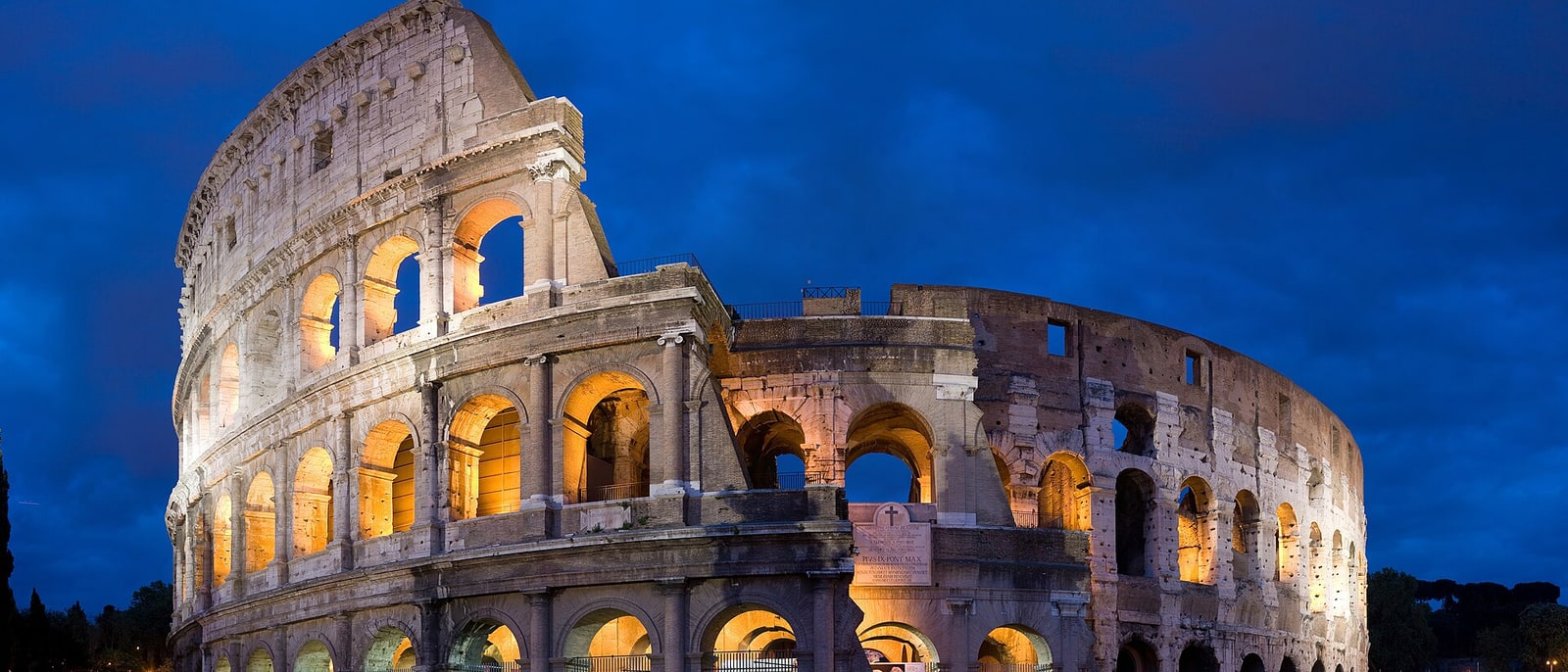
And that line exists because nobody here ever threw anything away: they built on top. The Pantheon has been in use since the year 126 without a single interruption, Piazza Navona is the shape it is because it sits on a Roman stadium, and the Colosseum is half missing because for centuries it was the quarry that half the city’s stone came out of. Rome isn’t a museum: it’s a building plot reused for three thousand years straight.
The route, stop by stop
6 STOPS- 01
The Colosseum, and why half of it is missing
It opened in the year 80, held fifty thousand people and emptied in fifteen minutes through seventy-six numbered gates, a piece of engineering still studied today. Start the day here and start early, because by midday the queue turns the corner and there’s no shade anywhere.
And the question everyone asks: half the outer wall is missing, and it wasn’t an earthquake, that only opened the crack, it was the city. For centuries the Colosseum was a legal quarry: the travertine was cut out and carted off to build palaces and churches, St Peter’s included.
Look at the holes pocking the stone: they’re the sockets of the iron clamps that held the blocks together, dug out one by one because the metal was worth more. Rome ate its own monument.
- 02
The Forum and the Palatine
For a thousand years this ground ruled the known world, and for another thousand it fed cows: it was called Campo Vaccino and lay buried under ten metres of rubble and earth. It wasn’t seriously excavated until the nineteenth century. What you walk on is the real level, and that’s why you go down to it.
Go up the Palatine, which almost nobody does and which is on the same ticket: it’s the hill where the emperors lived, that’s where the word palace comes from, and from the top you see the whole Forum at once, which is the only way to grasp what it was.
And one detail that changes how you look at it: all of this was in colour. The white marble we associate with Rome is what was left after the paint fell off.
- 03
The Pantheon
Nineteen hundred years on, it’s still the largest unreinforced concrete dome on the planet. Nobody has built a bigger one without putting steel inside it. The Romans managed it with two tricks: cement made with volcanic ash, and aggregate that got lighter as it went up, basalt at the bottom and pumice at the top. The dome is thinner at the crown than at the base, like an eggshell.
The nine-metre oculus is open and has no glass: when it rains, it rains inside, and the floor has second-century drainage holes that still swallow the water. It has been in continuous use since the year 126 and that’s the reason it exists: in 609 it was made a church, and that saved it from the quarry.
Entry is free and you see it in twenty minutes. Go early, when the shaft of light from the oculus lands on the wall and there aren’t eighty people looking at their phones.
- 04
Navona, and the stadium underneath
Look at the shape of the square: long, narrow, rounded at one end. That isn’t a baroque decision, it’s a tracing.
Underneath is the Stadium of Domitian, from the year 86, and the buildings around it are literally built on the foundations of the stands. The square is the track. You can go down and see the remains through a discreet entrance on the north side, and almost nobody does.
Above, the Fountain of the Four Rivers is Bernini’s, and there’s a legend people repeat that’s worth dismantling: the figures are said to be shielding their faces in horror from the church opposite, by his rival Borromini.
It’s false and the chronology proves it: the fountain was finished before Borromini started the façade. It’s a terrific story someone invented two hundred years later, and there it still is.
- 05
The Trevi Fountain
The fact nobody mentions while throwing the coin: the water doesn’t come out of a municipal pipe. It comes from the Aqua Virgo, an aqueduct inaugurated in 19 BC that still works, feeding this fountain and a few others in the centre. Two thousand years of uninterrupted service. It’s the oldest infrastructure in use in Europe and it’s right there, running in front of you.
About the coins: they’re collected every night and come to around a million and a half euros a year, which goes to Caritas for soup kitchens. So the most clichéd tourist gesture in the world genuinely funds something.
And an honest warning: at midday this is a wall of people and you see nothing. Come at seven in the morning. It’s a different fountain and you’ll be almost alone.
- 06
Dinner in Trastevere
You cross the Tiber on foot over Ponte Sisto and you change city: narrow lanes, cobbles, washing strung across the street and a square with a twelfth-century church whose gold mosaics light up when the sun hits them. Trastevere has been filling with people for twenty years and even so, two streets south of the square, it’s still a neighbourhood.
And here’s the rule that saves your dinner: carbonara has no cream. That isn’t an opinion. It has egg, guanciale, pecorino and pepper, and that’s it. If the menu offers it with cream, or there are photos of the dishes by the door, or there’s a menu in six languages and a man inviting you in, keep walking.
The four Roman pastas (carbonara, cacio e pepe, gricia and amatriciana) all come out of the same very short pantry, and that poverty is exactly the point.
Frequently asked
Can you see Rome in a day?
Ancient Rome, yes: Colosseum, Forum, Pantheon, Navona and Trevi are on the same bank and walk together. What doesn’t fit is the Vatican, which is another country, across the river, and between museums, Sistine Chapel and St Peter’s eats a long half-day. With one day, give it up.
Why is part of the Colosseum missing?
Because the city took it. For centuries it was a legal quarry: the travertine was cut out to build palaces and churches, St Peter’s included. The holes in the stone are the sockets of the iron clamps, dug out one by one because the metal was worth more. The earthquake only opened the crack.
What happens to the money in the Trevi Fountain?
It’s collected every night and comes to around a million and a half euros a year, which goes to Caritas for soup kitchens. And a better fact: the fountain’s water comes from the Aqua Virgo, an aqueduct from 19 BC that is still in service.