Day trips from Rome
4 stopsBest: Spring and autumn. In July and August, ruins are an ovenUpdated July 2026
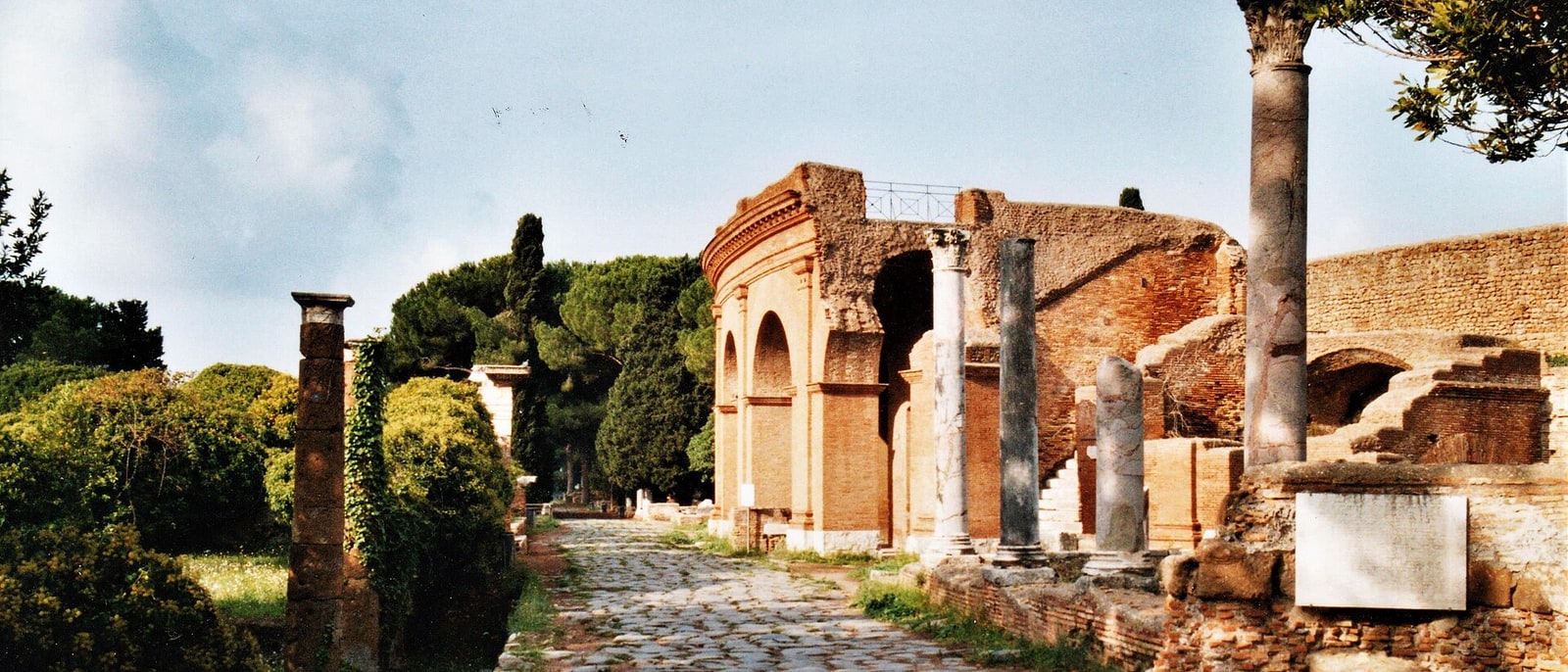
Half an hour away on a suburban train there’s a whole Roman city, with its streets, its four-storey blocks of flats, its bars with marble counters and its public toilets with twenty seats in a row and no partitions. It’s called Ostia Antica, it was Rome’s port, and almost nobody visits it, because everyone goes to Pompeii, which is three hours away.
That’s the summary of day trips from here: the city has things around it that in any other country would be the main destination and that here sit in the second row because they’re competing with the Colosseum. Tivoli, the Castelli, the Appian Way. Everything is under an hour away and everything is a suburban train or a bus, with no high-speed tickets and no bookings.
The route, stop by stop
4 STOPS- 01
Ostia Antica
Ostia served as Rome’s port and reached a hundred thousand inhabitants. No volcano buried it: the river killed it, silting up until it left the town three kilometres from the sea, and it was abandoned. That preserved it just as well, without Pompeii’s dramatic weight and without its queues: here you walk whole streets without passing anyone.
What makes it better than any book is the ordinariness. There are four-storey blocks of flats with staircases, which is how people actually lived rather than in villas. There’s a bar with a marble counter and the sockets for the amphorae. There’s a laundry. And there are public latrines with twenty seats in a row and no partitions at all, because going to the toilet was a social act.
It’s half an hour on an ordinary metro ticket.
- 02
Tivoli: Hadrian’s Villa and Villa d’Este
Hadrian’s Villa outgrows the idea of a country house: it’s a hundred and twenty hectares, the size of a small town, that the emperor Hadrian had built in the second century to reproduce the places he had liked on his travels round the empire. A piece of Egypt, a piece of Athens. It’s the largest architectural whim any single person has ever been allowed and you walk it in three hours.
Six kilometres away is Villa d’Este, from the sixteenth century, which is the opposite: small, vertical and obsessed with one thing, water. It has five hundred fountains and not one pump: everything has run on gravity for four centuries, with river water channelled round the hill. One of them played a water organ and does again. The two together make a full day and neither is overrun.
- 03
The Appian Way
It was begun in 312 BC and eventually linked Rome to Brindisi, six hundred kilometres. The first kilometres out of the city keep their original basalt paving, with grooves worn by cartwheels, and you can walk on it. It isn’t a reconstruction: it’s the stone they trod.
Along the sides are the tombs, because Roman law forbade burial inside the city and the rich competed for the most visible mausoleum beside the main road. And underneath are the catacombs, kilometres of galleries where Christians buried their dead.
The day to come is Sunday, when they close the traffic and the road belongs to people walking or cycling. It’s the cheapest trip on this list and one of the best.
- 04
The Castelli Romani
Forty minutes south-east there are a dozen villages perched on the rim of an extinct volcano, with two round lakes in the craters. Frascati, Castel Gandolfo, Nemi. It’s where Rome goes on Sundays to eat, and where the popes had their summer residence until recently: the Castel Gandolfo gardens can be visited.
The reason to come is an institution that exists nowhere else: the fraschetta. They were the cellars that sold their own wine and let you bring your food from home. Today they serve cured meat, cheese and porchetta on wooden tables with paper cloths, and there’s still no menu. You order house wine by the jug and eat what there is.
It’s the Roman Sunday and it appears in no English guidebook.
Frequently asked
What is Ostia Antica and is it worth it?
Ancient Rome’s port, a whole city of a hundred thousand people preserved half an hour from the centre on an ordinary metro ticket. No volcano buried it: it was abandoned when the river left it without a sea. It has blocks of flats, bars and twenty-seat public latrines, and almost nobody goes.
Can you do Pompeii in a day from Rome?
You can, but it’s about three hours each way and a brutal day. If what you want is to see a preserved Roman city, Ostia Antica is half an hour away, reads better and has no queues. Save Pompeii for a trip to Naples, where it makes sense.
Can you walk on the original Appian Way?
Yes. The first kilometres out of Rome keep the original basalt paving from 312 BC, with grooves worn by cartwheels. On Sundays they close the traffic and the road is left to walkers and cyclists, which is the day to go.