Where to stay in Rome
5 stopsUpdated July 2026
The Tiber splits Rome in two and that’s half the decision: ancient Rome is on the east bank, the Vatican and Trastevere on the west. The other half is set by something that can’t be fixed: the historic centre has no metro under it, because you can’t dig without finding ruins. Here you walk, always, and that’s why what really matters about your hotel is where it is.
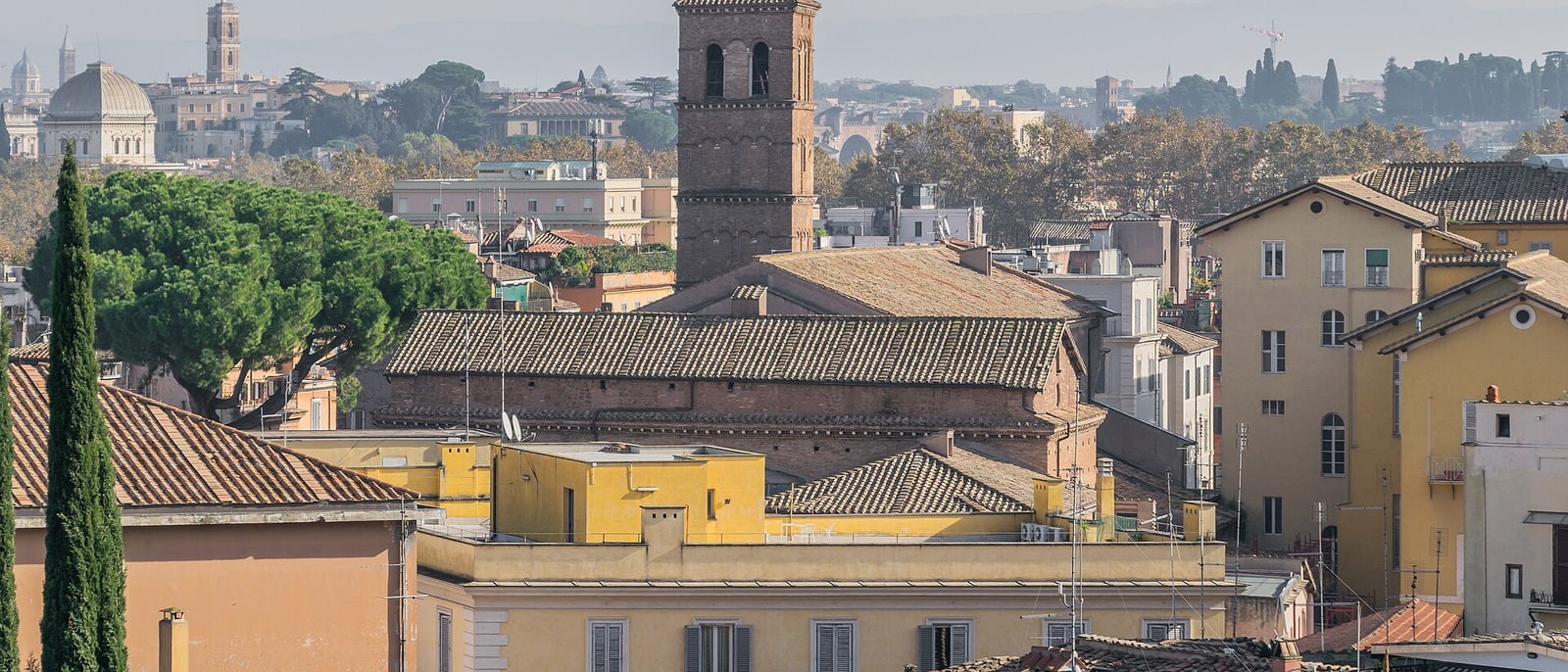
The practical consequence is that in Rome paying to be central isn’t an indulgence: it’s buying hours. Every extra kilometre is twenty minutes on cobbles, twice a day, in heat. And a calendar warning: in August the city empties of Romans and many neighbourhood trattorias shut, so what’s left is what was built for tourists.
The route, stop by stop
5 STOPS- 01
Centro storico
The triangle between the Pantheon, Navona and Campo de’ Fiori is where everyone wants to sleep and there’s a reason that isn’t aesthetic: from here you step out of the door and you’ve arrived. In a city with no metro in the centre, that’s literally two hours a day you don’t spend walking.
It’s expensive and two more things need saying. Campo de’ Fiori has open-air drinking until three in the morning and that isn’t an exaggeration: sleep on that square and you won’t sleep. And the restaurants on these streets live off people who pass once, so you eat badly at a high price.
Sleep here, eat in another quarter: it’s a perfectly reasonable decision and plenty of people make it.
- 02
Trastevere
Across the river, Trastevere brings alley, cobble, ivy and a twelfth-century church with gold mosaics on the front that light up at dusk. It’s Rome’s most photogenic quarter and also the one that has changed most in twenty years: from working-class district to going-out zone.
What to know is that it has two halves. The north, around Santa Maria and Piazza Trilussa, is the one that appears everywhere and has noise until late every night of the week. The south, beyond Viale Trastevere, is still a neighbourhood with people living in it. Sleep in the south.
And the metro doesn’t reach Trastevere either: it’s half an hour’s walk to the Colosseum, pleasant on the way out and less so on the way back.
- 03
Monti
Monti presses against the Forum from the north and it’s the closest Rome has to a perfect answer: it’s genuinely central, the Colosseum is ten minutes on foot, it has a metro at the door, and it’s still a neighbourhood with residents, workshops, long-standing bars and a square with a fountain where people sit on the ground at night.
For centuries it was the Suburra, imperial Rome’s bad quarter, where the taverns and brothels were and where Julius Caesar was born, something his family took care not to mention too often. Today it’s one of the city’s quarters with the most character and one of the few where you can eat well without crossing half of Rome.
First time here and not wanting to pay for the centro storico: this is it.
- 04
Testaccio
To the south, the old slaughterhouse district: early twentieth-century housing, a working covered market, the best Roman food in the city and not one souvenir. It has a metro stop on line B, so the Colosseum is five minutes, and prices here are Rome’s rather than the postcard’s.
It’s the choice of someone who already knows the city, and also of someone on a budget who doesn’t want to sleep by the station.
There’s nothing monumental to see except the mountain of amphorae and the Protestant cemetery, where Keats and Shelley are buried under cypresses, which is one of the quietest corners of Rome. What there is, is a city that works, ten minutes from the one you came to see.
- 05
Prati and the Vatican
North of the Vatican, Rome built Prati at the end of the nineteenth century, when it became the capital: straight streets, wide pavements, grand buildings and not one crooked cobble. It looks like another city, and that’s exactly its appeal for some and its problem for others.
Concrete advantages: it has a metro, it has Rome’s best ordinary shops, you eat well at neighbourhood prices, and you’re ten minutes on foot from St Peter’s, which on Vatican day is worth gold. Disadvantage: it has none of the Rome you came to see, and it’s a long half-hour to the Colosseum.
It’s a good base with children, or if the noise of the centre gets to you.
Frequently asked
Where is it best to stay in Rome?
Monti is the best balance: central, with a metro and with neighbourhood life. The centro storico saves you two hours a day of walking but is expensive and eats badly, Trastevere is the prettiest, with noise in its northern half, Testaccio is the eating one, with a metro and half the price, Prati, the orderly one, next to the Vatican.
Is it worth paying to be central in Rome?
More than in other cities, yes, for a specific reason: the historic centre has no metro under it, because you can’t dig without finding ruins. Here you always walk, and every extra kilometre is twenty minutes on cobbles, twice a day. Being central buys hours, not views.
Is Campo de’ Fiori a good place to sleep?
The square itself, no: there’s open-air drinking until three in the morning most nights, and that isn’t an exaggeration. The streets around it are fine. In general, in the centro storico it’s worth sleeping there and then eating in another quarter, because these streets live off people who pass once.