Tokyo in a day
10 h route6 stopsBest: Start at 8. And check the last train before dinnerUpdated July 2026
Tokyo isn’t a city, it’s twenty-three districts that used to be towns, each with its own giant station, its own department stores and its own centre. That’s why there’s no “central Tokyo” to head for: you have to choose. Trying to see it all in a day is the guaranteed way to see nothing.
The plan that works is a line from south to north along the Yamanote, the loop railway that circles the city and touches nearly everything you want. Start early and don’t move more than twice. And note now the fact that ruins the most trips: the last train runs around midnight, and if you miss it there is no night, there’s an eye-watering taxi or waiting until five.
The route, stop by stop
6 STOPS- 01
Meiji Jingū and its fake forest
Start here, in the forest, before the city gets going. The shrine was raised in 1920 in honour of Emperor Meiji, and what surrounds it looks like an ancient wood of twelve thousand trees. It isn’t: this was open ground, and the forest was planted entirely by hand, with around 100,000 trees donated from every corner of Japan and put in by volunteers. And here’s the good part: the foresters who designed it didn’t plant a garden, they planted a 150-year plan. They chose the species so the forest would evolve on its own, replacing itself over generations, until it became the forest the area would naturally have had. The people who planted it knew they would never see it. That’s the place you’re walking through.
- 02
Harajuku and Omotesandō
The starkest contrast in Tokyo and it happens in a hundred metres. You leave the shrine forest and step into Takeshita Street, a narrow pedestrian alley full of teenagers, costume shops, giant crêpes and impossible clothes. It’s loud and it’s heaving at weekends.
And a hundred metres away, running parallel, is Omotesandō: a wide tree-lined avenue of luxury flagship stores, each commissioned from a front-rank architect. Prada, Dior, Tod’s. It’s a street where the building matters more than what’s sold inside, and you can walk all of it without going in anywhere. From costume to marble in a two-minute walk: that’s Tokyo.
- 03
The Shibuya crossing
The most famous crossing in the world, and it works because every light turns red at once: cars stop in all five directions and pedestrians take the whole junction, diagonals included. At peak times up to around 3,000 people cross at a go, every two minutes.
The hypnotic part isn’t the number: it’s that nobody collides. Thousands of people walking in five directions at once and it works, without anyone raising their voice. To see it from above, the free option is the window of the Starbucks opposite, which is packed, or the station footbridge.
And right there is the statue of Hachikō, the dog who came to wait for his owner at this station every day for nine years after he died.
- 04
The free viewpoint in Shinjuku
Tokyo’s best cheap secret: the Metropolitan Government Building, two Kenzō Tange towers that look like a Gothic cathedral made of circuitry, has an observatory on the 45th floor, at 202 metres, and entry is free. No queue like the others, no booking.
From up there you see Tokyo’s real extent, which is what lands: buildings to the horizon in every direction, endless, with Fuji behind if the day is very clear. Which mostly happens in winter, in the morning.
Afterwards, downstairs, you’re in Shinjuku, whose station is the busiest in the world with around 3.5 million people a day and more than two hundred exits. That isn’t an exaggeration: pick your exit before you go down.
- 05
Sensō-ji, in Asakusa
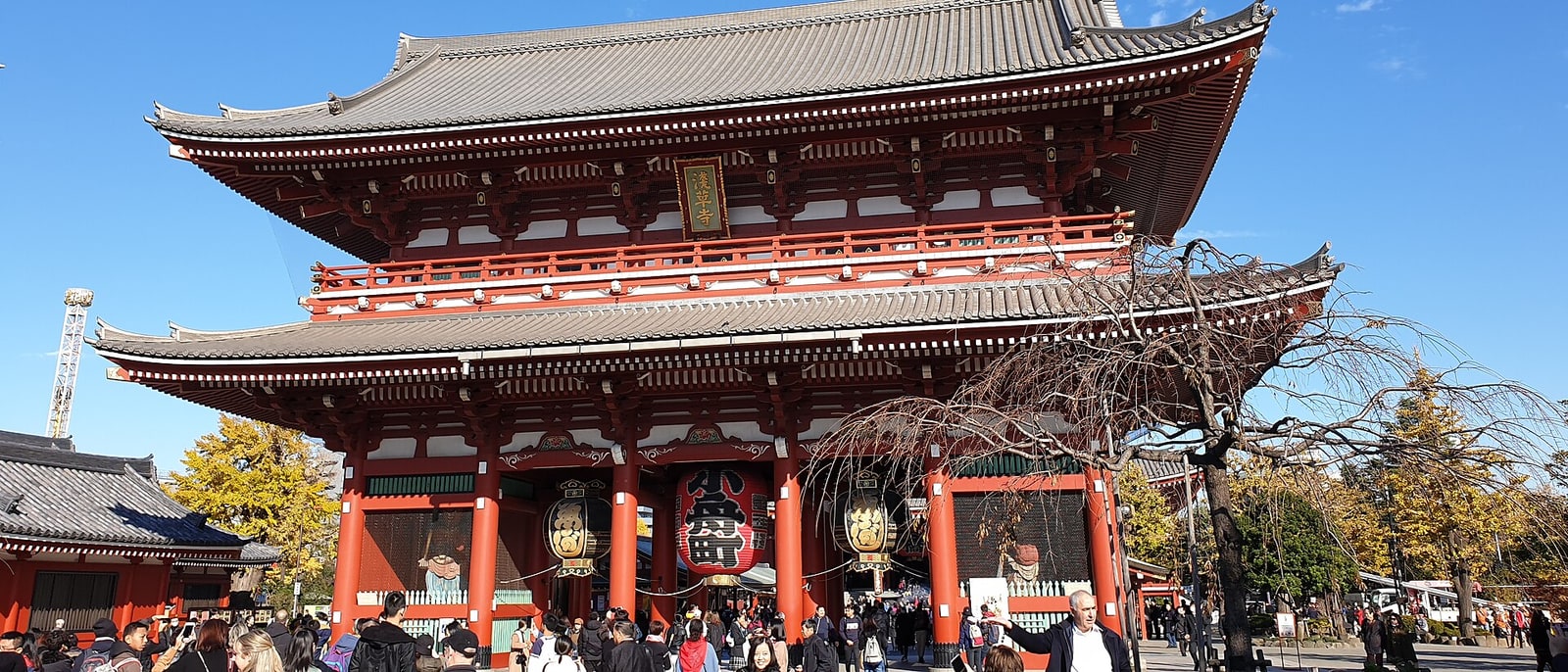
Tokyo’s oldest temple and the origin of everything: legend says that in 628 two fisherman brothers pulled a small statue of Kannon from the Sumida river in their net. They put it back and it reappeared. The village head took the hint and in 645 the temple was raised. Asakusa grew around it, and Tokyo grew around that. You enter through the Kaminarimon, the thunder gate, with a red lantern nearly four metres tall, and from there a street of stalls (Nakamise, which has been there for centuries) climbs to the temple. What you see is rebuilt: the 1945 bombing levelled this whole area. Go at dusk or at night, when the groups leave and it’s lit.
- 06
Golden Gai, to finish
A square of six narrow alleys in Shinjuku where around two hundred tiny bars survive, many with six or eight seats and nothing else. Each belongs to one person, each has its theme (jazz, punk, film, whatever) and going in means stepping into someone’s living room.
It survived because it’s a scrap of post-war Tokyo that escaped the bulldozers. Two warnings: plenty of bars charge a small seat fee, which is normal and isn’t a scam. And some post a Japanese-only sign, not out of xenophobia but because the owner doesn’t speak English and six seats leave no room for misunderstandings.
Look for one with the door open and an English menu. And watch the clock: the last train doesn’t wait.
Frequently asked
Can you see Tokyo in a day?
One line of it: Meiji Jingū, Harajuku, Shibuya crossing, Shinjuku’s free observatory and Sensō-ji in Asakusa, following the Yamanote line. Tokyo is twenty-three districts that were towns, each with its own centre, so you pick two or three and give up the rest.
Is the Meiji Jingū forest natural?
No: it was planted entirely by hand around 1920, with some 100,000 trees donated from across Japan and put in by volunteers on open ground. The foresters designed it as a 150-year plan, choosing species so it would replace itself until it looked like a natural wood.
Where are the free observatories in Tokyo?
At the Metropolitan Government Building in Shinjuku: an observatory on the 45th floor, at 202 metres, free and with no booking. On a very clear day you can see Fuji, mostly on winter mornings.