Day trips from Belgrade
4 stopsBest: May to October. The Danube in autumn is the best of itUpdated July 2026
The settlement at Lepenski Vir, in the Danube gorge, is eleven thousand years old, and what its inhabitants left behind are stone sculptures with fish faces and round eyes that resemble nothing else in European prehistory. When the Iron Gates dam was built in the sixties and the reservoir was going to swallow it, they decided to lift the entire site thirty metres up the hillside, stone by stone, and reassemble it.
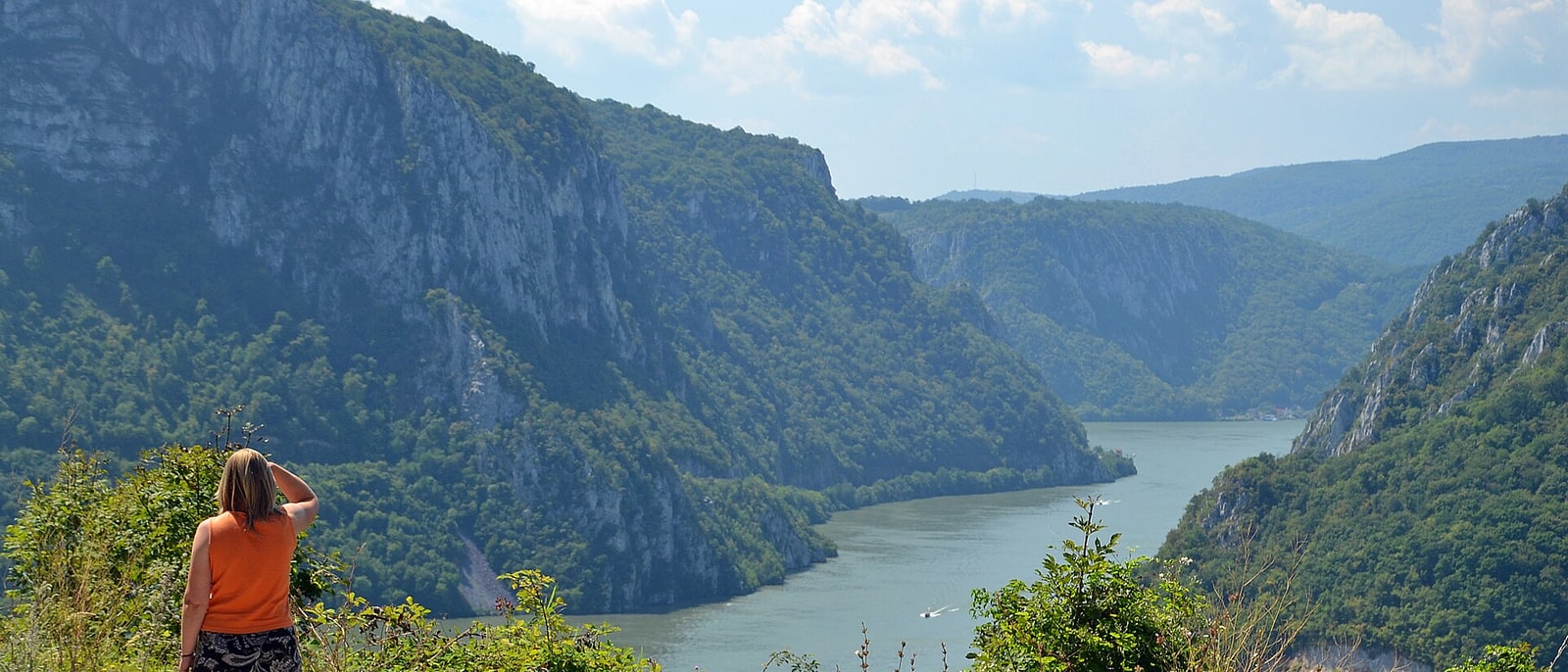
That’s two and a half hours away, downriver, and it’s the best trip in Serbia. And on the way is the rest: the gorge where the Danube narrows to a hundred and fifty metres between rock walls, a fourteenth-century castle in the water and a twenty-storey face carved into the cliff. It’s all done by car or on an organised trip: the train doesn’t reach it.
The route, stop by stop
4 STOPS- 01
Lepenski Vir
A Danube fishing settlement from between 9500 and 6000 BC, which makes it one of the oldest in Europe, with trapezoidal houses arranged in a fan facing the river and a stone hearth in the middle of each.
And inside the houses, beside the hearth, sandstone sculptures the size of a football with a human face and a fish mouth, eyes wide open.
They’re among the oldest monumental sculptures in Europe and they resemble nothing.
And what happened to it afterwards is just as extraordinary: in 1965 the Iron Gates dam was approved, which would raise the Danube and put the site under water. Instead of losing it, they excavated against the clock and moved the entire settlement thirty metres up the hillside, reassembling it piece by piece in its new position.
Today it sits under a glass canopy, facing the river that is now higher. It’s the best thing you can see in Serbia.
- 02
The Iron Gates
In the Đerdap gorge the Danube, wide and lazy at Belgrade, pushes between the Carpathians and the Balkans and narrows to about a hundred and fifty metres, with three-hundred-metre walls on either side. It was the most feared stretch of the river: there were rapids and rocks, and sinking boats was routine until the dam tamed it in the seventies.
The Romans cut a road here hanging off the cliff, with the beam sockets still visible, and left the Tabula Traiana, a plaque from the year 100 commemorating the work that had to be moved uphill when the water came.
And opposite, on the Romanian bank, there’s a face of Decebalus, the last Dacian king, carved into the rock: forty metres tall, the largest rock sculpture in Europe, and it’s from 1994. Two thousand years of propaganda in the same gorge, and only one of them is old.
- 03
Novi Sad
Serbia’s second city, an hour north, with a pastel Austro-Hungarian centre that looks nothing like Belgrade and an enormous fortress across the Danube: Petrovaradin, which the Austrians raised in the eighteenth century against the Ottomans and beneath which run sixteen kilometres of underground galleries on four levels.
Its clock has a quirk worth knowing before you look at it: the hands are swapped, the hour hand is the long one and the minute hand the short one. It was done deliberately so Danube fishermen could tell the time from the river, where only the big hand is visible. It has run that way for centuries and here they call it the drunken clock.
In July the fortress hosts the EXIT festival, which fills the city: if your dates land there, don’t even look for a hotel late.
- 04
Fruška Gora
A low wooded mountain to the north, which was an island in a sea millions of years ago and today is a national park full of monasteries: there were once thirty-five and sixteen remain, hidden among the trees.
Serbs fleeing north from the Ottomans between the fifteenth and eighteenth centuries built them, and that’s why they’re where they are: hidden on purpose.
You drive them in a day and there’s almost nobody. And there’s a second reason to come: it’s been vineyard country since Roman times, with small wineries where the owner shows you his.
It combines well with Novi Sad, at its foot. It’s the calm trip against the Danube’s, which is the spectacular one.
Frequently asked
What is Lepenski Vir?
A Danube fishing settlement from between 9500 and 6000 BC, one of the oldest in Europe, with stone sculptures with human faces and fish mouths. When the Iron Gates dam was going to flood it in the sixties, they moved the whole thing thirty metres up the hillside, stone by stone.
Why does the Petrovaradin clock have its hands swapped?
So Danube fishermen could tell the time from the river: at that distance only the big hand is visible, so the long one was made to show the hours and the short one the minutes. It has run that way for centuries and here they call it the drunken clock.