Belgrade in a day
8 h route4 stopsBest: May to September. Winter here is grey and longUpdated July 2026
This city has been destroyed and rebuilt around forty times, and that figure isn’t rhetoric: it sits at the exact point where the Sava enters the Danube, which is the crossroads between central Europe and the Balkans, and everyone who wanted to control the continent came through it. Celts, Romans, Byzantines, Hungarians, Ottomans, Austrians. And in the twentieth century it was bombed by the Germans in 1941, the Allies in 1944 and NATO in 1999.
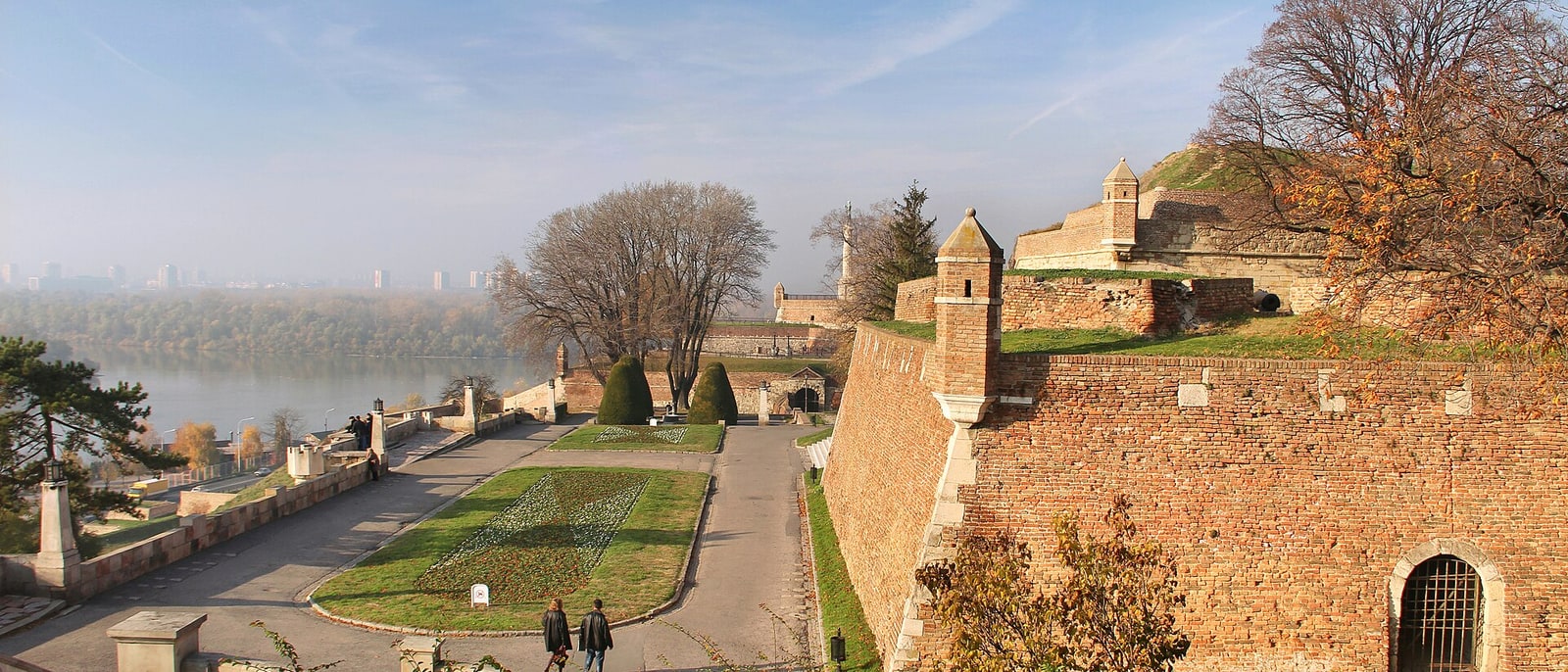
The consequence is simple: almost nothing here is old, because it wasn’t allowed to be. The only thing that has stood for two thousand years is the fortress, and precisely because it was what everyone wanted. So a day in Belgrade isn’t about monuments: it’s about a city that has remade itself forty times and takes it with fairly black humour.
The route, stop by stop
4 STOPS- 01
Kalemegdan
The fortress sits on the exact spur where the Sava flows into the Danube, and from the wall you see the two rivers joining: the Sava arrives greenish and the Danube brown, and for a stretch they run parallel without mixing. That corner is what explains the entire city: whoever held it controlled the river traffic of half of Europe.
What you see is a layer cake: Roman foundations, Byzantine walls, Hungarian towers, Ottoman gates and Austrian bastions, all on top of each other. The fortress is said to have been destroyed and rebuilt around forty times, and the count isn’t brochure exaggeration: it changed hands constantly because this was the border between the Ottoman and Austrian empires for centuries.
Today it’s a park, entry is free and the whole of Belgrade comes to walk. Go at dusk, when the view of the two rivers justifies the trip.
- 02
Skadarlija
A crooked cobbled street two hundred metres long, with lamps, taverns and musicians playing between the tables. It’s the most photographed corner of Belgrade and there’s one thing to know: it didn’t become bohemian by itself. In the late nineteenth and early twentieth centuries real writers and actors lived here, but when that faded, in the sixties and seventies the city decided to rebuild the atmosphere deliberately, consciously imitating Montmartre: it was cobbled, the lamps went up and the kafanas were recovered.
So it’s a deliberate recreation of itself, and the curious thing is that it worked: today the street is alive, the taverns have been open for decades and the musicians are real. It comes with a warning: it’s the most touristed area in the city and you eat better and for half two streets away.
Come for a rakija and to hear music, not for dinner.
- 03
The church of Saint Sava
One of the largest Orthodox churches in the world, and its story is Serbia’s in one building. It was begun in 1935, the wars stopped it, and then the communist regime refused for decades to let it be finished: the site was used as a car park and a depot. Work didn’t resume seriously until the eighties.
The interior wasn’t finished until 2020: four thousand square metres of gold mosaic, made with Venetian glass tesserae and funded largely with Russian money, in a job that took years and was assembled in pieces offsite and fixed inside. Entry is free and the effect is overwhelming precisely because it’s new: there’s no patina, no centuries of smoke, it’s freshly laid gold. Eighty-five years to finish a church says more about this country than any museum.
- 04
The House of Flowers
Josip Broz, Tito, who governed Yugoslavia for thirty-five years, is buried here, and the fact to carry with you is his funeral: in 1980 a hundred and twenty-eight countries came to Belgrade, with thirty-one presidents, four kings, six princes and twenty-two prime ministers. It was probably the state funeral with the most heads of state in history, and at the same burial stood Thatcher, Brezhnev, Saddam Hussein and Arafat. That was the position Yugoslavia held between the two blocs.
The grave is a white marble slab in a glasshouse, with no pomp at all, and beside it is the Museum of Yugoslavia, which keeps the gifts he was given: an entire vanished country, told through the objects people gave one man. And the relay batons, thousands of wooden staves run to him every year for his birthday.
It’s the most interesting visit in Belgrade and the one fewest people make.
Frequently asked
What to see in Belgrade in a day?
The Kalemegdan fortress at dusk, on the corner where the Sava enters the Danube, Skadarlija street, the church of Saint Sava, which took 85 years to finish, and the House of Flowers, with Tito’s grave and the Museum of Yugoslavia, which is the most interesting thing and the one fewest people do.
Why aren’t there old buildings in Belgrade?
Because it has been destroyed and rebuilt around forty times: it sits at the crossroads between central Europe and the Balkans and everyone who wanted to control the continent came through. In the twentieth century alone it was bombed by the Germans in 1941, the Allies in 1944 and NATO in 1999. The only thing standing for two thousand years is the fortress.