Day trips from Shanghai
4 stopsBest: Spring and autumn. Suzhou’s gardens were made for exactly thatUpdated July 2026
There’s a train that takes twenty-five minutes to a city of sixteenth-century gardens listed as world heritage. Twenty-five minutes: less than it takes to cross Shanghai end to end by metro. It’s called Suzhou and there’s a thousand-year-old Chinese saying that in heaven there is paradise and on earth there are Suzhou and Hangzhou.
That’s this city’s advantage: the Yangtze delta has been China’s richest region for centuries and it’s stitched together by the densest high-speed rail network in the world. Hangzhou is forty-five minutes, Nanjing an hour and a quarter. All of it is a day trip with no early start, with trains every few minutes and nothing to book.
The route, stop by stop
4 STOPS- 01
Suzhou
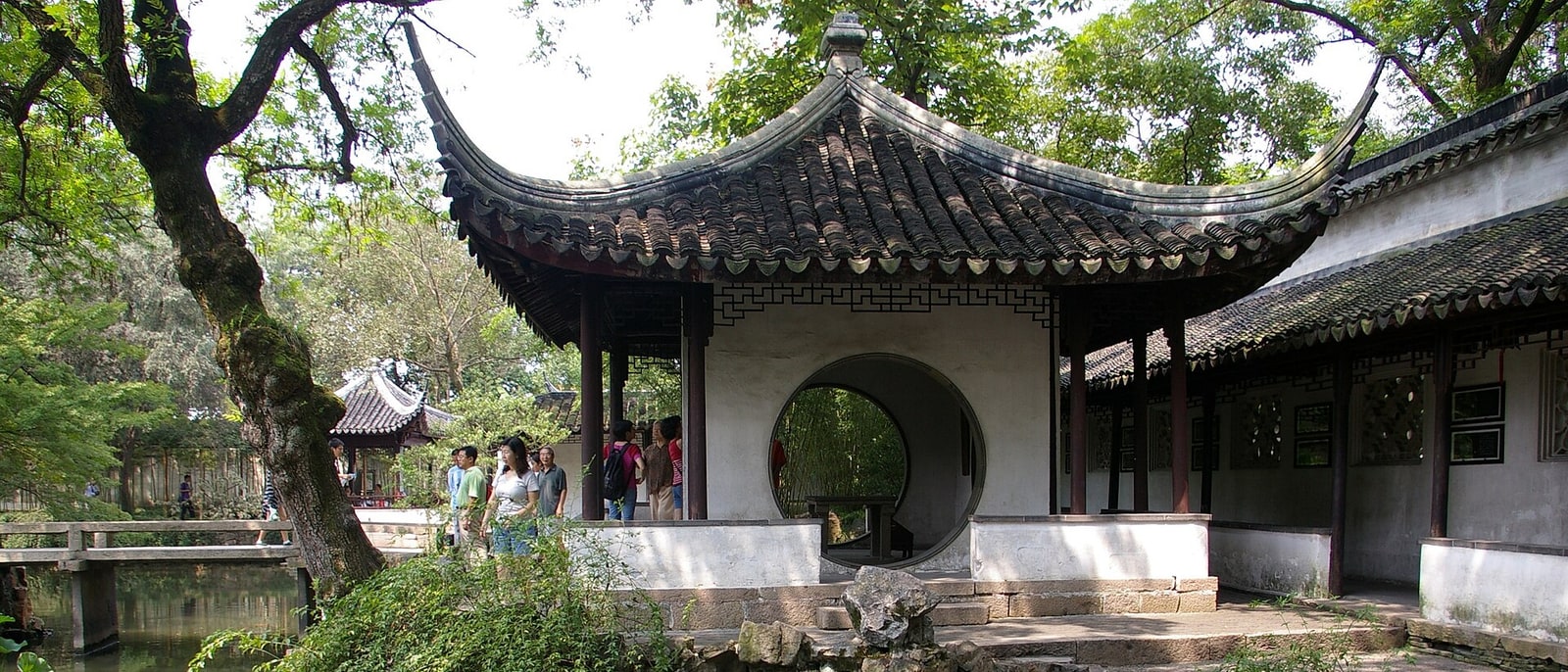
Suzhou was founded two and a half thousand years ago on a network of canals and got immensely rich on silk, and its merchants and retired officials built private gardens to prove it. Several survive and nine are world heritage: the Humble Administrator’s, from 1509, is the largest and most famous, and the name is a joke because the man who built it was anything but humble.
A Chinese garden isn’t a park: it’s a three-dimensional painting you walk through, designed never to be seen whole, with Lake Tai rocks chosen one by one for their shape and windows framing scenes as if they were pictures.
The best are seen first thing, before the coaches from Shanghai arrive. And there are canals, and boats, and the old part of the city walks end to end. At twenty-five minutes by train, there’s no excuse.
- 02
Hangzhou and West Lake
No landscape in East Asia has been more influential than West Lake: for a thousand years, poets and painters turned it into the model of what a landscape should be, and it was copied in gardens across China, Japan and Korea. It’s world heritage not for its nature but for that: for being an idea.
And here’s the interesting part: it isn’t natural. The lake formed and was then maintained, dredged and shaped by hand over centuries.
The causeways crossing it were ordered built by poets who were also governors, and one carries the name of Su Dongpo, who was both.
It’s a designed landscape that has looked spontaneous for a thousand years, which is exactly what a Chinese garden is after. You walk it, you cross it by boat, and you drink Longjing green tea, grown on the hill next door.
- 03
Zhujiajiao
A seventeen-hundred-year-old water town, with canals, stone bridges and houses hanging over the water, reachable by metro: line 17 ends practically at the gate and it’s still administratively Shanghai. It’s the easiest trip you can do here and that’s why it’s always full.
Honesty requires saying what it is: it’s restored and commercialised, with souvenir shops in the houses and tourist boats on the canals. It isn’t a discovery. But the layout is real, the Fangsheng bridge is from 1571, and the back lanes, two streets off the circuit, are still a village.
Go on a weekday and early, and it works. Go on a Sunday and you’ll regret it.
- 04
Nanjing
Nanjing served as China’s capital at several points, including the Republic between 1927 and 1937, and the scale still shows: wide avenues, government buildings and a fourteenth-century Ming wall that is the longest in the world and still rings much of the city. Sun Yat-sen’s mausoleum, on a hill with three hundred and ninety-two steps, is the place every Chinese person goes once.
And there’s the Nanjing Massacre Memorial, documenting what the Japanese army did in this city in the winter of 1937 and 1938. It isn’t a pleasant visit and we won’t soften it: there’s an excavated mass grave, open to view, and there are walls of names.
It’s the hardest visit on this list and the one most needed to understand the relationship between China and Japan today. Go knowing what’s there and save the afternoon for something else.
Frequently asked
What’s the best day trip from Shanghai?
Suzhou, twenty-five minutes by high-speed train: a canal city 2,500 years old with nine classical gardens listed as world heritage. Hangzhou is forty-five minutes away and has West Lake. Both are day trips with no early start and nothing to book.
Is Zhujiajiao worth it?
On a weekday and early, yes, on a Sunday, no. It’s a seventeen-hundred-year-old canal town reachable by metro (line 17), but it’s restored and commercialised and it fills up. The layout and the 1571 bridge are real, and the back lanes are still a village.
Is Hangzhou’s West Lake natural?
Not entirely: it has been dredged, maintained and shaped by hand for centuries, and the causeways crossing it were ordered built by governors who were also poets. It’s a designed landscape that has looked spontaneous for a thousand years, and it’s world heritage for that: for being the model copied across East Asia.