Mumbai in a day
9 h route4 stopsBest: November to February. In the monsoon this genuinely floodsUpdated July 2026
Seven islands separated by marsh and creeks: that was Mumbai, and much of the ground you walk on today didn’t exist. It was filled in by hand, over two centuries, joining one to another until it formed the present tongue of land. The city is, literally, manufactured ground. And that explains its long absurd shape, along which seven million people travel every day from south to north and back, because there’s only one possible direction.
How it came into British hands is one of the empire’s better stories: the islands were Portuguese and passed to England in 1661 as part of Catherine of Braganza’s dowry when she married Charles II. Charles II thought it a mediocre present and leased it to the East India Company for ten pounds a year. Out of that lease came the richest city in India. A day here is about the south: the port, the Victorian Gothic and the sea at dusk.
The route, stop by stop
4 STOPS- 01
CST station
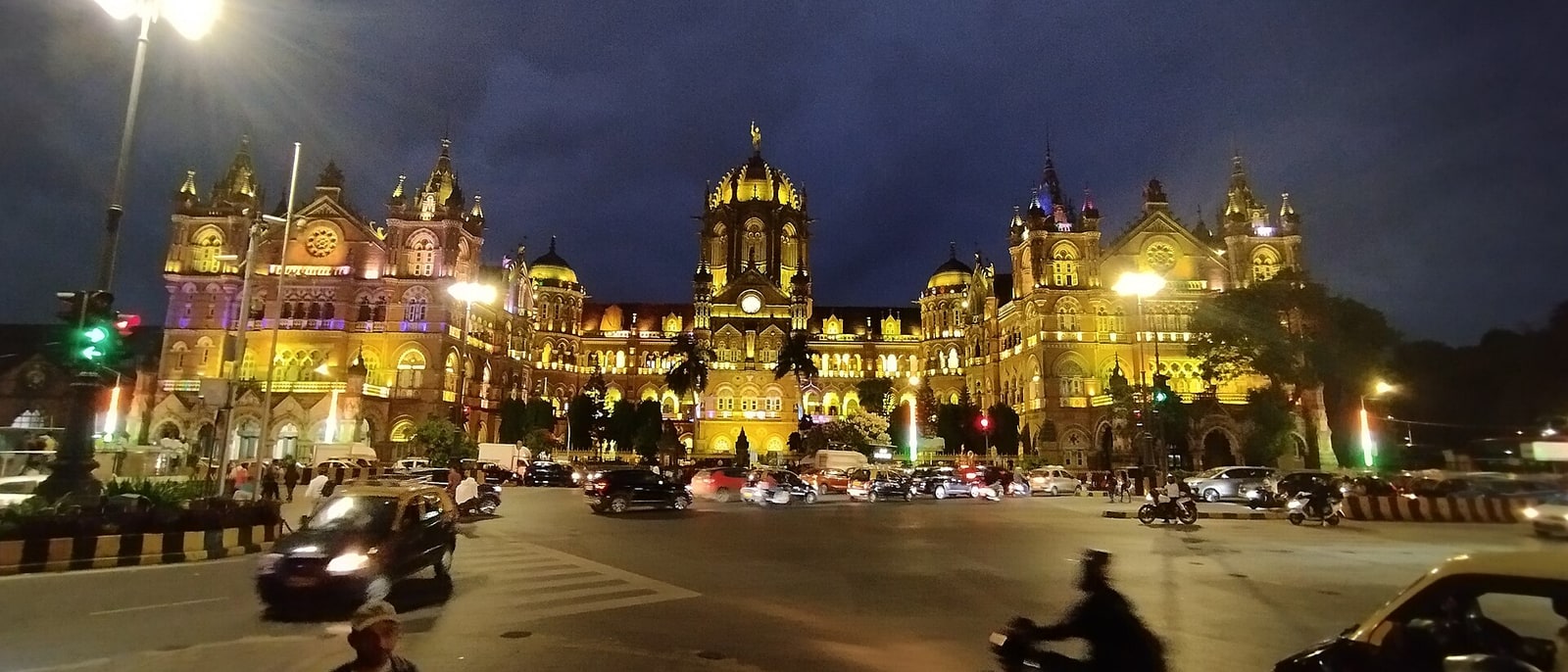
A cathedral. That’s what it looks like and it isn’t a coincidence: it was finished in 1888 in Victorian Gothic Revival, with gargoyles, rose windows, turrets and a dome, but fused with Indian palace architecture. Bulbous domes, arches, carvings of local flora and fauna. The result is a building that exists nowhere else: English Gothic made by Indian craftsmen with Indian motifs. It’s a World Heritage Site.
And here’s what makes it unlike any monument: it’s still running at full tilt. Some three million people pass through it every day. It isn’t a pretty station you visit: it’s the most intense commuter station you’ll ever see, with a nineteenth-century building on top. Stand in a corner of the concourse at seven in the evening and watch: that’s Mumbai.
And it needs saying because it’s part of the place: this station was one of the targets of the November 2008 attacks, in which dozens of people died inside it. There’s a memorial.
- 02
The Gateway of India
A twenty-six-metre yellow basalt arch facing the sea, finished in 1924. It was raised to commemorate King George V’s visit to India in 1911: a monument to empire at its most self-assured.
And from that comes the historical irony that makes this place worth it: in February 1948, barely twenty-four years after it opened, the last British regiment left in India embarked and departed under that very arch. The monument to arrival ended up as the door out.
Opposite it is the Taj Mahal Palace hotel, from 1903, which was the other target of the 2008 attacks. The siege lasted three days and there’s a plaque. It’s the corner of the city most loaded with history, and at the same time it’s always full of families, balloon sellers and people taking photos, which is exactly as it should be.
- 03
The art district and the Gothic
Kala Ghoda and the historic south you cover on foot, the only part of Mumbai that allows it, and you should make the most of it because the rest of the city is impossible. Within a few blocks are the city museum, galleries, old cafés, bookshops and a row of Victorian buildings forming an ensemble listed as World Heritage: the High Court, the university and its clock tower.
Notice a detail that’s everywhere here and is the best thing about this architecture: the Indian stonemasons who executed these buildings put their own fauna into the carvings. On an English Gothic Revival building there are monkeys, peacocks, snakes and palm trees cut into the stone.
It’s tropical Gothic, a hybrid that happened nowhere else in the empire with this intensity. And in the High Court, which can be visited, there’s a famous carving: a blindfolded monkey holding the scales of justice. Nobody knows whether the mason meant it as a joke. I think he did.
- 04
Marine Drive at dusk
A three-kilometre promenade describing a perfect curve on the Arabian Sea, with a low concrete parapet where the whole city sits as the sun drops. They call it the Queen’s Necklace, and the name is literal: at night, seen from one end or from above, the streetlights draw a curved line of points of light that looks like a necklace.
What to do here isn’t to see anything: it’s to sit on the parapet and stay. At dusk all of Mumbai comes (families, couples, older men taking their walk, people coming off work, sellers of tea and peanuts) and that hour is the only one when this city, the fastest in India, stops. It’s free, it’s the best image of Mumbai and there’s no catch.
At the end of the promenade is Chowpatty beach, where you eat bhel puri with your feet in the sand. Mind one thing: the sea here isn’t for swimming, and nobody does.
Frequently asked
What to see in Mumbai in a day?
CST station, a World Heritage Site and at the same time a station three million people pass through every day, the Gateway of India, the 1924 arch through which the last British troops left in 1948, the Kala Ghoda district and the tropical Victorian Gothic, which is the only part of the city you walk, and Marine Drive at dusk, sitting on the parapet with the whole city.
Why is Mumbai such a long thin shape?
Because they were seven islands separated by marsh, joined by filling in the sea by hand over two centuries: the city is literally manufactured ground. Hence seven million people travelling south to north and back every day, because there’s only one possible direction. The islands were Portuguese and passed to England in 1661 as Catherine of Braganza’s dowry. Charles II leased them to the East India Company for ten pounds a year.