What to see in Mumbai
8 h route4 stopsBest: A weekday to see the city working. The weekend to walk itUpdated July 2026
The last British troops in India embarked in 1948 beneath an arch that had been built twenty-four years earlier to celebrate a king’s arrival. That detail, the monument to arrival turned into the door out, is as Mumbai as it gets: here things change meaning halfway through and nobody knocks them down, they’re given another use.
The same goes for the rest. An English Gothic Revival station that turns out to have monkeys carved into its stone because Indian masons made it. A luxury hotel from 1903 that is also the scene of a siege in 2008. A nineteenth-century laundry still washing the hospitals’ sheets. In Mumbai almost nothing is retired from service, and that’s why seeing this city isn’t about visiting monuments: it’s about looking at things that are working.
The route, stop by stop
4 STOPS- 01
The tropical Victorian Gothic
The ensemble of Victorian buildings in south Mumbai is World Heritage and it isn’t a whim of the list: it’s a style that exists here and nowhere else. The British brought the Gothic Revival, and the people who executed the work were Indian masons and craftsmen trained at the local art school. The result is English Gothic with the climate, materials and bestiary of the tropics.
It reads better the closer you look. On the façades there are palm trees, peacocks, monkeys, cobras and local flowers carved where in England there would be acanthus leaves. In the High Court, which can be visited, there’s a celebrated carving: a blindfolded monkey holding the scales of justice, with one pan tipped. Nobody has proved the mason meant it wryly, and nobody has proved otherwise. That ensemble (the court, the university, the clock tower, CST) walks in an afternoon.
- 02
The hotel on the corner
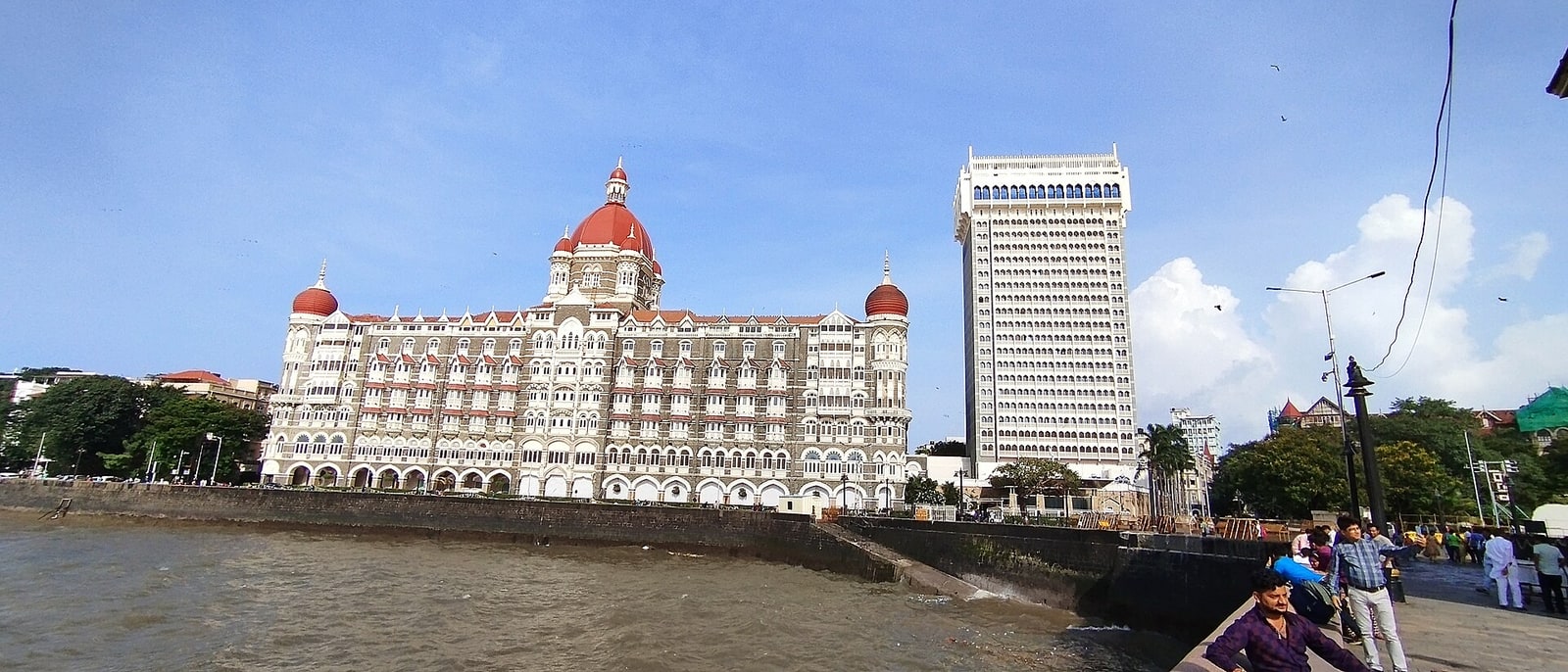
The Taj Mahal Palace, opposite the Gateway of India, opened in 1903 and is India’s most famous hotel. You can go in for a drink without staying, and the lobby and staircase deserve the ten minutes.
The story you’ll be told is this: that the industrialist Jamsetji Tata built it because he was refused entry to a hotel in the city reserved for Europeans, and so he made it bigger and grander than that one. It’s a magnificent story and the truth needs saying: there’s no contemporary evidence supporting it, and the Tata group itself has denied it more than once. It has circulated for decades because it fits too well.
What is true and is serious: in November 2008 this hotel was stormed in the coordinated attacks that struck the city, the siege lasted three days and dozens of people died, many of them staff who stayed behind helping guests out. There’s a memorial inside.
- 03
The Elephanta Caves
An hour by boat from the Gateway of India there’s an island with temples cut inside the rock between the fifth and eighth centuries: not built, excavated, hollowing the mountain from the outside in and leaving the columns, ceilings and sculptures in place. It’s World Heritage.
The piece is the Trimurti: an almost six-metre Shiva bust with three faces, carved into the back wall of the main cave, representing three aspects of the god. It stands in half light and it’s one of the great sculptures of the world. Many of the figures around it are broken and there’s an explanation that gets repeated: the Portuguese, who held the island in the sixteenth century, damaged the carvings. They named it Elephanta after an elephant sculpture that stood on the shore.
A practical warning: during the monsoon the boats don’t sail and the island is closed. And there’s a long flight of steps up from the jetty, with sellers on every one.
- 04
The commuter trains, which are the city
Mumbai’s commuter trains matter more than anything else in this city: they move millions of people every day along that narrow tongue of land, north to south, and without them the city wouldn’t exist. They’re the infrastructure everything rests on, the dabbawalas and their two hundred thousand tins included.
You can ride them and it’s worth doing once outside rush hour, on a short run in the south, to see the city from inside. But the other part has to be said, because it’s real and because not saying it would turn it into folklore: these trains run packed to a degree that’s hard to describe, with people hanging from open doors, and every year thousands of people die on this network’s tracks, from falls and from crossings. It’s one of the deadliest transport systems in the world and it’s a debated public issue here.
If you ride: never at rush hour with luggage, and there are women-only carriages, signposted.
Frequently asked
What must you see in Mumbai?
The Victorian ensemble in the south, World Heritage, with its tropical Gothic carved by Indian masons: look for the blindfolded monkey at the High Court, the Gateway of India and the Taj Mahal Palace hotel opposite, the Elephanta Caves, an hour away by boat, with the six-metre Trimurti cut into the rock, and Marine Drive at dusk, which is free and is the city’s best image.
Are the Elephanta Caves worth it?
Yes, if you have half a day: an hour by boat from the Gateway of India, and there you’ll find fifth- to eighth-century temples cut inside the rock, not built. The piece is the Trimurti, an almost six-metre three-faced Shiva bust carved into the back wall. Two warnings: in the monsoon the boats don’t sail and the island is closed, and from the jetty there’s a long climb of steps.